

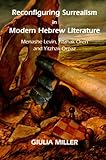
Giulia Miller. Reconfiguring Surrealism in Modern Hebrew Literature: Menashe Levin, Yitzhak Oren, and Yitzhak Orpaz. London: Vallentine Mitchell Publishers, 2013. 188 pp. $84.95 (cloth), ISBN 978-0-85303-843-6.
Reviewed by Karen Grumberg (University of Texas at Austin)
Published on H-Judaic (May, 2014)
Commissioned by Jason Kalman (Hebrew Union College - Jewish Institute of Religion)
Hebrew Modernism Reconsidered
“Why is there no Surrealism in Modern Hebrew literature?” asks Giulia Miller enticingly in the introduction to her book, Reconfiguring Surrealism in Modern Hebrew Literature: Menashe Levin, Yitzhak Oren and Yitzhak Orpaz. To answer this question, Miller, an affiliated lecturer in modern Hebrew at the Faculty of Asian and Middle Eastern Studies in Cambridge, sets out to demonstrate two distinct modes of incorporation of Surrealism into Hebrew literature: first, a direct influence by French Surrealism; and second, an indirect influence of particular Surrealist elements within a particularly Israeli Hebrew context. As the study unfolds, though, it seems that the twofold question driving it is actually different: Why have three particular Hebrew authors with Surrealist tendencies been marginalized continually? And why isn’t their affinity with Surrealism at the fore of Hebrew literary historiography and discussions of modernist innovation?
The book opens with a useful introduction that outlines and analyzes the absence of French Surrealism in three different periods of twentieth-century Hebrew literature: the late 1920s to early 1930s; 1936-1960; and the 1960s and 1970s. The introduction continues with a discussion distinguishing the main concerns and stylistic differences of Hebrew and French modernism, followed by a rationale of Miller’s choice of authors and texts. The three authors at the center of her study were all born in eastern Europe and emigrated to pre-state Palestine at an early age: Menashe Levin (1903-81), perhaps best known for his translations from French to Hebrew; Yitzhak Oren (1918-2007), who translated Russian literature to Hebrew and published prose and essays for almost five decades; and Yitzhak Orpaz (1921-), who was awarded the Israel Prize for Literature in 2005. The final section of the introduction outlines key concepts of Surrealist poetics, including the marvelous, the fantastic, and Surrealist metaphor. As the foundation of much of the literary and historiographical analysis that follows, this section could have been expanded to a chapter all its own, or at least to a more substantive component of the introduction. It is clear from the introduction (and from the book as a whole) that Miller is deeply engaged with the issues at hand, that she is familiar with the history and ideology of Surrealism as an artistic and literary movement, and that she has devoted a great deal of time and energy to understanding the way Surrealists incorporated their concerns into their art. Nevertheless, the cultural-historical contextualization of Surrealism’s ideological underpinnings warrants more than two or three pages.
The introduction is followed by four chapters and a brief conclusion. Each of the first three chapters focuses on one author and his work, beginning biographically, then moving on to a story-by-story analysis, with periodic discussions of specific Surrealist phenomena interwoven into these analyses. The fourth chapter considers the marginal status of all three authors in recent decades. The book’s chapters are organized according to author rather than in terms of the various themes invoked by the introduction, and this author-based structure is echoed within the introduction and conclusion as well as in the fourth chapter. In a study that lends itself so well to a comparative, integrated discussion, organization based on particular aesthetic or ideological phenomena might have strengthened some of Miller’s points. For instance, the book might have more forcefully highlighted the two types of Surrealism she identifies in Hebrew literature as combining to form Hebrew Surrealism--one that suggests the direct influence of French Surrealism and another that develops independently in an Israeli and Hebrew context--by devoting a chapter to each. Indeed, the book is most compelling in those sections that integrate and synthesize Miller’s ideas beyond the authorial division.
The first chapter, on Menashe Levin, begins by discussing how Levin’s work differs from his contemporaries’: “in stark contrast to realism or socialist realism, Levin’s writing seems completely unconcerned with the reader’s comprehension of the text.… Consequently one may argue that Levin resisted the key features of traditional nineteenth-century European realism that were being used in varying ways by his contemporaries, such as social and political verisimilitude, extensive representations of the inner worlds of individuals, and rational plots that allowed such features to evolve and develop” (p. 44). Miller’s analysis of Levin as an author who went against the grain both in relation to his contemporaries in Hebrew literature as well as the dominant European aesthetic models that influenced them is a cogent exemplar of her strength in close reading. Periodically, though, these readings leave the reader to assemble the analytical pieces. For instance, the potentially intriguing discussion of Levin’s “The Blue Horse” (1987) and Georges Seurat’s painting “The Circus” (1890-91) in this chapter compares visual details of the story to those in the painting, noting that “Levin’s story is more or less a literary enactment of what the painting suggests will happen” without offering an analysis of these similarities or their implications (p. 59).[1] Chapter 2, on Yitzhak Oren, includes a useful and thorough discussion of Tzvetan Todorov, particularly on his themes of the self and the other. This discussion guides the reader through Miller’s fascinating interpretations of several of Oren’s short stories.[2] Her analysis of the novella Shangalinah (1977) is particularly forceful, drawing on Todorov's notion of the other to consider the link between desire and death and to investigate the gendered dynamics of the story. It would have been worthwhile, for the sake of readers less intimate with the dynamics of Surrealism, to reiterate how these concepts are relevant to the movement. This chapter is perhaps the most critical regarding the conventions of Hebrew literary historiography, returning repeatedly to the assertion that the generational designations of authors that have become standard (“State Generation,” “Palmach Generation,” etc.) are reductive. This is an important point, particularly in a study that questions a lacuna in this historiography. However, the study relies on these selfsame generational designations throughout, without explaining why it does so (see, for instance, pp. 76, 115, and 118). Similarly, while it critiques the canon’s exclusion of authors like Levin, Oren, and Orpaz, it is not clear if Miller’s frequent citation of critics like Gershon Shaked and Dan Miron--shapers of the modern Hebrew canon--suggests that she rejects or implicitly accepts their outsized influence.
Chapter 3, on Yitzhak Orpaz, offers a compelling close reading of gender and the grotesque in Orpaz’s Three Novellas (1972), linking the grotesque to the feminine transgression of social norms and boundaries. Though it would benefit from further theorization on the link between the female and the grotesque, this interpretation provides a convincing example of the kind of comparative work that the Surrealist lens makes possible for Hebrew literature. Moreover, the emphasis on gender in this chapter raises questions that hover beneath the surface of this study as a whole regarding the gendered dynamics of Surrealism itself, questions that Miller briefly addresses in the French context. Were any women writing in Hebrew influenced by Surrealism? Is there something inherently masculine in its poetics?
Chapter 4, entitled “The Marginal Status of Levin, Oren and Orpaz in Recent Decades,” begins by suggesting “further possible avenues of research: to what extent is the marginal status of the three authors related to [S]urrealist features contained within their works?” (p. 161). This is a question within the purview of this book, and specifically of this chapter. Miller does address the question, dealing with each of the three authors separately within this final chapter, as she does within the book more broadly. Though the concerns raised in regard to each author overlap, the division into author-based sections disrupts this cohesion, and the lack of a concluding section that might enable their integration confirms this separation.
A brief conclusion follows, addressing “this particular tendency within Modern Hebrew [S]urrealism” of simultaneously resembling and deviating from traditional Surrealism (p. 173). It is here, in the final three pages of the book, that Miller synthesizes the material of the first three chapters, explicitly stating that “the single unifying feature shared by the three authors is the employment of the marvelous--both the Surrealist model and the conventional model--within specifically Hebrew, Jewish and Israeli contexts” (p. 173). The reader has awaited a statement like this since the introduction. The conclusion raises a critical consideration: “to what extent this act of literary selectivity and exclusion is related to a general resistance to the issues raised by Surrealism” (p. 175). The key, asserts Miller, is that “[in] effect, all three authors created a reality that in no way fitted the ideological requirements of their time and yet all of the texts are socially engaged” (p. 176). This is an exciting assertion, and it is not difficult to imagine how one might compare it to other unconventional trends in Hebrew literature of the twentieth century, and especially to considerations of inter- or transnational literary modes that left a mark on Hebrew writing yet continue to be neglected in Hebrew literary criticism and historiography.
On a technical note, this book would have benefitted from a more rigorous proofreading. Missing words and letters, grammatical errors, and inaccurate transliterations detract from what is otherwise an engaging reading experience. Here is an example from chapter 3: “Why is the because the grotesque is an exaggeration of that which is perceived as negative” (p. 118). On the same page, the title of Amos Oz’s novel Mikhael sheli (1968) is rendered Ha-Michael Sheli.
These minor flaws do not diminish the book’s overall strengths. Miller’s discussion of the marvelous and the fantastic are nuanced, thorough, and sophisticated. Several analytical focal points emerge as particularly illuminating. Her sustained analysis of Surrealist metaphor provides a basis for insightful interpretations throughout the study. Her understanding of the revitalization of the relationship between language and the world as a key concern of Surrealism enriches her reading of Orpaz. Miller’s literary analysis, perhaps the greatest strength of this study, demonstrates a keen understanding of the key concepts of Surrealism; an intimate familiarity with the authors and texts at hand; and a sensitive awareness to the blind spots in Hebrew literary historiography. Furthermore, this study complements the ongoing reconsideration and reconfiguration of Hebrew canonicity. It does so by recuperating these marginalized authors who, despite prolific literary production and a presence in the Israeli literary scene, have been more or less neglected. Perhaps even more significantly, though, it also insists that we critique not only the conventions of the Hebrew canon, a process that has been underway since the 1980s, but also that we reconsider the conditions for the critical redrawing of its boundaries. Levin and Oren, in particular, have been left behind even by those projects aiming to renovate the canon, Miller notes: they are “too privileged to warrant ‘rescuing’” (p. 169). This provocative observation leads Miller to propose that critics ought to reevaluate not only the concept of canonicity but also of marginality--and the privilege it offers in critical reconceptualizations of the canon.
Two broad issues remain unresolved. First: though a basic premise of the study is that Hebrew literary criticism has neglected the presence of Surrealist elements in Hebrew literature, Miller repeatedly cites studies by prominent critics that do acknowledge this influence, even if they do not devote themselves to it. One of the key points of chapter 1, for example, that “[the] use of metaphor in Levin’s writing is probably the feature that is the most reminiscent of traditional Surrealism,” is attributed to Nurit Gertz’s book on Hebrew literature in the Yishuv in the 1930s (p. 46). In chapter 3, on Orpaz, Miller cites Shaked’s “Introduction to Surrealism” from his monumental Hebrew Narrative Fiction: 1880-1980 (1998, volume not provided) (p. 141). How can we reconcile the recognition of Surrealism in Hebrew writing by the most canonical of critics with its marginalization? Later in the same chapter, Miller describes a debate among critics about whether or not Orpaz’s works are Surrealist, suggesting that, contrary to the book’s assertions, Surrealism does have a place in the Hebrew critical consciousness (pp. 150-152). Indeed, it seems that the governing question is not why there is no Hebrew Surrealism (especially since the book proceeds on the assumption that there is not one but two paradigms contributing to Hebrew Surrealism), but rather why it has not earned a more prominent place in the Hebrew canon.
The second issue is that, as the book builds a case for the presence of Surrealism in Hebrew writing, it waits until the conclusion to clarify why this presence matters or why it is significant that Surrealism was more of an influence than critics have acknowledged. The introduction prompts various questions at which the book gestures but does not confront until its final pages: what is the significance of Surrealism in the Hebrew context? What does the recognition of Surrealist Hebrew works add to our understanding of modern Hebrew literature?
In the conclusion, Miller offers some answers, asserting that “[the] intertwining of such locales [pre-Hitler Berlin and pre-state Israel] embodies several apt oppositions, both literal and metaphorical, that clearly resonate more strongly with the critical community in Israel than does the experimental forging of a new, Hebrew genre, and its implications for understanding heterogeneous trends in Hebrew modernism” (p. 165). In other words, Miller proposes that literary experimentation divorced from the immediate political, ideological, and historical concerns that preoccupied so many Hebrew authors and critics of the twentieth century was anomalous and therefore difficult to process. Moreover, she suggests that our very understanding of Hebrew modernism warrants reassessment in light of the Surrealism that she identifies. Ultimately, this book, in offering another mode of non-national or post-national analysis for Hebrew literature, has the potential to bring this writing into meaningful conversation with other literatures.
Notes
[1]. Miller discusses Levin's short stories “Crows on the Moon,” “Three Brides,” “The Pilot's Widow and the Robber,” “Night of the Guitar,” and “The Blue Horse,” all from the collection Water Mill in the Spring (1987). She also examines his story “At the Circus” from The Flying Danseuse (2000) and “The One-Eyed Thief,” a text first published in 1938 and then included in Water Mill in the Spring.
[2]. She analyzes the short stories “Rain” (1950), “Swing” (1950), “God Has Made Me Laugh” (1983), and “Somewhere” (1950), as well as two novellas, Like a Shadow in Streets of River (1977) and Shangalinah (1977).
If there is additional discussion of this review, you may access it through the network, at: https://networks.h-net.org/h-judaic.
Citation:
Karen Grumberg. Review of Giulia Miller, Reconfiguring Surrealism in Modern Hebrew Literature: Menashe Levin, Yitzhak Oren, and Yitzhak Orpaz.
H-Judaic, H-Net Reviews.
May, 2014.
URL: http://www.h-net.org/reviews/showrev.php?id=38223
 | This work is licensed under a Creative Commons Attribution-Noncommercial-No Derivative Works 3.0 United States License. |

