

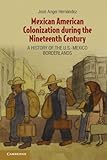
José Angel Hernández. Mexican American Colonization during the Nineteenth Century: A hiHstory of the U.S.-Mexico Borderlands. Cambridge: Cambridge University Press, 2012. xvii + 266 pp. $94.00 (cloth), ISBN 978-1-107-01239-4; $30.99 (paper), ISBN 978-1-107-66624-5.
Reviewed by Sterling Evans (Univ. of Oklahoma)
Published on H-Borderlands (December, 2013)
Commissioned by Benjamin H. Johnson (University of Wisconsin, Milwaukee)
Los repatriados in the Borderlands
Diego Rivera’s “Repatriados en Torreón” beautifully graces the cover of José Angel Hernández’s book Mexican American Colonization during the Nineteenth Century. The watercolor and ink painting shows a southward moving people, dejected and looking down, with their belongings on their backs and in bags. Repatriation of Mexicans living in the United States usually conjures images of the 1930s in California during the Great Depression, and Rivera’s 1931 painting illustrates that episode, of course. Still, it is a fitting graphic for the much less studied, and indeed much less known, repatriation of Mexicans living in the United States that occurred many decades before the Depression, during the aftermath of the Treaty of Guadalupe Hidalgo (1848) that ended the U.S.-Mexican War. Then, as Hernández points out through a variety of community case studies from Texas, New Mexico, and California, in this book, there was a very real north-to-south migration pattern of Mexicans who wanted to continue to be residents of their motherland, Mexico. With these studies, then, Mexican American Colonization during the Nineteenth Century offers a compelling transnational story that adds to historians’ and other scholars’ understanding of Chicano and borderlands history. This is timely, as debates continue to rage in the United States regarding immigration (documented and undocumented) of Mexicans. Historians and policymakers should have a solid background of this research on north-to-south migration to understand and appreciate the age-old Mexican American adage, “We didn’t cross the border; the border crossed us.” If ever there were a group of people to whom this saying applies, it is indeed the ones we meet in this book.
Hernández’s study, based on his PhD dissertation from the University of Chicago, follows the lead of another important borderlands study that looked closely at the language of the Treaty of Guadalupe Hidalgo to discern important implications of policy. In War of a Thousand Deserts: Indian Raids and the U.S.-Mexican War, Brian DeLay was inspired by the specific language in Article 11 of the treaty--language that he referred to as “a little door” into the larger historical processes of Comanche and other Native raiding into Mexico. According to Article 11, the U.S. government was supposed to work to halt Indian raiding to protect northern Mexicans from further incursions from Indian peoples now absorbed into the United States.[1] In a similar vein, Hernández’s inspiration was a Mexican government decree from August of 1848—a decreto concerning “Mexican families who found themselves in the United States who are permitted to immigrate to the homeland” that was written into a larger Colonization Code.[2] Hernández found that this policy applied to a number of communities in the southern sections of the borderlands, and he worked to retrace the stories of those people.
Lest readers here, however, fear that this revisits too closely some of Arnoldo De León’s work on a similar topic for post-U.S.-Mexican War Mexicans in Texas, note please that Hernández extended the topic to include communities from further west along the border (New Mexico and California) and has extended the timeline of his study to include episodes from the 1870s and 1890s as they applied to these colonization initiatives.[3] Hernández’s analysis, then, also extends deeper into the nineteenth century, and deals with other themes and questions, than did Andrés Reséndez for the first half of that century.[4] He also added fresh research from archival documents from Mexican national and Chihuahua state archives and from a wide assortment of newspapers from both sides of the border during this time period. The author also drew heavily from secondary sources (especially for chapters 1 and 2), creating a monograph of mixed primary and printed sources, as any such study would do, to interpret this important part of Mexican American and borderlands history.
Following Hernández’s order here, his introduction is an excellent foray into discussing how Mexican American Colonization during the Nineteenth Century adds borderlands dynamics to repatriation history, and how repatriation dynamics should better inform borderlands history. The author duly accomplishes that goal. Chapter 1 continues along this path, but adds a great deal of theory on colonization processes to the discussion. I suppose that this was important to do, but perhaps more so for Hernández’s dissertation than what was needed for the book. However, I would add that readers will very much appreciate the author’s attention to providing a transnational approach to the topic that he defines quite well, and which is also spelled out theoretically, but clearly, here.
Meanwhile, Chapter 2 deals with expulsions, repatriation, and military colonization. Hernández illustrates the severity of why various communities of Mexican Americans wanted/needed to repatriate: “The individuals who usually avoided expulsion eventually took refuge further south ... [and] lived in constant fear of raids and threats of violence from the burgeoning Euro American population” (p. 72). Chapter 3 goes further to show postwar repatriation efforts that followed a “dominant nationalist discourse” (p. 97), which exposes a central thesis of the book: “In contrast to past interpretations, the Mexican state emerges not as a benevolent protector of prodigal sons and daughters, but as an institution distantly attending to repatriation as if it were a colonial afterthought” (p. 100). At this point, the author provides thorough discussion and analysis of the Federal Repatriation Commission, its mission, its and shortcomings. In fact, we learn--perhaps taking too long to get to this point, that “the vast majority of Nuevo Mexicanos ultimately chose to remain under a U.S. system of governance--one that offered better incomes, more safety, and trade--rather than become ‘subjects of the government of Mexico’” (p. 134).
Chapter 4 gets into the growth of some of the borderlands cities in the latter half of the nineteenth century, especially the importance of repatriated citizens to the development of these urban areas. Labor issues arose at this point that are also well discussed in this chapter. Once again, and in excellent borderlands history fashion, Hernández shows the tension of competing national policies: “The United States could not protect Californios against various abuses related to labor competition, xenophobia, economics, and bigotry, while Mexico could not protect Californios because of empty coffers, ‘administrative disorder,’ and continued war against the Indios Bárbaros” (p. 156). For New Mexico, the La Mesilla (part of the Gadsden Purchase country) is the case study analyzed in chapter 5, with especially good discussion of push-pull factors affecting Mexican American migration patterns. Here, there is also sound analysis of political implications affecting this population, as both Republicans and Democrats in New Mexico Territory at the time had differing approaches to dealing with Mexican Americans but with similar results. Chapters 6 and 7 deal more with more useful case studies of revolts and violence in the borderlands.
All of these matters are important in the history of Mexican American colonization in the borderlands. But at times, the book seems to get bogged down in jargon and dissertation-y theory, some of which should have been better edited by the press. At the same time, the author seems compelled constantly to explain what he’s doing. For example, he does not need to remind readers of his “analysis of heretofore unexamined archival documents” (p. 100). Nor does he have to add unnecessary signposting, such as “our analysis of the process of repatriation to Mexico begins with ... ” (p. 100); “I will end the chapter by ... ” and “Let us now return to … (p. 182); and “We return to one of the concerns ... (p. 223). Such language gives the book an unfortunate mechanical flavor that interrupts otherwise very fine writing. These examples also reflect an annoying inconsistency of first-person singular and first-person plural perspectives--again, oddly not edited out by the press when this is a clearly a single-author study. To the author’s good credit, however, the chapter epigraphs are excellent--very well chosen and pertinent to each chapter, and I applaud the press for providing on-page footnotes (a rare but delicious treat!) instead of endnotes at the back of the book.
Finally, a few thoughts here on how the book ends: Hernández’s conclusion is excellent! Readers get a useful review of the three types of repatriation (private, collective, and government-sponsored), and learn--perhaps a bit late for the book--of the overall significance of the study: an estimated 25 percent of Mexican Americans in these years returned to Mexico. Of course, this shows that a vast majority did not migrate southward, clearly illustrating that Mexican colonization policy more often did not result in the desired end. He then brings some of these findings and arguments to the present to discuss the current situation of México de afuera and the whole discourse of expanded Mexican (cultural, demographic) boundaries. Likewise, Hernández’s final words are poignant and necessary, and once again show the trajectory of binational policymaking and transnational effects on migrant peoples in this borderlands region: “As I write these final sentences,” he observes, “both governments today are unwilling to address the millions of undocumented Mexican migrants who reside in the United States, and the millions deported to Mexico are arriving more impoverished than when they left.” Further, “whether because of local and regional politics, or due perhaps to the longest and most drawn out economic crisis since the Great Depression of 1929, neither the United States or Mexico have come to practical and pragmatic accord about how to accommodate the millions already in the United States or the millions who have already returned to Mexico.” Thus, this work should be more than a dissertation-to-book academic project. Hernández appropriately concludes on the same page that his hope “is that this analysis of Mexican American colonization during the nineteenth century may contribute to providing a more nuanced and historical understanding of this process ... [and that] it may serve to generate a more modern and effective policy to accommodate today’s ‘México de Afuera’” (p. 230). I sincerely hope so, too.
Notes
[1]. Brian DeLay, War of a Thousand Deserts: Indian Raids and the U.S.-Mexican War (New Haven, CT: Yale University Press, 2008). See specific wording of Article 11 that concerned DeLay on p. xiii.
[2].My translation of the decree’s Spanish-language title from the Código de Colonización whose longer name is established in footnote 12 on p. 6.
[3]. See Arnoldo De León, “Life for Mexicans in Texas after the 1836 Revolution,” in Major Problems in Mexican-American History: Documents and Essays, ed. Zaragosa Vargas (Boston: Houghton-Miflin, 1999), and De León’s larger work, The Tejano Community, 1836-1900 (Albuquerque: University of New Mexico Press, 1982).
[4]. See Andrés Reséndez, Changing National Identities at the Frontier: Texas and New Mexico, 1800-1850 (New York, NY: Cambridge University Press, 2004).
If there is additional discussion of this review, you may access it through the network, at: https://networks.h-net.org/h-borderlands.
Citation:
Sterling Evans. Review of Hernández, José Angel, Mexican American Colonization during the Nineteenth Century: A hiHstory of the U.S.-Mexico Borderlands.
H-Borderlands, H-Net Reviews.
December, 2013.
URL: http://www.h-net.org/reviews/showrev.php?id=38168
 | This work is licensed under a Creative Commons Attribution-Noncommercial-No Derivative Works 3.0 United States License. |

