

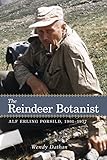
Wendy Dathan. The Reindeer Botanist: Alf Erling Porsild, 1901-1977. Calgary: University of Calgary Press, 2012. 600 pp. $46.95 (paper), ISBN 978-1-55238-586-9.
Reviewed by Bathsheba Demuth (University of California - Berkeley)
Published on H-Environment (April, 2013)
Commissioned by Dolly Jørgensen (University of Stavanger)
This Arctic Life
Alf Erling Porsild, was, in the words of his biographer Wendy Dathan, “a man behind the scenes in northern decision-making” for well over half of the twentieth century, and his life illuminates fascinating but “little-known segments of Canadian history” (p. xxi). In The Reindeer Botanist, not only does Dathan animate historical events that might otherwise have been lost, from adventurous scientific expeditions across the Arctic to professional rivalries, but she also crafts a biography meant to honor Porsild as a man whose “many contributions to his chosen country deserve our recognition and appreciation.” This volume is, therefore, partly a memorial, and a testament to how individuals like Porsild, “a quiet, soft-spoken man who worked best alone,” can be the subject of rewarding historical and biographical inquiry (p. xxii).
Porsild may have been quiet by disposition, but his life covered a great deal of intellectual and geographical ground. To manage the different threads of Porsild’s career, Reindeer Botanist is subdivided into three sections. The first, “Reindeer Survey/Exploration, 1901-1928,” is a bildungsroman of the young scientist, beginning with his childhood in Greenland, where he learned Inuit, listened to the tales of Arctic explorers visiting his parents, and inherited his father’s interest in botany. Porsild’s fascination with the North, and northern plants, did not diminish with age, and his Arctic experience and botanical collecting abilities caught the eye of Oscar Malte, chief botanist of the National Herbarium in Canada. It was through Malte that Porsild was assigned, in 1926, to map the vegetation of Canada’s Northwest as a precursor to introducing reindeer farming to the region’s indigenous population. Porsild’s expedition, which lasted thirty months and covered hundreds of miles from the Pacific Alaska into the Northwest Territories by boat, dog sled, and foot, found suitable reindeer pasture in the Mackenzie River Delta, and gave Porsild an impressive understanding of the geographically diverse and botanically abundant landscapes of the western North American Arctic.
Porsild spent several years, after his overland adventure at the National Herbarium, cataloging plant specimens and participating in aerial surveys of more possible reindeer pastures, a period Dathan describes in the second section of the book, “Canada’s Reindeer Herd, 1929-1935.” These surveys ranged eastward toward Hudson’s Bay, further expanding Porsild’s collections. Involvement with the reindeer program took Porsild yet further afield on a trip to Sweden to recruit Saami reindeer herders, four of whom journeyed back to Canada to assist the new government reindeer station near Aklavik, Northwest Territories, in 1931. While in Sweden, Porsild met fellow botanist and future rival Eric Hulten, whose plans for a comprehensive volume on the flora of Alaska and the Yukon were similar to Porsild’s. However, Porsild’s professional desires were frustrated by the mismanagement of the reindeer project; the herd purchased by the Canadian government in Alaska took five years to cross the Brooks Range, leaving Porsild to commute between the Mackenzie River Delta station and Ottawa until 1935.
When finally freed from reindeer duties, Porsild returned to the National Herbarium, initially to identify and organize the institution’s vast botanical collections. Despite uncertainties over his unorthodox credentials--Porsild had no formal university degree--and interdepartmental squabbles, Porsild continued to work at the Herbarium, as the only botanist on staff until the close of WWII and as chief botanist until his retirement in 1967. It is this thirty-two-year period that Dathan covers in the final section of the book, “The National Herbarium in Peace and War, 1936-1977.” The war years saw Porsild’s love of plants sidetracked again, this time putting childhood ties and linguistic expertise to work in opening a Canadian consulate in Greenland, which had been cut off from Denmark by the Nazis and was a key supplier of the cryolte ore critical to North American war industries. Even while in Greenland, Porsild kept an eye on his beloved Herbarium, an institution that supported his immersion in major botanical debates throughout his tenure. Foremost among these, especially for a scientist interested in northern ecological systems, were discussions and disputes over the distribution and spread of plant life across the Bering Strait before, during, and after the last ice age. These debates, and his occasional reluctance to grant access to the National Herbarium collections, sometimes put Porsild at odds with Hulten, although his most contentious publication was a critique of Farley Mowat’s People of the Deer (1952), a book Porsild described as having “little to no relation to actual facts” (p. 570). By the end of his life, Porsild had traveled from Russia to the Rocky Mountains, had over a hundred publications to his name, played a founding role in the creation of the Arctic Institute of North America, and never lost his love of plants and their adaptations to extreme climates.
In Reindeer Botanist, in the three separate arenas of reindeer farming, Canadian wartime diplomacy, and the development of botany and Canada’s National Herbarium, Dathan touches lightly on some larger themes of the twentieth-century Arctic. Attempts at state-building ambitions in the North, especially focused on assisting and making full citizens of indigenous populations, is certainly present in Dathan’s recounting of the badly executed and ultimately unsuccessful Canadian Reindeer Project. The North as a repository for natural resources and national security concerns comes through in Porsild’s Greenland years, while the increasing specialization and professionalization of science during the twentieth century, not to mention the related issues of academic disagreements and controversies, are currents throughout the book. Indeed, Porsild must be one of the last botanists, or scientists of any discipline, to attain such status in his discipline well before completing a doctorate--a degree Porsild was granted only in 1955. Dathan remains true to the biographical form in that these themes are not articulated as explicit arguments or open engagements with historiography, but instead emerge from the lived and carefully reconstructed experience of Porsild’s life. While this may frustrate those looking for a thesis-driven monograph, Dathan’s fluent writing and clear empathy with her subject’s limitations and accomplishments makes The Reindeer Botanist a pleasant, if substantial, read.
Behind the tales of northern adventures by dogsled, scientific discoveries, and professional achievement is a deeply researched book that draws on Canada’s national archives, the National Herbarium’s records, family papers, and collections in the United States. Reindeer Botanist is, therefore, both a rich biography and a guide for scholars whose work intersects with one or more of the episodes of Porsild’s varied life. The wealth of material that Dathan draws upon and her tendency to quote at considerable length does, occasionally, threaten to overwhelm, especially for a reader not well versed in Arctic geography or the cast of scientists and explorers who traversed it in the twentieth century. The larger context of Porsild’s life and the stakes of his various adventures occasionally seem indistinct, especially in sections relating Porsild’s botanical contributions, which were significant but would seem more so with some additional explanation of the field’s debates for a lay audience. It is also a professional rather than personal biography; although Porsild’s brother Robert, who participated in the reindeer project, emerges as an important character, in general we learn far more about Porsild’s frustrations in publishing his botanical findings than, say, about any of his multiple wives. Such an emphasis, however, is in keeping with Dathan’s desire to honor the integrity and scientific dedication of her protagonist, who emerges as a gifted observer of plants and landscapes.
Given the length of this volume, and the varied experiences it relates, different sections may appeal to specialists in different fields and periods, particularly historians of Canadian northern development, Arctic science, Greenland during WWII, and botanical specialists looking to understand their discipline’s past. It also offers new perspectives on a few well-known characters, such as Mowat and Vilhjalmur Stefansson. The work as a whole will enrich those deeply interested in the Arctic during the twentieth century. For environmental historians, it provides an example of how biography allows for a broad temporal and geographical span without losing narrative coherence and the utility of using an individual’s experience to root a specific geography in the reader’s mind. Most of all, Reindeer Botanist is a thoroughly researched, clearly executed portrait of a man whose life, in the words of one of his colleagues, “was a saga of unique experiences and accomplishments--an inspiration to all those who have faith in the capacities of an individual human mind” (p. 659).
If there is additional discussion of this review, you may access it through the network, at: https://networks.h-net.org/h-environment.
Citation:
Bathsheba Demuth. Review of Dathan, Wendy, The Reindeer Botanist: Alf Erling Porsild, 1901-1977.
H-Environment, H-Net Reviews.
April, 2013.
URL: http://www.h-net.org/reviews/showrev.php?id=38049
 | This work is licensed under a Creative Commons Attribution-Noncommercial-No Derivative Works 3.0 United States License. |

