



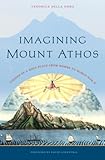
Veronica della Dora. Imagining Mount Athos: Visions of a Holy Place from Homer to World War II. Charlottesville: University Of Virginia Press, 2011. 328 pp. $49.50 (cloth), ISBN 978-0-8139-3085-5.
Reviewed by Kenneth Olwig
Published on H-HistGeog (January, 2013)
Commissioned by Robert J. Mayhew (University of Bristol)
A Mountain Sacred to the Mind
Imagining Mount Athos is a significant and valuable departure from geography's modern theoretical fixation on space and other abstractions, on the one hand, and the technology of spatial representation, on the other. The author, Veronica della Dora, effectively returns to the discipline's classical ancient Greek "Herodotian" and chorographical roots in a study that is appropriately concerned with a place at the core of Greek identity since ancient times (though she does not commit the hubris of identifying herself with Herodotos). Classical chorography involves the study of places (choros) in all their historical, cultural, and natural manifoldness. In this case, the place, Mount Athos, is in Herodotos's backyard, located on a peninsula jutting out into the Aegean Sea in southern Macedonia. Athos’s imposing physical height and location made it an obvious holy site for the ancient Greeks, some of whose most important gods were known to have a predilection for mountains. This view of the mountain, furthermore, continued into the Christian Middle Ages, when Athos became the site of an expanding complex of Orthodox Christian monasteries, which, virtually without break, have characterized and controlled the peninsula to this day. The extraordinary physical character of such a high mountain in such a virtually insular location also made the mountain fascinating to natural scientists and lovers of natural scenery. And, of course, the combination of centuries of monastic use, and the resultant classics of Orthodox Byzantine architecture, with an extraordinary physical height and setting, created the basis for many overlapping interests between culture and nature.
The chapter headings give a useful impression of the content and the approach taken in this thoroughly researched book by a scholar with a magisterial command of the relevant languages and literatures: "Mythical Athos" (literary and emblematic Athos); "Utopian Athos" (Edenic Athos); "Iconic Athos"; "Erudite Athos" (the narratives of eighteenth- and nineteenth-century educated visitors); "Geopolitical Athos" (modern early twentieth-century narratives); and "Scientific Athos." In a literate, and well-illustrated, tour de force, della Dora's "muse" is appropriately mythopoetic, utopian, iconic, erudite, geopolitical, and scientific in language and approach to each of the topics. There is thus no privileged truth in della Dora's beautifully written presentation of the many facets of the mountain. The mythical stories concerning, for example, the length of the mountain's shadow or an ancient Persian built canal supposed to have been dug across the peninsula's base are presented for what they were perceived to be until they are questioned, or even debunked, in a later chapter, at which point one is forced to decide which truth is the most compelling in which context. The shadow of the island thus may not be quite as long as once believed, but the poetics of hyperbole nevertheless tell much about how the mountain was perceived. As with the work of Ryszard Kapuściński, another modern "Herodotian," Travels with Herodotus (2007), this is a book that could well be read by general readers for its literary qualities alone, but it is likewise an important scholarly work due to the insights it gives into fields ranging from intellectual history to cultural geography, to cartographic history, to geopolitics, and to science. As David Lowenthal puts it in his thoughtful foreword, the book is "peopled by a stunning cast--monks and mountaineers, mystics and mapmakers, saints and sinners, aesthetes and invalids, botanists and archaeologists, pilgrims and imperialists" (p. xi).
A decidedly literary characteristic of this book is the way the author has consciously created a structure, like the beats and rhymes of a sonnet, that both challenges and stimulates the narrative. In this case, this structure involves a "cubist" approach to the mountain in which its different facets, whether mythic, iconic, scientific, etc., stand by themselves, yet also form a fragmented whole as seen from a distance, as in the paintings of Montagne Sainte-Victoire by Paul Cézanne. It also involves, however, a deeply personal rule against violating the integrity of the island's interiority. A salient feature of monastic life on Mount Athos is that women are not allowed entry to the peninsula. As a woman, the author therefore has written an entire book about a place that she may not enter, and that she, out of respect for the monks, their place, and their religion, to which she has converted, will not expose to her entry. The one major lacuna in the book's chapters is thus a missing chapter speculating on how the island is experienced from the inside, by the monks. The book, thus, sticks with the imaginings of the island by outsiders, including those outsiders who have been privileged to take a peak inside, but who remain, nevertheless, curious aliens, generating a myriad of mental images about a place they cannot know from the inside. The mountain, like God, remains a holy mystery.
The book's "chorography," as it has been termed here, is bookended by an introduction and an epilogue where della Dora eruditely takes account of the current gods of geographical theory, as is necessary in an academic publication. Various academic authorities are cited concerning the largely phenomenological meaning of such concepts as "place" and "landscape." Phenomenological pronouncements, however, are a kind of essentialist pitfall because they, as in the work of Martin Heidegger, have a tendency to pretend to have a grasp of the whole, the holy and sacred, without having an evident theological foundation. From a religious mind-set, mountains, however, are not intrinsically sacred phenomena in and of themselves, unless one is a pantheist. Athos is no doubt holy to the ancient Greeks and to the Orthodox monks, but also no doubt in different ways. Judeo-Christianity thus has long standing issues with idolatry (as in the worship of holy bulls, trees, or even mountains, which have been known to house Satan), the distinction between symbol and referent being critical issues--not the least with regard to Roman Catholicism and Orthodox Christianity--in distinguishing paganism and myth from Judeo-Christian religion. The phenomena of place and landscape may thus have certain intrinsic qualities to the mainly British academic authorities cited at the beginning and end of the book (but largely ignored in between), but one wonders, for example, if these concepts have the same meaning for the monks on Athos? Landscape, which is contrasted with place as representing an outside versus place's inside perspective, is a good example.
This book is dedicated to della Dora's "mentor," the geographer Denis Cosgrove, who is best known for his work on the iconography of landscape, showing how the modern conception of landscape largely grew out of the science of perspective and cartography during the Italian Renaissance, thereby creating a conception of landscape as a scenic spatial phenomenon to be seen from the point of view of an outside viewer. It was this conception of landscape that became dominant in Great Britain, as represented, for example, by the British landscape park. Eastern Orthodox Christianity, however, is not noted for visual representations of the perspectival kind studied by Cosgrove under the banner of landscape (quite the opposite), just as the semiotics of representationality in the Eastern Orthodox Christian iconographic tradition is different from the semiotics of representationality in the West. What then is the meaning of landscape in relation to place in the minds of the monks? Do they distinguish landscape from place, or is landscape a form of place, as it was commonly conceptualized throughout Europe prior to the Italian Renaissance, and still is, as Cosgrove eventually recognized, in many places outside the sphere of British intellectual hegemony today?[1] It is here that it would have been useful to have a chapter that went behind the mental, if not the physical, walls of Athos, and this would be possible because, as della Dora points out, Athos is a peninsula that has not been mentally isolated from the outside world, and it is possible, even for a woman, to legally enter that world through correspondence and written texts. This chapter would be a fitting sequel to this present book, a sequel that I am sure della Dora would be highly qualified to write.
Note
[1]. Denis Cosgrove, "Landscape and Landschaft” (lecture presented at the “Spatial Turn in History” Symposium, German Historical Institute, February 19, 2004), GHI Bulletin 35 (2004): 57-71.
If there is additional discussion of this review, you may access it through the network, at: https://networks.h-net.org/h-histgeog.
Citation:
Kenneth Olwig. Review of della Dora, Veronica, Imagining Mount Athos: Visions of a Holy Place from Homer to World War II.
H-HistGeog, H-Net Reviews.
January, 2013.
URL: http://www.h-net.org/reviews/showrev.php?id=38036
 | This work is licensed under a Creative Commons Attribution-Noncommercial-No Derivative Works 3.0 United States License. |

