

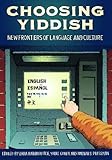
Shiri Goren Lara Rabinovitch, Hannah S. Pressman, eds. Choosing Yiddish: New Frontiers of Language and Culture. Detroit: Wayne State University Press, 2013. 360 pp. $34.95 (paper), ISBN 978-0-8143-3444-7.
Reviewed by Zelda Kahan Newman (Lehman College)
Published on H-Judaic (April, 2013)
Commissioned by Jason Kalman (Hebrew Union College - Jewish Institute of Religion)
What We Are Choosing When We're "Choosing Yiddish"
Much can be gained from reading the articles in Choosing Yiddish. The articles of part 1 are concerned with Jews who “write on the edge” because they view themselves as Jews despite themselves. As Anita Norich points out, this discomfort did in fact produce some unusual and fascinating literature. The articles of part 2, “Jews and the City,” once again, concern themselves with Jews who need to adjust to modernity. These attempts at adjustment are unquestionably of interest to social historians. For the writers of part 3, “Yiddish Goes Pop,” there is hardly anything left of Jewishness. If one is content to make do with this much-reduced Jewishness, then Yiddish culture does indeed become “pop” culture. Part 4, which deals with the Jewish immigrant experience in the United States, reminds students of what former generations did to make themselves into “Jewish Americans.” Part 5, in which Yiddish encounters Hebrew, addresses a population which has both Hebrew and Yiddish literacy. Like the articles of part 1, these literary analyses are of great interest to a literary historian. Finally, the articles of the last section, like this whole book, contain something for everyone: an article on sociolinguistics, an article by a musicologist, and an article on hip-hop. Perhaps there is no common thread to all of this, but at least there is a great selection to choose from.
The title of this book is misleading. While there is one article in this book that discusses choosing to educate children in Yiddish rather than English in the secular Yiddish schools of Montreal, and one short piece in which a researcher explains why she chose to study Yiddish, none of the other articles in this book go in either of these directions. Indeed, the topics in this book range from the past to the present; they cover issues in sociolinguistics, history, literary analysis, pop culture, and musicology. A more appropriate, if less catchy, title, then, would be Issues in Yiddish Studies.
This book has six subsections, each of them introduced by a four-page “prelude.” The first subsection, entitled “Writing On The Edge,” assumes that the powerlessness of Jews in the diaspora “has led to an incredibly creative literature” (Norich, p. 12). Dara Horn analyzes Der Nister’s symbolic stories; Shiri Goren, analyzing David Vogel’s’ last work of prose, suggests that perhaps Yiddish was used to protest the “Nationalist impulse” of the German and French (p. 42); and Jordan Finkin shows, how, in writing about the Sacco-Vanzetti case of the 1920s, Yiddish poets used the opportunity to claim “a stake in American identity politics” (p. 58).
Part 2, subtitled “Yiddish in the City,” assumes that the urbanization that fostered Yiddish creativity in the early twentieth century, helped promote the goal of Yiddishists: curing “secular Jews of the ills of assimilation” by replacing religion with culture (Estraikh, p. 67). The workings of this new Yiddish culture are examined in three case studies: an article on the immigrant Jews of New York, an article on a Parisian Yiddish newspaper’s treatment of the Spanish Civil War, and an article on how the Yiddish immigrant writers living in Buenos Aires responded to the new Polish state of 1919. Only the last article of this section, the aforementioned “Choosing Yiddish in the Classroom,” discusses the valorization of Yiddish for its own sake, and not as a necessary immigrant tool for accommodation with the outside world.
In the prelude to the next subsection, Jeffrey Shandler speaks of the present “post-vernacular” period of Yiddish, in which Yiddish culture “has developed a new dependency on the academy for its sustenance” (p. 144). Since, in Shandler’s view, Jews no longer speak a full-blown language, the “post-vernacular” remains are open to “pop” uses. One article in this section celebrates the obscenity that Isaac Goldberg introduced in his translations of Yiddish literature, and argues for an inherent connection between obscenity and Yiddish; another analyzes the stereotypical mothers in Yiddish film and suggests that “the elevated ideal of martyrdom and self-abnegation” of the idealized mother points to the “personal price” their daughters had to pay (p. 175). Finally, in an article entitled “Russian Militia Singing in Yiddish” and subtitled “Jewish Nostalgia in Soviet and Post-Soviet Popular Culture,” Anna Sternshis chronicles the nostalgia for Yiddish in a country (Soviet Russia) whose policy was to obliterate Jewish culture and suppress the speaking (and teaching) of Yiddish.
The fourth subsection of this book, entitled “Yiddish Comes to America,” is barely concerned with Yiddish, but very much concerned with America. The first article here addresses the 1876 case of a Jewish murderer and the treatment of this event in the Yiddish press of the time. The next two articles are about the great Yiddish linguist Max Weinreich. The first covers his trip to Tuskegee in 1932, and sees this trip as a formative event in his career; the second describes his successful effort to move YIVO, the center for the promotion of the Yiddish language and its culture, from Vilna to New York.
The fifth section of this book, entitled “Yiddish Encounters Hebrew,” deals with the crossing paths of the two languages. Here Ela Bauer describes the way Yiddish was seen in the fin de siecle Hebrew newspapers of Eastern Europe; Shachar Pinsker describes the work and fate of “Yung Yisroel,” the native Yiddish speakers/writers who continued to write Yiddish in Israel after the state of Israel was established; and Adriana X. Jacobs describes the lingering effects of Avot Yeshurun’s native Yiddish on his Hebrew poetry.
The final section of this book, cleverly entitled “The Hear and Now,” follows the catch-as–catch-can approach of the whole book. Sara Bunin Benor’s article, entitled “Echoes of Yiddish in the Speech of 21st-Century Jews,” is about how Jews, so linguistically assimilated that their Yiddish is a mere remnant of a full-blown, functioning language, use bits of Yiddish for Jewish identification. Asya Vaisman’s article, “Hold on Tightly to Tradition,” discusses “generational differences in Yiddish song repertoires among contemporary Hasidic women,” while Shayn E. Smulyan’s article, “The SoCalled Past: Sampling Yiddish in Hip-Hop,” discusses the ways in which the musician “SoCalled” incorporates the sounds of old, discarded Yiddish records into his hip-hop songs. Of these three articles, only Asya Vaisman’s article on the songs of Hasidic women deals with a population composed of genuine native speakers of Yiddish. Thus it stands at the extreme end of a linguistic continuum: Vaisman’s fully-Yiddish-speaking informants are at one end; Benor’s religious speakers have some Yiddish in their speech, and it is meaningful for them, while the “actual Yiddish linguistic content” of SoCalled’s hip-hop, “remains largely irrelevant” (p. 363).
The editors of this volume note in their introduction that “with the exception of some ultra-orthodox communities, the language [Yiddish- ZKN] is no longer a vernacular” (p. 3). In essence, the editors have noted here that there are communities of native speakers of Yiddish, but the articles in this book (with one exception) are not about those speakers. Would researchers of Spanish (or those in Spanish studies) knowingly set out to examine the dying, heritage language of third-generation Spanish-Americans, when they could instead focus their efforts on genuinely native Spanish speakers? The Hassidim of Antwerp, Jerusalem, Netanya, and New York are the people who truly choose to speak Yiddish.[1] Yet they are largely ignored in the articles of this volume.
Shandler, as we have seen, speaks of a “Jewish culture” that is dependent for its existence on the academic world. Does this culture necessarily have speakers of a uniquely Jewish language? Does this culture consist of a unique set of beliefs and/or a unique worldview? Does it subscribe to a unique set of behaviors, or have a deep connection to a unique canon of literary texts? Sadly, the answer is the same to all these questions: no. Many of the articles in this book are about Jews whose “culture” includes none of these factors. Few take pride in knowing Yiddish; only a minority knows Hebrew; few have a deep acquaintance with the great canon of Hebrew and/or Hebrew-Aramaic/Jewish texts; few observe Jewish ways of living and only a few subscribe to a uniquely Jewish worldview. No wonder, then, that this culture has no independent existence outside of the academic world.
An article discussed above assumes that Yiddish is inherently connected to obscenity. For all of the folk wisdom to the contrary, there is no genuine proof of a connection between Yiddish and obscenity. Nor is there an inherent connection between Yiddish and humor. All human languages have an equal capacity for both obscenity and humor. And all human languages have a high register and a low register. If the modern Jews discussed in this book know only the low register, that is because they have been raised in a society that has not equipped them with a high register. A secular Yiddishist home or a religiously observant home of the early twentieth century would have provided this; a modern secular American Jewish home likely does not.
An educated American who says “bullshit” in his or her speech, nevertheless knows beautiful English poetry and enjoys the richness of Shakespeare’s language. Such a speaker would never say that English is an inherently obscene language just because he/she can say “bullshit” when he/she wants to dismiss something as devoid of value and unworthy of attention. And yet, those who use the Yiddish word bopkes (goat turds) to mean “worthless” do insist that this usage indicates an inherent relation of Yiddish to obscenity. The fact that this low register usage exists should not blind speakers to the "terrible beauty" of Avrohom Sutzkever's poetry, the playful Yiddish of Purim Torah, and Kadya Molodowsky's children's poetry, or the lyric beauty of the contemporary Israeli poet, Rivka Basman Ben-Haim.
Note
[1]. It should be noted that these communities of genuinely native speakers have been dealt with by researchers. Netta Abugov has studied the Yiddish speakers of Netanya and is now studying the Yiddish speakers of Antwerp; Dalit Assouline has studied the Yiddish of Jerusalemites, and I have recorded and am writing about the speech of New York Hassidic men and women. Here are some references to this work: N. Abugov and M. Tannenbaum, “The Legacy of the Linguistic Fence: Linguistic Patterns among Ultra-Orthodox Jewish Girls,” Heritage Language Journal 7, no. 1 (2010) : 74-90, N. Abugov and D. Ravid, “Home Language Usage and the Impact of Modern Hebrew on the Israeli Hasidic Yiddish Nouns and Noun Plurals,” International Journal of the Sociology of Language, forthcoming; Dalit Assouline, “The Emergence of Two First-Person Plural Pronouns in Haredi Jerusalemite Yiddish,” Journal of Germanic Linguistics, 22 (2010): 1-22, and “Veiling Knowledge: Hebrew Sources in the Yiddish Sermons of Ultra-Orthodox Women,” International Journal of the Sociology of Language, forthcoming; Zelda Kahan-Newman, recordings of nine Hasidic young men (2009) and sixteen Hasidic young women (2012), available at www.talkbank.org, and “Discourse Markers in the Narratives of New York Hasidim: The Expected and a Case of Contact-Induced Grammaticalization in Yiddish,” in Germanic Heritage Languages in North America: Acquisition, Attrition, and Change, ed. Joseph Salmons (Amsterdam: John Benjamins Publishing, forthcoming).
If there is additional discussion of this review, you may access it through the network, at: https://networks.h-net.org/h-judaic.
Citation:
Zelda Kahan Newman. Review of Lara Rabinovitch, Shiri Goren, Hannah S. Pressman, eds., Choosing Yiddish: New Frontiers of Language and Culture.
H-Judaic, H-Net Reviews.
April, 2013.
URL: http://www.h-net.org/reviews/showrev.php?id=37975
 | This work is licensed under a Creative Commons Attribution-Noncommercial-No Derivative Works 3.0 United States License. |

