

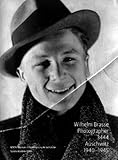
Wilhelm Brasse, photographer. Wilhelm Brasse: Photographer 3444, Auschwitz, 1940-1945. Compiled by the Museum of Contemporary Art, Krakow, Poland. Brighton: Sussex Academic Press, 2012. Illustrations. 128 pp. $39.95 (paper), ISBN 978-1-84519-539-7.
Reviewed by Harriet Scharnberg
Published on H-German (September, 2014)
Commissioned by Shannon Nagy
Photographing Mass Murderers and Their Victims
Wilhelm Brasse was one of the Auschwitz prisoners who was forced to photograph incoming camp inmates. Even though he rejected being called a historical figure, he is well known to many visitors of the Auschwitz Museum as well as to some historians. As a survivor-witness, in archival accounts and interviews with museum visitors, he shared his work and survival in the Identification Service of the main camp Auschwitz I. And last but not least, Brasse is the protagonist of the 2005 documentary Portrecista directed by Ireneusz Dobrowolski.
Shortly after being released in Polish and German, Brasse's testimony is now available in an English translation. The account is based on an interview that Maria Anna Potocka, director of the Museum of Contemporary Art in Kraków, Poland, conducted with the photographer in 2010, two years before his death. Attached to the book the reader finds a DVD (Polish with English subtitles) that assembles fragmental footage filmed during the interview. As in the book, the part of the interviewer is entirely excluded. Therefore the account reads as a self-contained, autobiographical narration.
The main part of the volume is dedicated to Brasse's account. In addition to contributing details about people who are mentioned in Brasse's testimony, the editor decided to include sparse commentary. One distressing inaccuracy is the incorrect dates of the initial operation of the gas chambers in Birkenau (the book states 1941 but it was actually 1942). Brasse's account is accompanied by many photographs, namely, those of prisoners, but also portraits of SS men and photos showing Brasse before and after imprisonment. Furthermore the reader finds a somewhat disturbing cartoon on the Identification Service that was drawn by Brasse's prisoner-colleagues and remains in the edition completely unexplained. Moreover, the volume contains a short essay preface by Potocka and a concise outline of the main camp Identification Service authored by Teresa Wontor-Cichy from the Auschwitz Museum.
In the first part of his testimony, the photographer, born in Żywiec at the end of 1917, provided an account of his Austro-Polish family background before turning to the outbreak of the war and his attempt to escape to Hungary. He reflected on his imprisonment and the first contact with the cruel daily life routine in the camp. Thereafter the account covers in more detail Brasse's duties in the Identification Service, his daily work, photography apparatuses, and colleagues. Brasse was imprisoned at Auschwitz for four and a half years, during which he took some seventy thousand photos. On some days up to 150 prisoners were recorded at the Identification Service. It is due to Brasse that a large part of the incoming prisoners' registration photographs survived the war instead of being destroyed.
A second focus lays on the extraordinary occurrences in the main camp. He witnessed camp life from a somewhat privileged position and throughout almost the entire time the camp was in operation. Brasse described the first gassing of Soviet prisoners or war (POWs) in a provisional gas chamber, gave an account of the unique case of an authorized prisoner's wedding ceremony in Auschwitz, and told the story of some prisoners who attempted to escape. He reported how he had to copy American dollars with other prisoners and how he was forced to take photos of the cruel experiments on humans carried out by the camp's physicians.
Life in Auschwitz for Brasse was not as life threatening as for other camp inmates. The most devastating situations in the report arise as a result of this contrast. For example, the so-called medical experiments are interwoven in a love story with a female prisoner when Brasse explained when and where they met--when she brought emaciated children to Brasse, who was to record the different stages of the deadly experiments the camp physicians carried out on them. Due to his socializing with many other prisoners, among them a lot of important figures of contemporary history, Brasse was able to report about encounters with them in the camp and after liberation. As his responsibility shifted more and more from taking prisoners' photographs to the portrayal of SS men, he interacted with many members of the camp's personnel, too. Brasse concluded his account by reporting about the camp's evacuation, liberation, and the years after the war. Finally, he reflected on his concept of a survivor-witness.
Beginning with the first page, the reader is fascinated by the accuracy of Brasse's account. Of course, as a result of his privileged position, he was able to observe camp life closely. Nevertheless it is remarkable how precisely he remembered dates, transport and occupancy rates, and names and origins of prisoners and SS men. Among historians such a precise recall might prompt relevant questions regarding general appraisal of eyewitness accounts. As is well known, nobody is able to encapsulate memories. In the course of gaining new information or on the background of new experiences they might be reinterpreted. But what does this mean in the case of a well-informed and experienced survivor-witness? Is it not possible or even likely that he integrated information (for example, dates) into his account that originated from historical research--and that the historical research is now ennobled with the authority of the eyewitness?
The fact that the editors decided not to ask questions concerning the historical validity of eyewitnesses' accounts, could suggest that this book might cater to a nonscholarly audience. This is also indicated by the lack of suggested further reading or the addition of an index of people. So it is not surprising that the book fails to mention that Brasse's testimony, which was first recorded in the 1950s, has already been a topic in the scholarly debate on "photographing the Holocaust" years ago.[1] And since this issue is not revealed in the preface either, the question remains unanswered to whom the editors address.
In a short preface, Potocka explains her perspective on Brasse and his account. In her opinion, Brasse was "a prisoner who condemns no one" (p. 7). However Brasse does not deal with this question, at least not in the published parts of the interview, leaving the reader unable to determine whether Brasse indeed does not condemn, or, if he perhaps as a result of his concept of an "eyewitness account," prioritizes factual information over ethical condemnation. Potocka draws some assumptions that are both far-reaching as well as daring. Firstly, she projects Brasse's alleged attitude, which she wants to have recognized in 2010, back into the time of his imprisonment. Based on this empirical narrow and doubtful basis, she then speculates that the SS men would--perhaps--have systematically advanced prisoners who were "sufficiently magnanimous to refrain from condemning them. This would attest to a covert cruelty complex in the SS men, to their repressed humanity" (p. 9). Furthermore, the author boldly claims that Brasse's non-condemning attitude would vouch for a neutral perception: "situations viewed through 'non-condemning' eyes are neutral in their descriptions" (p. 10). The preface would have benefited from confronting Potocka's assumptions with an in-depth discussion and well-established concept of "eyewitnessing." But Potocka denies their existence already in the beginning. In her opinion, scholarly methods are applied to the perpetrators only, on the one hand: "prisoners, on the other hand, are approached in a literary way, with descriptions in a more or less exalted mode of their feelings and gestures: resignation, heroism, helplessness, or Muselmannization" (p. 7). What this astonishing appraisal is based on, the author does not explain.
Note
[1]. Janina Struk, Photographing the Holocaust: Interpretations of the Evidence (London: Tauris, 2004), 102-119.
If there is additional discussion of this review, you may access it through the network, at: https://networks.h-net.org/h-german.
Citation:
Harriet Scharnberg. Review of Brasse, Wilhelm, photographer, Wilhelm Brasse: Photographer 3444, Auschwitz, 1940-1945.
H-German, H-Net Reviews.
September, 2014.
URL: http://www.h-net.org/reviews/showrev.php?id=37928
 | This work is licensed under a Creative Commons Attribution-Noncommercial-No Derivative Works 3.0 United States License. |

