

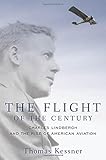
Thomas Kessner. The Flight of the Century: Charles Lindbergh and the Rise of American Aviation. New York: Oxford University Press, 2012. 336 pp. $17.95 (paper), ISBN 978-0-19-993117-0.
Reviewed by Craig Morris (Auburn University)
Published on H-War (May, 2013)
Commissioned by Margaret Sankey (Air University)
Charles Lindbergh: The Right Man for the Right Time
In the more than eighty years since Charles Lindbergh’s famous flight, his legacy has become obscured by the complex nature of his own life. Almost from the moment he landed in Paris, the press and public started dissecting his life. This trend continues to the present, with many historians identifying fascinating new details. Unfortunately, this approach often misses the greater understanding of why Lindbergh was such an icon in the first place.
Thomas Kessner attempts to rectify this shortcoming by exploring how Lindbergh became an international hero and used that status to promote the development of aviation. He argues that Lindbergh’s success resulted from the marriage between his own personality and outside support from key advisors. Kessner builds on the aviator’s complex nature by demonstrating how the dichotomies in his life worked to produced the perfect combination of homespun hero and sophisticated business promoter, which, under the tutelage of experienced advisors, started the civil aviation age.
Lindbergh’s youth appears as an intricate interweaving of seemingly contradictory traits into the foundations for the perfect American hero. Kessner depicts a series of contrasts defining the young Lindbergh. He was a quiet loner, but also enjoyed the rapport and hijinks of the barracks and airfield. Despite being a meticulous planner, he was a daring showman and stunt flyer. Most important, he was an unpretentious country boy, who was also at ease speaking to business leaders and potential investors.
This background made Lindbergh the right man at the right time during and after his historic flight of May 1927. Lindbergh was not the first to cross the Atlantic in an airplane and he was by no means the most famous aiming for Paris that spring. Yet, his success captured the nation and the world’s attention like no other aviator had. Kessner contends that Lindbergh’s solo success through grit, determination, and a little bit of luck seemed the ideal metaphor for American success. When he proved an effective diplomat and spokesman, winning over first the Europeans and then the Central and South Americans, he cemented his role in aviation history.
As in any heroic epic, an individual’s flaws often taint his or her successes. Lindbergh was no exception. Kessner depicts yet more dichotomies shaping his future. The young aviator, who rose to fame through the metaphor of the lone man fighting against great odds, owed much of his success to advisors like J. P. Morgan Jr, Dwight Morrow, and Harry Guggenheim. Lindbergh seemed to personify the ordinary man, yet he helped steer civil aviation towards a corporate structure. Finally, he desired public and government attention for his policies, but shied away from the spotlight cast on his personal life. In the end, Kessner suggests these conflicts not only colored his aviation policies, but also shaped our understanding of the man as he retreated into his inner world exploring biology and eugenics.
Thus, Kessner produces an important addition to the historiography. He effectively refocuses the Lindbergh story to his role in advancing aviation. In doing so, he highlights how contradiction shaped this complex man and his legacy. If there is one complaint against Kessner’s work, it is that he may not have expanded his focus enough. While his broad analysis helps explain Lindbergh’s fame and role in the development of aviation, fitting that life into the broader social, governmental, and business histories would have added more context in which to evaluate Lindbergh’s success and legacy. Still, Kessner provides both the academic and the general reader with a multifaceted analysis of the importance of Charles Lindbergh to American aviation.
If there is additional discussion of this review, you may access it through the network, at: https://networks.h-net.org/h-war.
Citation:
Craig Morris. Review of Kessner, Thomas, The Flight of the Century: Charles Lindbergh and the Rise of American Aviation.
H-War, H-Net Reviews.
May, 2013.
URL: http://www.h-net.org/reviews/showrev.php?id=37857
 | This work is licensed under a Creative Commons Attribution-Noncommercial-No Derivative Works 3.0 United States License. |

