

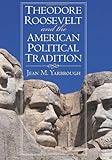
Jean M. Yarbrough. Theodore Roosevelt and the American Political Tradition. American Political Thought Series. Lawrence: University Press of Kansas, 2012. 400 pp. $39.95 (cloth), ISBN 978-0-7006-1886-6.
Reviewed by Paul M. Taillon (University of Auckland)
Published on H-SHGAPE (August, 2013)
Commissioned by Julia Irwin (University of South Florida)
How Theodore Roosevelt Was Not a (Small “r”) Republican
In the introduction to Theodore Roosevelt and the American Political Tradition, Jean M. Yarbrough, professor of government and Gary M. Pendy Sr. Professor of Social Sciences at Bowdoin College, is careful to say that this book is not an intellectual biography of the twenty-sixth president of the United States. What Yarbrough offers instead is a normative analysis of Theodore Roosevelt’s political thought “and what it means for republican self-government” (p. 6). Roosevelt’s biographers have shied away from his political thought, largely, Yarbrough suggests, because of his tendency for large talk and action. Richard Hofstadter’s dismissal of TR as a political opportunist with an “occasional insight” and in the end as a “conservative” has contributed to this neglect.[1] At first glance it looks like Yarbrough wishes to resuscitate TR as a political thinker. For too long, she says, political theorists and students of American political development have given him a “pass” because “he talked a good game,” and they have taken “his admiring references to the more nationalistic Founders and Lincoln at face value” (p. 5). Yet what follows in this book is an exercise in measuring where and how Roosevelt ignored, failed to understand, or contradicted The Federalist (1788), the Founders, and Abraham Lincoln.
Yarbrough’s approach follows from her conviction “that The Federalist makes a persuasive case for ‘limited but energetic’ national government, and especially a vigorous executive” (pp. 4-5). For Yarbrough, The Federalist stands as a foundational text for republican government, one that should protect individual rights but not strangle free markets or, worse, seek to redeem human nature through regulation. Roosevelt admired the Founders and “pronounced the Constitution ... the best possible arrangement for America” (pp. 5-6). He exhorted college graduates to read The Federalist and as president he turned to Lincoln’s thinking on the Constitution for inspiration.
But if Roosevelt drew on the political principles of Lincoln and the Founders, did he understand them? As a president, did he govern according to their principles consistently? To his credit, in Yarbrough’s opinion, TR promoted national greatness. To his detriment in domestic affairs, however, he went “seriously astray from the economic principles of Alexander Hamilton and Abraham Lincoln during his presidency, and certainly afterwards” (p. 5). The problem, Yarbrough elaborates, is that Roosevelt failed to seriously consider (and, it appears, remain consistent with) the Founders’ political principles. In the end, he drifted far from the principles of limited republican government for which these men stood and which he professed to admire. In a “most ‘Lincoln-like’ sense,” Yarbrough concludes, “Theodore Roosevelt was never a ‘conservative’” (p. 5).
Yarbrough organizes the book thematically and chronologically, charting Roosevelt’s intellectual development in tandem with the progress of his career in politics. Early chapters explore his education and the influences of Teutonic “germ theory,” Darwinism, historicism, and German idealism and statecraft. Yet, through an examination of his biographical and historical writings, comparing his scholarship with the political thought of the Founders, Yarbrough finds that TR never reconciled the evolutionary and historicist approach to politics that he had imbibed with natural rights republicanism, outlined in The Federalist. Over time, Roosevelt would part from that republican tradition, opening the door to his ultimate embrace of progressive ideals.
Subsequent chapters cover Roosevelt’s career in politics, charting his expansive view of executive power and embrace of progressive thought. Beginning with his time in the New York state legislature and then as New York City police commissioner and governor of New York, Yarbrough demonstrates the inconsistency of TR’s reform agenda and views on government with the Founders’ vision. During his time in the White House, Roosevelt sought to place his vigorous use of executive power (visible in his intervention in the 1902 anthracite coal strike and championing of regulatory legislation in Congress) within a republican constitutional order, arriving at his “stewardship” theory of the presidency during his second term. Rhetorically, Roosevelt justified his use of authority by comparing his actions to Lincoln’s extraordinary use of presidential power as a Civil War president, especially his suspension of habeas corpus. Yarbrough, however, argues that there can be no comparison between Lincoln’s actions, undertaken with a concern for preserving the Constitution, and Roosevelt’s program, which effectively superseded it.
With his loose understanding of the Constitution according to Yarbrough, Roosevelt posited a much larger role for national government than its framers imagined. Citing his heroes even as he contradicted them, TR oversaw the creation of a new American state, one based in administrative rather than political control; one with its authority located in the executive branch rather than the legislature; and, in Yarbrough’s telling, one that erased limits on federal power and eroded private property rights. All of this amounted to a new kind of state and a new constitutional order, propelled by TR’s rhetoric of national service and patriotism, which he distilled in the “New Nationalism.” Much of this is not new for scholars of American political development, but for Yarbrough the telling of the tale serves as an opportunity to highlight how far TR had traveled from the principles of his constitutional heroes and how fundamentally he controverted them in his domestic policies.
Theodore Roosevelt and the American Political Tradition is less a work of historical scholarship than a normative assessment of Roosevelt’s political thought. What is missing (or at least underdeveloped) is a sense of historicism. Where Yarbrough assesses Roosevelt’s thought against the ideal standard of The Federalist, a historian might have gone to greater lengths to describe how he understood or misunderstood and/or adapted, willfully misused, or ignored the Constitution toward explaining how he achieved what he did as a political and historical actor. Yarbrough offers a certain kind of insight onto the development of TR’s political thought and comments on what she sees as the unfortunate consequences of his “attempt to transform American politics,” to be sure (p. 267). Students of American political thought and philosophy will no doubt find value in this book (it has won the American Political Science Association’s Richard E. Neustadt Award for 2013 after all). But scholars of the Gilded Age and Progressive Era may find that it does not fully satisfy as a work of history.
Note
[1]. Richard Hofstadter, The American Political Tradition, and the Men Who Made It (New York: Alfred Knopf, 1948), 265-306, quotation on 295.
If there is additional discussion of this review, you may access it through the network, at: https://networks.h-net.org/h-shgape.
Citation:
Paul M. Taillon. Review of Yarbrough, Jean M., Theodore Roosevelt and the American Political Tradition.
H-SHGAPE, H-Net Reviews.
August, 2013.
URL: http://www.h-net.org/reviews/showrev.php?id=37645
 | This work is licensed under a Creative Commons Attribution-Noncommercial-No Derivative Works 3.0 United States License. |

