



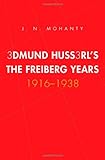
J. N. Mohanty. Edmund Husserl's Freiburg Years: 1916-1938. New Haven: Yale University Press, 2011. 512 pp. $85.00 (cloth), ISBN 978-0-300-15221-0.
Reviewed by Michael Gubser (James Madison University)
Published on HABSBURG (March, 2013)
Commissioned by Jonathan Kwan (University of Nottingham)
An Impressive Intellectual Biography
In the preface of his new book, Edmund Husserl’s Freiburg Years, 1916-1938, J. N. Mohanty announces that it will be his last volume on Husserl. This is a pity. Few Husserl scholars can boast so long and varied a resume. Mohanty has penned not only leading interpretations of phenomenology--Edmund Husserl’s Theory of Meaning (1969), The Concept of Intentionality (1971), Husserl and Frege (1982), to name a few--but also accounts of his native Indian philosophy, commentaries on Immanuel Kant, and thematic essays on a broad range of topics, including 2000’s monograph The Self and its Other (2000). Mohanty, thus, is not only one of today’s leading experts on the founder of phenomenology--he launched the journal Husserl Studies in 1984--but a philosopher with an unusually broad range in both Western and Eastern thought.
His latest book, the final installment of a two-part intellectual biography that began with The Philosophy of Edmund Husserl (2008), elaborates Husserl’s thought from the time he moved to Freiburg in 1916 until the end of his life, when he labored in virtual isolation as a Jewish pariah in Hitler’s state. Roughly, this fecund period corresponds with the ascendancy of transcendental phenomenology after 1913--Mohanty’s analysis picks up with Ideas II, edited from 1916-18 based on an earlier draft--and carries on through the analyses of time consciousness, intersubjectivity, and the life-world. It concludes with The Crisis of European Sciences and Transcendental Phenomenology (1936), probably Husserl’s most recognized work beyond phenomenological circles.
Like the first half of Mohanty’s biography, Edmund Husserl’s Freiburg Years will appeal chiefly to those who are already steeped in phenomenology and familiar with its idiosyncratic lexicon. In thorough if not always lucid detail, Mohanty canvasses both published and unpublished works, taking advantage of what earlier scholars could not: the availability, through the Husserliana series, of many manuscripts that admirers past did not have. For this reason, his book is likely to become the standard synthesis.
Unfortunately, what is gained in detail is lost in accessibility. While the book offers a comprehensive portrait of the founder in the second half of his life, it is so bound to close readings that few non-specialists will appreciate Husserl’s wider philosophical and historical importance. This insularity is entirely in keeping with the tendencies of Husserl scholarship: secondary introductions tend to replicate the complexities of Husserl’s own frequent introductions to phenomenology, thereby limiting the audience to insiders. Mohanty, alas, continues the tradition. It is emblematic of Husserl’s marginalization within twentieth-century intellectual history that Mohanty’s two volumes are now perhaps the only intellectual biography--as opposed to introductions to his philosophy--available on so significant a thinker. Yet one wants greater perspective from this career-capping biography by an interpreter with a breadth as great as Mohanty’s. For Husserl exerted far more influence over twentieth-century cultural and even political trends than this book acknowledges and most people know. This is part of the pity noted at the outset of this review.
Mohanty’s book is divided into six sections. The first analyzes Husserl’s novel concept of “constitution,” central to the transcendental program that dominated the second half of his career. With the 1900/01 publication of the Logical Investigations, Husserl became a hero to many young philosophers who saw in his analysis of essences a recovery of the external world for philosophical investigation--an escape to “real reality” (to use a phrase favored by early phenomenologists) from the absolute consciousness of German idealism. Yet after 1913, Husserl’s new conviction that the mind constituted its intentional objects seemed to betray phenomenology’s original realism and retreat back to the Kantian premise that mental categories determined reality. The real world gained by the young Husserl was relinquished by the older thinker. For Mohanty, as for many recent commentators, this view is mistaken: constitutional analysis did not undermine the realism of Husserl’s earlier work, particularly its refutation of psychologism and defense of a concrete world of material and logical objects; the new position simply examined experience from the other side--the subjective side--by detailing the modes of consciousness entailed in worldly perception. Put otherwise, Husserl devoted the first half of his career to rescuing reality from reduction to human consciousness and psychology; the second half countered the opposite ill--the divorce of science from human experience--by examining the subjective contribution to meaningful experience. In Husserl’s as in Mohanty’s view, the one type of analysis complemented the other; the turn to transcendentalism was continuous with an earlier realism, not a break from it. Mohanty is right, therefore, to insist on a crucial difference between Husserl and Kant: whereas Kantian a priori categories were part of the mental hardware brought to experience, Husserlian categories grew from experience itself, emerging out of the interaction between a perceiving subject and real objects.
Parts 2 and 3 examine Husserl’s analyses of time, intersubjectivity, and logic. Mohanty is particularly compelling when he argues against those who accuse Husserl of solipsism--including major mid-century scions such as Alfred Schutz, Aron Gurwitsch, Maurice Merleau-Ponty, and Emmanuel Levinas. This is a long-standing charge, made partly on the basis of Husserl’s famous Fifth Cartesian Meditation, which built knowledge of the other--the alter ego--out of empathetic analogy with one’s own lived body (Leib). It also grows from Husserl’s determination during his transcendental phase to present the sphere of one’s “ownness” as the primordial experiential realm, out of which all meaning grew. Despite these apparently inward inclinations, Mohanty contends, the charge of solipsism is misplaced. Defenders of Husserl often contend that the reduction to immanent consciousness is simply a methodological move, designed to open for analysis the conscious experience of subjectivity. Mohanty takes a different tack, heading straight for the ontological question that troubles many critics: if the mind constitutes its objects, how do we know that other people actually exist? He argues that even within the ego purified of all external reference, one discovers the absolute “metaphysical ur-fact” of “being-in-one-another.” There is no person without an other. Husserl’s absolute subject, in this sense, is not Hegel’s; it is not a spirit or consciousness existing exclusively in itself. The transcendental ego is intersubjective to the core, a view, contends Mohanty, that becomes clear when the Fifth Meditation is situated in Husserl’s wider writings on intersubjectivity--most of which remained unpublished before the Husserliana series devoted three volumes to them in 1973. It seems a bit too easy to let Husserl completely off the hook here: the lifetime publications, most especially the original French-language Cartesian Meditations, are famously ambiguous, if not downright misleading--Husserl himself abandoned the project of publishing a German version--and while the compiled manuscripts, totaling thousands of pages, reveal a nuanced awareness of the phenomenological quandaries of intersubjectivity, they do not conclusively exorcise the phantom of solipsism. Nonetheless, if Mohanty is overly adamant in dismissing this long-standing charge, his argument for the ontological priority of otherness aligns Husserl more closely with subsequent philosophers of self than is commonly admitted.
Husserl’s transcendental logic was equally potent, and Mohanty stresses the effort to expand formalistic notions of rationality by rooting logic in the intuitive evidence (Evidenz) of experience. To use terminology that Martin Heidegger would later make famous, Husserl argued, before his famous protégé, that truth, au fond, rested neither on external correspondence to things nor on internal formal coherence, but on the unveiling of essences and the affirmation of being. It is no coincidence that many phenomenologists--Edith Stein, Adolf Reinach, Dietrich von Hildebrand, Aurel Kolnai, and Max Scheler, not to mention Husserl himself and Franz Brentano before him--embraced religious revelation as a further emblem of the truth of being, one that fell beyond--but not way beyond--the grasp of experiential insight. The phenomenological partnership of reason and revelation is an important but little-known juncture in twentieth-century intellectual history, shaping not only the course of philosophy, but also, through Central European phenomenologist-dissidents such as the Nazi critic Dietrich von Hildebrand and the Cracow archbishop and future pope Karol Wojtyla (John Paul II), European politics more generally. Mohanty notes this link but not its wider historical sway.
The penultimate sections of Mohanty’s book are dedicated to Husserl’s renewal of phenomenology through analysis of the surrounding life-world, including the famous attempt to win human meaning for the technical sciences by rooting them in history and culture. By tracing the sciences back to their pre-scientific origins, Husserl hoped to overcome a modern crisis of nihilism that he (and many other interwar German commentators) diagnosed in contemporary Western Europe, a crisis embodied in the virulent fascist worldviews of the age but born of the divorce of specialized sciences from everyday life and human need. Humans, Husserl believed, needed philosophical orientation that science failed to provide It is for this final Husserl that Mohanty, normally quite reverent, reserves his greatest skepticism: the attempt to discover the worldly origins and primordial purpose of scientific traditions such as geometry--to which Husserl devoted a late essay famously parsed by Jacques Derrida--affords “no guarantee that one can penetrate through the thickness of history and relive the original meaning-constitution without any distortion” (p. 437). Indeed, Husserl’s faith in the reduction of theory to history led him to posit the exclusively European origin of true science and philosophy, a claim that Mohanty rightly doubts.
The analyses in the first five parts of Mohanty’s biography focus on Husserl’s books and manuscripts. The final section is different. In a chapter entitled “Husserl and his Others,” Mohanty considers the founder’s relations to Kant, Hegel, and Heidegger--the first two giants of the German idealism from which phenomenology supposedly broke, the last a wayward disciple. This comparative analysis promises more than it gives, primarily because it is too brief. What would have happened if Mohanty had started his book here and built back toward the chronological close reading of manuscripts? Fuller and more prominent contextualization might have made it more accessible to non-phenomenologists. Hegel, for example, makes for striking comparison; Husserl claimed to know little of his work, yet Mohanty notes some intriguing parallels. Johann Gottlieb Fichte as well deserves comparative attention: Husserl, after all, devoted numerous tracts to the arch-idealist and philosopher of the absolute I. After a long career, Mohanty would make an excellent docent in the halls of comparative philosophy, but this book’s tour is simply too short to offer much perspective on Husserl’s influence or surroundings.
In sum, while Mohanty achieves the substantial feat of providing a detailed synthesis of Husserl’s thought, he does not accomplish the sorely needed task of situating Husserl in wider intellectual and historical context. Despite general awareness of the founder’s importance, Husserl remains the preserve a small enclave, acknowledged but barely understood by outsiders. As a result, we have limited awareness of phenomenology’s substantial engagement with the mid-twentieth-century world. Indeed, Husserl is widely relegated to the role of foil for supposedly more important thinkers such as Heidegger, Derrida, Levinas, and Foucault: his was the last gasp of Cartesianism, a failed attempt to ground knowledge in the purified mind. Only by surpassing Husserl, it is believed, did Continental thought progress. This story, phenomenologists know, is drastically simplified; it ignores not only the degree to which Husserl anticipated and informed many subsequent philosophical trends that he was purportedly too esoteric to recognize, but also the persistence of Husserlian concerns among important philosophers and cultural theorists throughout the century.
The dividends of fuller historicization would be quite significant. More important than elevating Husserl’s profile would be the elucidation of phenomenology’s role in spurring mid-century social philosophies and political activism: the existential politics of Jean-Paul Sartre and Merleau-Ponty, the dissident engagement of Czechoslovakia’s Jan Patocka and Poland’s Wojtyla. Sealing Husserl in academic enclosures renders his brainchild abstruse, inaccessible, and bloodless. We must, alas, wait for future books to give it new life--though it is hard to imagine a scholar more suited to present phenomenology’s conspectus to “others” than J. N. Mohanty.
If there is additional discussion of this review, you may access it through the network, at: https://networks.h-net.org/habsburg.
Citation:
Michael Gubser. Review of Mohanty, J. N., Edmund Husserl's Freiburg Years: 1916-1938.
HABSBURG, H-Net Reviews.
March, 2013.
URL: http://www.h-net.org/reviews/showrev.php?id=37110
 | This work is licensed under a Creative Commons Attribution-Noncommercial-No Derivative Works 3.0 United States License. |

