



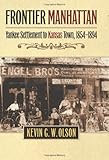
Kevin G. W. Olson. Frontier Manhattan: Yankee Settlement to Kansas Town, 1854-1894. Lawrence: University Press of Kansas, 2012. x + 273 pp. $29.95 (cloth), ISBN 978-0-7006-1832-3.
Reviewed by Silas Chamberlin
Published on H-SHGAPE (January, 2013)
Commissioned by Julia Irwin (University of South Florida)
The Rise and Fall of Yankee Radicalism in Kansas's "Little Apple"
“Frequency illusion” is a term used to describe the perception that a word or name that has recently come to one’s attention suddenly appears “everywhere” with improbable frequency. Since reading Kevin G. W. Olson’s Frontier Manhattan, I have experienced this so-called illusion on several occasions. References to Manhattan, Kansas, of which--I have to admit--I previously knew very little, seem to pop up in television news reports, books, magazines, college football coverage, and random conversations. Thanks to Olson’s recounting of Manhattan’s formative years, the period during which the fervently abolitionist town of tents, dugouts, and primitive cabins evolved into a thriving, if subdued, college town, I have a better appreciation of why the town is known to so many people.
In 1855, a small group of Yankee settlers from the New England Emigrant Aid Company founded Manhattan, on a remote section of prairie at the confluence of the Big Blue and Kansas rivers, as an antislavery stronghold in Kansas Territory. Although the book’s coverage ends in 1894, Olson devotes twelve of the fifteen chapters to describing the town’s development in the context of antebellum “Bloody Kansas” tensions and the Civil War. During this period, the settlers sought to recreate a traditional New England town in terms of layout, architecture, institutions, and an enlightened ideological outlook on the equality of African Americans. Although the establishment of Protestant churches and businesses were an important part of the community-building process, Olson suggests that the town’s higher education facilities played an even more prominent role. Kansas’s Territorial Legislature designated Blue Mont Central College on the outskirts of Manhattan in 1858--a remarkable development given that many of the town’s residents were still struggling to find shelter and steady food during this period. In 1863, the recently passed Morrill Land Grant Act allowed the new state government to reorganize Blue Mont as Kansas State University (KSU), the first public university in the state. KSU was exceptional in that it was the second coeducational university in the nation and allowed African Americans to enroll. The presence of the college helped establish the nascent town’s prominence in the region and institutionalized the original settlers’ radical egalitarianism.
Despite the progressive origins of the town, Olson’s most interesting observation is how drastically Manhattan’s political culture changed between its founding and 1894. Drawing from correspondence, diaries, and other rich primary materials, Olson convincingly argues that Manhattan’s first settlers were fervent antislavery activists who risked their lives and endured harsh environmental and social conditions to establish the antislavery town. Between 1865 and 1880, the town’s black population grew from 9 to 315 as the town’s leading figures, churches, and schools sought to create a welcoming climate for African Americans. Although most African Americans congregated on cheap, undeveloped land on the south side of town, Manhattan’s public institutions, including the secondary school and college, were integrated and most whites acted benevolently--if sometimes condescendingly--toward the town’s black population.
This began to change in the 1880s as the end of Reconstruction led to acceleration in black settlement and the town’s progressive ethos waned. Yankee influence over the town had diminished throughout the 1860s and 1870s, with railroad and bridge connections and a flurry of new construction for industry, businesses, and homes attracting newcomers from regions much closer than New England. As a result, the abolitionist and suffragist influences in the town--so strong just a decade prior--gave way to growing insularity and racial tension. Segregation crept into the town, first in the educational institutions as classes and eventually entire schools were designated for black students, and then in public spaces throughout town. As Olson notes, the clearest testament to growing racial restrictions was the decline in black settlement in the years following 1885, from 357 people representing 13 percent of the population to, in 1940, 270 people representing only 2 percent of the population. This lasting legacy of black underrepresentation continued into the twenty-first century, with African Americans composing only 5.5 percent of Manhattan’s 2010 population. In short, despite the outward appearance of a New England town, the progressive, Yankee influence over Manhattan gave way to an increasingly conservative and restrictive culture by 1894, which limited the original vision of the town’s settlers.
If this attractive and well-written book has a weakness, it is that Olson appears to be unsure of his audience, and as a result, Frontier Manhattan teeters between a conventional local history aimed at residents of the region and a monograph that speaks to a broader audience. Olson gives significant attention to individual settlers, describes the fate of prominent buildings and artifacts of the period, and provides explanations of such seemingly obvious concepts as the political inclinations of nineteenth-century Republicans and Democrats--of course, juxtaposed in the twenty-first century. This approach sometimes obscures the relevance of Manhattan’s history to contemporaneous developments in other parts the country and leaves a number of potentially important questions unanswered. Were the experiences of Manhattan’s founders typical of the New England abolitionists’ settlement movement, or is Manhattan’s history unique? In what ways did Manhattanites’ bold stand against proslavery elements enter the national slavery debate or influence antebellum political discourse? Did the town’s progressive and comparatively welcoming attitude toward blacks inspire other communities, and did they also experience a transition to political moderation and segregation later in the century? Olson spends little time addressing these issues, and despite bringing to light numerous colorful characters and fascinating anecdotes, the reader is left wondering about the broader implications of Manhattan’s founding. Despite this complaint, historians and general readers interested in the history of nineteenth-century Kansas, abolitionism, community building, and social history will find Frontier Manhattan thoroughly researched and engagingly written.
If there is additional discussion of this review, you may access it through the network, at: https://networks.h-net.org/h-shgape.
Citation:
Silas Chamberlin. Review of Olson, Kevin G. W., Frontier Manhattan: Yankee Settlement to Kansas Town, 1854-1894.
H-SHGAPE, H-Net Reviews.
January, 2013.
URL: http://www.h-net.org/reviews/showrev.php?id=37008
 | This work is licensed under a Creative Commons Attribution-Noncommercial-No Derivative Works 3.0 United States License. |

