



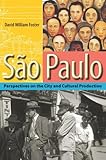
David William Foster. São Paulo: Perspectives on the City and Cultural Production. Gainesville: University Press of Florida, 2011. Illustrations. 176 pp. $69.95 (cloth), ISBN 978-0-8130-3665-6.
Reviewed by Michael Colvin (Marymount Manhattan College)
Published on H-Urban (May, 2013)
Commissioned by Alexander Vari (Marywood University)
Navigating the Fragments of São Paulo
David William Foster’s São Paulo: Perspectives on the City and Cultural Production is a series of essays that “capture[s] some of the most characteristic cultural products that index” that city (p. 5). Because of personal choice, the author includes works that have been less studied in relation to São Paulo’s imaginary, and as a result, his book tells the story of São Paulo’s evolution in the twentieth century from coffee plantations to megacity through its construction by poets, novelists, photographers, essayists, film directors, multimedia anthropologists, and graphic novelists. His study concerns architecture, music, urban development, immigration, and industry. And it includes various perspectives in the making of the city’s cultural identity: feminist, queer, Jewish, Brazilian, European, immigrant, paulistano, and resident.
São Paulo is divided into ten chapters; an introduction and conclusion; and notes, works cited, and an index with an eclectic list of names from the last century, in and out of Brazil. It also contains seventeen illustrations as diverse as the book’s scope. In fact, I almost lost track of the book’s proposed scope to “focus on the city of São Paulo in the triple dynamic of cultural production: the critical representation of society, the analytical interpretation of the internal dynamic, and the principled imagination of alternative ways of living” (p. 5). It is not that the book does not deliver on what it promises; in fact, it does and how! Rather, in some chapters, the dryer, theoretical elements of literary and cultural studies fade into the background--as scaffolding should--and it is the more human and, for that matter, more compelling story of one of the twentieth century’s controversial byproducts, the megacity, that is most memorable about Foster’s book.
Foster’s narration ambles gracefully through a cultural dialogue between biography, history, oral history, creative expression, and urban development. It is at those moments that his book is perhaps most captivating to a general audience. In chapter 2, “The Feminization of Social Space in Patrícia Galvão’s Parque Industrial” (published in English as Industrial Park [1993]), and its appendix, chapter 3, “Patrícia Galvão: The Private Autobiography of a Brazilian Feminist Writer,” the author analyzes Galvão’s writing of space with sensitivity toward her alienation from those very spaces she was writing. Likewise, Foster’s three chapters on photography (4, 5, and 7) present biographical profiles of Swiss-born iconic urban photographer, Hildegard Rosenthal; French anthropologist/ethnologist, Claude Lévi-Strauss; and urban portrait photographer and Jewish-European refugee, Madalena Schwartz, in a study of their images within the very context of their milieu. Chapters 8 and 9 are fascinating because they deal with narration and alternative ways of understanding community and alienation in a megacity. Foster’s examination of Oscar Niemeyer’s iconic Copan Building as a microcosmos of “the indignities of urban life in São Paulo,” in Regina Rheda’s Arca sem Noé (published in English as First Class Third World and Other Tales of the Global Mix [2005]), comes to life through a historical analysis of the world’s largest apartment building’s failure to maintain or even attain the very modernization it was supposed to represent (p. 117). And in Foster’s study of Eduardo Emiliano Fenianos’s Expedições Urbenauta: São Paulo, uma aventura radical (2007), he explains that unlike what the tourist might expect, “most people do not experience the megalopolis as a whole”; rather, they “merely live in little more than fragments of the city” (pp. 122-123). And somehow, through the conversant nature of Foster’s narration in these chapters, these fragments--be they perspectives, neighborhoods, or representations of a cultural history--help the reader, like the “naïve tourist,” construct a São Paulo that is a little less daunting to navigate (p. 123).
In contrast, chapter 1, on Mário de Andrade’s Pauliceia desvairada (published in English as Hallucinated City [1968]), and chapter 10, on the graphic fiction of Fábio Moon and Gabriel Bá, seem a bit too hemmed in by the limits of literary analysis in comparison to the more interdisciplinary and more historically grounded essays in this collection. Chapter 7, “Films by Day and Films by Night in São Paulo,” is a collection of four brief analyses of films from the 1960s, 1980s, and 2000s. This particular essay presents perspectives on film production in São Paulo, however its analysis of those very products is not as developed in relation to the cultural development of the city as in the chapters on narrative and photography. Nevertheless, these chapters, on their own, are interesting as essays on the representation of São Paulo in different genres, and, as part of this book, they do present part of the fragmented experience of the megalopolis.
Foster explains in his conclusion, that “two threads ... dominate the chapters that make up this book”: gender and a “culture that promotes proletariat interests” (pp. 151-152). And the cultural products that he studies may follow one thread or the other; at times they intertwine. However, within these threads, we find a São Paulo that crosses social, racial, geographical, and ideological circuits and reveals the dynamic nature of the megalopolis. By focusing his study on these perspectives, Foster may have given us a more comprehensive overview of São Paulo than “the initial sampler” that he had intended his book to be (p. 153).
If there is additional discussion of this review, you may access it through the network, at: https://networks.h-net.org/h-urban.
Citation:
Michael Colvin. Review of Foster, David William, São Paulo: Perspectives on the City and Cultural Production.
H-Urban, H-Net Reviews.
May, 2013.
URL: http://www.h-net.org/reviews/showrev.php?id=36919
 | This work is licensed under a Creative Commons Attribution-Noncommercial-No Derivative Works 3.0 United States License. |

