



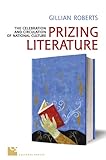
Gillian Roberts. Prizing Literature: The Celebration and Circulation of National Culture. Toronto: University of Toronto Press, 2011. x + 261 pp. $45.00 (cloth), ISBN 978-1-4426-4271-3.
Reviewed by Andre Narbonne (Independent Scholar)
Published on H-Canada (July, 2013)
Commissioned by Jane Nicholas (University of Waterloo/St. Jerome's)
Transnational Values in the Prizing of Canadian Literature
Gillian Roberts’s Prizing Literature: The Celebration and Circulation of National Culture examines the role of literary prizes in the perception of Canadian authors and in evaluations of their contributions to Canadian cultural capital. The book is six chapters in length, of which the first frames the terms and the scope of Roberts’s analysis. In it, she positions national and international literary prizes in terms of the roles they play in hospitality. The next four chapters are dedicated to each of the study’s authors, whose canonical texts (paradoxically or not) eschew nationalistic narratives. In the last chapter, “Conclusion, or Discrepant Invitations,” Roberts opens with a reading of Yann Martel’s What Is Stephen Harper Reading? (2009) before entering into a discussion about the uneasy fit of Aboriginal literature in Canadian cultural identity.
Roberts, a lecturer in the School of American and Canadian Studies at the University of Nottingham, has published articles on transnationalism, hospitality, culture, and the Canada-U.S. border. In Prizing Literature, she focuses on four authors with hyphenated nationalities, who have won both national and international literary prizes: Michael Ondaatje, Carol Shields, Rohinton Mistry, and Yann Martel. Ondaatje was born in India and immigrated to Canada when he was nineteen, Shields emigrated from the United States at twenty-two, and Mistry emigrated from India at twenty-three. Although Martel’s parents are French-Canadian, his roots are the most cosmopolitan of the four. He was born in Spain and lived in Costa Rica, France, Mexico, and Canada. Roberts notes that “all four have had their national identities translated for them in both the Canadian and extranational press as a result of their celebration within and outside Canada. All four have attracted high-profile, international celebration that has been recruited for national interests, for the symbolic capital accrued through the winning of or nomination for ‘prestigious,’ particularly international, prizes ultimately confers cultural value on the nation itself” (p. 226).
Central to Roberts’s analysis is the concept of “hospitality.” In her introduction, she reads theories on hospitality written by Jacques Derrida, especially, and Immanuel Kant, as well as cultural theories written by Homi Bhabha and Walter D. Mignolo to differentiate between the roles of host cultures and their guests and to define the connection between hospitality and healing. Roberts argues that literary prizes are paratexts that significantly influence the way prize-winning novels are understood as cultural markers. Winning an international prize transforms writers into hosts, their nationality paradoxically configured for them by a symbol of extranational success. Roberts’s concern is with the national habitus, which she explains “rests on what we might consider national capital, rather than economic, cultural, and academic capitals, that are integral to a class capital: a national habitus uses the nation as its currency, emphasizing the value of national cultural products precisely because of their nationality, and attempting to forge a national taste--a taste for the nation and its culture, whether considered ‘cosmopolitan’ in aesthetic terms or not” (p. 14).
Chapter 1 opens with a description of the world literary marketplace in the early 1990s and a brief narration of the success of Canadian writing during that decade starting with Ondaatje’s 1992 Booker Prize win for The English Patient. In terms of international recognition, 1992 was a watershed year for Canadian literature. Before Ondaatje’s win, the Canadianness of an author was seen as a liability to book sales. Roberts observes the sea change that followed, noting that “Ondaatje’s Booker Prize shifted the momentum of Canadian literature’s place in the global cultural marketplace” (p. 16). Three years later, when Shields won the Pulitzer Prize for The Stone Diaries, Canadian literature was more exportable than it had been at any other time. Roberts follows with a discussion of the role of literary prizes in constructions of value and of literary reputation that rests on six prizes: three national (the Governor General’s Award for English-Language Fiction, the [Scotiabank] Giller Prize, and Canada Reads) and three international (the [Man] Booker Prize, the Commonwealth Writers’ Prize, and the Pulitzer Prize). National prizes contribute to the cultural boundaries of a nation, selecting works that Canadians can share and that are representative of Canadian culture, but all prizes breed controversy: the Governor General’s Award and the Giller Prize represent different elites and have been accused of catering to the tastes of a minority, while the Canada Reads Prize is populist and viewed as unsophisticated. Of the international prizes, the Booker is slammed for being Anglocentric, focused on publishing in London in particular; the Commonwealth Prize on representing a colonial past; and the Pulitzer Prize on fostering bad taste and conformity, having been originally designed to award literary “wholesomeness.” If the Booker and Commonwealth prizes suggest a colonial mind-set in Canadians who see their British committees as authorities on the value of Canadian books, the Pulitzer Prize suggests a neocolonial mentality in Canada with the United States as the cultural colonizing power.
In chapter 2, Roberts narrows her focus to three Ondaatje novels, which she sees as concerned with the structures and constraints of citizenship: In the Skin of a Lion (1987), The English Patient (1992), and Anil’s Ghost (2000). For Roberts, these three novels “focus on issues of citizenship, habitation and nation, and cosmopolitanism” (p. 54). Her analysis includes close readings of the texts matched with critical discussions based on arguments presented and defined in chapter 1. This strategy is repeated in the next three chapters. In the Skin of a Lion focuses, in part, on immigrant populations in Toronto and “probes the distinction between citizenship and national belonging” (p. 61). The English Patient was translated in 1996 into a very successful Hollywood movie that partially removes the Canadianness while homogenizing the politics of the novel. To do this, the main characters in the novel, one of whom is Canadian, are made secondary in the film. Nevertheless, the movie was regarded by many as a triumph for Canada, and was endorsed by Ondaatje. Anil’s Ghost won both the Governor General’s Award and the Giller Prize, something that had never been done before.
Chapter 3 looks at Shields’s novels, Swann (1987), The Stone Diaries (1993), and Larry’s Party (1997), all of which “examine the Canada-U.S. border as a site of negotiating identity and the relationship between nation and habitation” (p. 97). Shields won the Pulitzer Prize for The Stone Diaries, which also won the Governor General’s Award and was shortlisted for the Booker Prize. Before the publication of Swann, she was seen as a middle-brow author. After winning the Pulitzer Prize, she was claimed as an author by both American and Canadian readers. Roberts notes that all of Shields’s writing took place in Canada with assistance of Canada Council grants and that for Canadians her identity was separate from her birth.
Chapter 4 discusses Mistry, a writer who is well positioned to describe the limits of multiculturalism. His narratives largely take place in the confines of Bombay’s Parsi community, and Mistry’s Parsi status means that he has himself belonged to a minority in two countries. As Roberts explains, “Mistry’s work also concerns itself with questions of home on an intimate scale that invoke the micro-politics and economics of hospitality while suggesting an interconnection between private units and the nation” (p. 139). Such a Long Journey (1991) was nominated for the Booker Prize, won the Governor General’s Award, and won the overall Commonwealth Writers’ Prize. A Fine Balance (1995) was nominated for the Booker Prize, won the Giller Prize, and won the overall Commonwealth Writers’ Prize. Family Matters (2002) was Mistry’s third novel to be nominated for the Booker Prize. The upshot of Mistry’s success is that he has been seen by some Canadian critics as a national parasite rather than a host because he does not write about Canadian subjects. When he does depict Canada in Tales from Firozsha Baag (1987) and Family Matters his stories and characterizations speak to the inability of Canadian multicultural policy to allow immigrants to attain the status of hosts.
Chapter 5 is about Martel, a writer of Québécois lineage, who speaks French with a Parisian accent and writes Anglophone novels. In 2002, his Life of Pi was one of three Canadian novels in contention for the Booker Prize, and his win over Shields’s Unless (2002) and Mistry’s Family Matters elevated his status as a national writer despite a cosmopolitan upbringing that belied his Canadianness. According to Roberts, “Martel’s international upbringing has prompted a misrecognition of his nationality, one which was heatedly debated following his Man Booker Prize Win. Martel’s own recruitment into the debate functioned not only to reassure Canada of his Candianness but also fed into the celebration of Canada as a hospitable space, a celebration not entirely upheld in Martel’s own representations of his country” (p. 182). Roberts reads three of Martel’s books, a collection of short stories, The Facts behind the Helsinki Roccamatios (1993), and two novels, Self (1996) and Life of Pi (2001), through ideas of dislocation. Martel, in his stories, takes the negotiation of multiculturalism beyond the management of the state to include the individual as a private actor. Multiculturalism requires an imaginative process to bridge “the disjunction between official policy and lived reality,” between the discordant global, national, and individual identities of Martel’s characters (p. 188).
In her “Conclusion, or Discrepant Invitations,” Roberts looks at the role of Aboriginal writing in Canadian literary nationalism. She begins by returning to Martel, examining What Is Stephen Harper Reading?--a work of nonfiction that attempts to foster an appreciation for Canadian literature in the conservative prime minister of Canada, who has disparaged and presided over significant cuts to arts funding. The book is composed of a series of letters, which Martel addresses to Harper “From a Canadian Writer.” One of the books that Martel suggests Harper reads is The Rez Sisters (1988), a play by Aboriginal author Tomson Highway. Roberts moves fluidly from the choice of Highway as a representative Canadian author into a discussion of the Canadian government’s role as host to Canadian artists and of the position of Aboriginal literature in assessments of Canadian writing. She notes that “notions of hospitality and celebrated Canadian culture necessarily operate differently--indeed awkwardly, at best--in relation to Canada’s Aboriginal peoples, usurped hosts in a settler-invader ‘postcolonial’ nation-state that has yet to decolonize” (p. 223). Thomas King, an award-winning Aboriginal writer who ran for the New Democratic Party in the 2008 federal election, sees the 49th parallel that marks the Prairie Provinces’ Canada-U.S. border as an imaginary line that does not exist in his own imagination. The chapter questions how authors can contribute to a narrative of nation that either partially excludes them or with which they disagree.
Throughout Prizing Literature Roberts’s style is accessible. Her writing brings cultural theories written by Bhabha, Derrida, Michel Foucault, and others into a lucid, insightful argument that is especially timely as Canadian demographics rapidly change and the national cultural model with them. Studies on literary nationalism in the age of globalization are by no means new. Kit Dobson’s Transnational Canadas: Anglo-Canadian Literature and Globalization (2009), which Roberts cites four times, includes a chapter on In the Skin of a Lion and another entitled “Mainstreaming Multiculturalism? The Giller Prize,” both of which echo in Roberts’s work. What Roberts offers new to the discussion is not just her own well-researched facts, but also a critical paradigm through which to read those facts. The intersection of hospitality and literature is especially useful. Hospitality is itself a borderless concept even if the ways in which hospitality is conducted take on different codes across different regions. At a time when schools of Canadian critics are deconstructing the notion of a national literature, when terms like “cosmopolitanism,” “globalism,” and “transnationalism” have decentered the old constructions of Canadianness, Prizing Literature offers fresh and valuable insights.
If there is additional discussion of this review, you may access it through the network, at: https://networks.h-net.org/h-canada.
Citation:
Andre Narbonne. Review of Roberts, Gillian, Prizing Literature: The Celebration and Circulation of National Culture.
H-Canada, H-Net Reviews.
July, 2013.
URL: http://www.h-net.org/reviews/showrev.php?id=36782
 | This work is licensed under a Creative Commons Attribution-Noncommercial-No Derivative Works 3.0 United States License. |

