



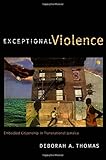
Deborah A. Thomas. Exceptional Violence: Embodied Citizenship in Transnational Jamaica. Durham: Duke University Press, 2011. xiii + 298 pp. $84.95 (cloth), ISBN 978-0-8223-5068-2; $23.95 (paper), ISBN 978-0-8223-5086-6.
Reviewed by Anne Rush (University of Maryland)
Published on H-Empire (August, 2012)
Commissioned by Charles V. Reed (Elizabeth City State University)
Exploring Citizenship, Understanding Violence
As at least one prominent publisher has recently proclaimed, we are at a crucial moment for globalizing the study of citizenship as a field.[1] In her new monograph, Exceptional Violence. Embodied Citizenship in Transnational Jamaica, anthropologist Deborah A. Thomas presents a fascinating case for the importance of this project. Strongly endorsing the recent push by academics of all stripes to embrace the transnational, she insists that to truly understand the nature of citizenship today--and its relationship to current societal problems, such as violence--we must go beyond superficial assumptions about culture to look squarely at the impact of economic, political, and social structures of both past and present. In doing so, she argues, we can generate a “sustained conversation about history” that leads us beyond our reliance on flawed ideologies to a future envisioned “on new terms” (p. 238). Over the course of five chapters, Thomas embraces a variety of methodological approaches, including sociological and historical analysis, anthropological tools, and literary criticism, to explore how citizenship and violence have been understood--or, as she aptly puts it, embodied--by Jamaicans since the end of the colonial era. She uses numerous sources, including newspaper articles, government reports, oral history, music, film, and fiction, to investigate widely varying topics, from the eruption of gang warfare in the small Jamaican community of Jacks Hill and a public debate over nudity in the statue Redemption Song, to the official cultural policy of the Jamaican state and the Rastafarian experience. As she moves from the local to the national and international, from the present to the past, and back again, she suggests the importance of attention to both the local case study and the transnational nature of Jamaican society in highlighting links between colonial approaches to rule and postcolonial ideas about citizenship and the nation.
Underpinning Thomas’s work is the contention that the Western idea of citizenship, and indeed, the modern nation-state itself, while grounded in a rhetoric of equality and human rights, was (and is) instituted and maintained through policies of subjugation and violence. While scholars have been exploring the violence of imperial rule for decades, the full significance of the relationship between Western democratic societies and the many structures created under what was for so many an oppressive mode of governing has only recently begun to gain serious attention in scholarly circles. Historians interested in racial slavery in the early modern era have paid particular attention to this issue, tracing the substantive links between ideas about political participation, money and the market, race, class and gender distinctions, and sexuality that developed in the early Atlantic world.[2]
What Thomas brings to the table is her insistence that we must investigate these issues in the context not only of the colonial world but also of the postcolonial state. She argues that, while the end of imperial control was cause for celebration, we need to understand that the peoples who resisted colonial rule shared basic beliefs about the nature of the nation and citizenship with those who had maintained imperial power. Political, social, and economic structures (including modes of control) established during colonial times thus often remained unchallenged in the new nation-states. Nationalist leaders triumphantly appropriated the “the master’s tools” as they took charge in the mid-twentieth century, only to find that these tools were designed to be wielded in ways that perpetuated the very problems independence was expected to solve.
In Thomas’s view, attention to these structural links between colonialism and the postcolonial state opens up a new avenue for understanding the reasons for the extreme violence that has plagued postcolonial Jamaica. At several points (especially chapters 1 and 3) she provides examples of the similarities between the spectacular cruelty, torture, and executions suffered by black men and women of Jamaica’s plantation past and the methods used by those involved in (and responding to) gang warfare and other instances of unrest since the mid-twentieth century. As Thomas explains, both officials and scholars have, more often than not, ignored these similarities, in part because they have not paid attention to the ready availability in Jamaican society--through myth, oral traditions, and material objects--of models of the violent means through which both the imperial state and plantation owners controlled Jamaicans in the colonial era. In Thomas’s view this neglect is a grave mistake, for not only did the extreme violence inherent in the British colonial system reappear in independent Jamaica, it has, in her view, become an organizing principle of the Jamaican state.
Thomas argues that this truth has been obscured, not only by our failure to recognize that a political shift to independence could eradicate neither deeply embedded colonial structures, nor the fetishism of the nation-state that came with them, but also by the tendency of scholars since the mid-twentieth century, in the United States as well as the Caribbean, to rely on what she calls “culturalist” explanations of poverty and violence. In chapter 2 she postulates that the widely accepted--yet remarkably simplistic--assumption that black people created a “culture of poverty” that led directly to a “culture of violence” ignores the details of Jamaica’s colonial past. For example, in her view, when state officials and academics argue that current violence stems from a shift away from a traditional nuclear family, they are working from misconceptions that stem from both their acceptance of colonial era values and a lack of historical knowledge. She suggests that careful research would reveal that the paternalistic nuclear family is neither key to a stable national body nor normal in the Caribbean. Instead, she suggests that structural elements that actually existed and worked quite well--such as the matrilineal family--were disrupted and changed in Jamaica during the mid-twentieth century by migration as well as by political tribalism.
While Thomas warns against accepting simplistic “culturalist” explanations, she does not advocate neglecting the impact of culture itself. In chapter 4 she explores the emerging nature of Jamaican citizenship that, she argues, rests not on territorial borders, but on a long-established relationship between sovereignty, gender, and sexuality. To demonstrate the nature of this relationship she analyzes a 2003 public debate over the appropriateness of commemorating Emancipation Day by erecting a statue depicting a nude man and woman. It will come as no surprise to readers familiar with Caribbean society that Thomas traces within this debate differences in perspective between Jamaican elites and the working class. Yet, as she points out, it also illustrates the views they share, including notions about homosexuality and masculinity that stem from the “gendered dynamics during slavery” that informed the anticolonial struggle (p. 166). And while they might not always agree on the specific parameters within which Jamaicanness should be confined, people of all classes agree that “policing ... sexuality” and using “a notion of respect” are appropriate ways to define authentic Jamaicanness--shared values that not only stem from the colonial past, but feed off the needs of a developing diasporic present, both of which, as Thomas suggests, deserve fuller attention (p. 127).
Over and over, Thomas dips into the structures of Jamaican life to challenge essentialist assumptions with historicized accounts of events both past and present. This approach is laudable, but her enquiring mind dances down so many different paths that it is sometimes difficult to keep up. Thomas’s writing is dense, and she has a tendency to over-explain--at times the reader wishes that instead of putting her thoughts “in other words” she simply used fewer words. Given the plethora of ideas she presents, some organizational adjustments might also have been helpful. For example I would have recommended giving her analysis of popular fiction and film in chapter 4 its own chapter, and introducing the succinct list of questions with which she opens her chapter 5--questions that seem to me an excellent distillation of her major concerns throughout the book--in her introduction (p. 174).
Following Thomas’s combination of rigorous historical analysis with theoretical models designed to explain how behaviors can fold back in on themselves in patterns that defy a linear idea of time can be challenging. However, it is worth the effort, for the determined reader is well rewarded with the insights she gains through this approach. This is particularly true in chapter 5, which begins with a fascinating case study of the circumstances surrounding the appalling treatment of Rastafarians both before and since the infamous Coral Gardens incident of the 1960s. Within her richly historicized account of these events Thomas also looks to the present, suggesting (here and in the coda) that the framework of reparations might usefully be used to heighten awareness about how discrimination maintained through narrow ideas of citizenship continues to reflect and influence societal and economic structures--and to provoke spectacular violence. Her hope is that such attention will motivate state officials as well as private concerns and individuals to work to change the structures, as some members of the Rastafarian community are already trying to do.
At the opening of her book Thomas explained that she did not originally set out to write about violence, for its prominence in present-day Jamaican society seemed to have rendered it cliché as a subject for academic study. Yet, as her work in Exceptional Violence makes abundantly clear, the cliché is not the violence itself but the simplistic ways violence--and citizenship--have thus far been addressed in Jamaica and elsewhere. In her sophisticated and heartfelt analysis, Thomas issues a warning about what can happen if we refuse to look squarely at the influence of the dark places of our past on our present, and presents a framework for moving forward once we finally begin to do so.
Notes
[1]. See the 2012 call for papers for the forthcoming Routledge Handbook of Global Citizenship Studies.
[2]. Good examples include papers presented by Molly Farrell, “How People Became Populations: Richard Ligon on Barbados”; and Jennifer Morgan, “Quotidian Erasures: Gender, Numeracy, and Race in the Development of the Transatlantic Slave Trade” at the recent conference The “Political Arithmetick” of Empires in the Early Modern Atlantic World, University of Maryland, College Park, March 16-18, 2012.
If there is additional discussion of this review, you may access it through the network, at: https://networks.h-net.org/h-empire.
Citation:
Anne Rush. Review of Thomas, Deborah A., Exceptional Violence: Embodied Citizenship in Transnational Jamaica.
H-Empire, H-Net Reviews.
August, 2012.
URL: http://www.h-net.org/reviews/showrev.php?id=36736
 | This work is licensed under a Creative Commons Attribution-Noncommercial-No Derivative Works 3.0 United States License. |

