



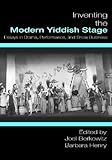
Joel Berkowitz, Barbara Henry, eds. Inventing the Modern Yiddish Stage: Essays in Drama, Performance, and Show Business. Detroit: Wayne State University Press, 2012. Illustrations. 416 pp. $39.95 (paper), ISBN 978-0-8143-3504-8.
Reviewed by Stuart Hecht (Boston College)
Published on H-Judaic (June, 2013)
Commissioned by Jason Kalman (Hebrew Union College - Jewish Institute of Religion)
Our Yiddish Theatre, Ourselves
Coeditors Joel Berkowitz and Barbara Henry have assembled a diverse collection of essays and shaped them into a broad, revealing, and invaluable volume. Inventing the Modern Yiddish Stage is a rich account of Yiddish theatre history and practice, from its earliest days to the present. Their collection zigzags across nations and centuries, from shund to high art, from the commercial to the avant-garde. It includes tales of scandals and rivalries, of poets and vagabonds, of self-expression and opposing oppression, ever celebrating the vitality and drive of a people passionately taken with the stage.
Scholars have written eloquently about the Yiddish theatre, perhaps most notably Nahma Sandrow with her book, Vagabond Stars: A World History of Yiddish Theater (1995). There are also valuable collections of Yiddish plays translated into English, such as Ellen Shiff’s Awake and Singing: Six Great American Jewish Plays (2004). In more recent years, a younger generation of theatre scholars has begun to consider the Yiddish theatre form from a different perspective, one not so bent on preservation as on analysis; Inventing the Modern Yiddish Stage is just such a book. Furthermore, in addition to its editors, this book introduces the work of a number of scholars tilling comparable topical soil. Part of the reason for the long-standing dearth of scholarship is because such study often requires a working knowledge of Yiddish language and culture, as well as any number of other languages, given the Diaspora: Russian, Polish, German, Hebrew, and/or Spanish, in addition to English. That scholars are now able to report on a theatrical form whose heyday was almost a century ago indicates renewed interest and study in the Yiddish language by this new generation of researchers.
The book is composed of thirteen essays, divided into four sections (plus an excellent introductory overview). The first part, “Origins, Influences, and Evolution,” includes three essays that consider the roots and nature of early Yiddish theatre as found in Russia; the second part, “Toward a Jewish Stage,” centers on translations of Uriel Acosta and two studies of Yiddish theatres in Warsaw; the third, “Authors, Actors, and Audience,” takes a sociological turn, recounting the culture of audiences and the business of doing Yiddish theatre, both in New York City and in Argentina; the fourth and final part, “Recoveries and Reconstructions,” looks at the interaction between the Yiddish stage and often contradictory other social and political agendas embraced by Jews, ranging from Communism to Zionism. In all, this represents a montage of the Jewish/Yiddish theatre experience, which aims not to be comprehensive but rather far reaching and, achieving this, revelatory in its counterbalance of scope and detail. In addition, the book includes well-chosen photographs, important and useful notes on transliteration, and a comprehensive bibliography.
Most accounts of the Yiddish stage tend to be puff pieces, awe-filled tributes to stars such as Jacob Adler, Boris and Bessie Thomashevsky, or Maurice Schwartz as cultural darlings. Such memoirs are filled with backstage gossip on the one hand, and ringing descriptions of theatrical triumphs on the other. They are melodramatic tales of adventure with our heroes being these larger-than-life tragedians and comics winning greasepaint glories. But such accounts usually overlook any substantive mention of the plays that they performed or any insight into the world of their adoring fans. Perhaps part of the reason for this, aside from publicity and self-promotion, is that Yiddish theatre icons generally represented escapism and, increasingly, the older generation’s nostalgia for the “old country” and traditional ways, especially to New York City’s impoverished immigrant, Jewish community.
This collection of essays opens up the subject of Yiddish theatre to reveal that it encapsulates so much more than that. It exposes us to the complexity and variety of theatrical, cultural, political, and historical forms that Yiddish theatre took, both in America and abroad. Rather than focus solely on the lives of famous performers, it also zeroes in on the everyday lives of those who attended to it: young men who peopled the balconies, vying violently with each other in the name of the particular actors they chose to serve and promote, and those same actors who encouraged them. Another essay traces the lifelong, vituperative feud between two scholars over whether to include in print a star actress’s questionable past, and hence how best to represent the Jewish people themselves. Still another chapter recounts how post-World War Two political agendas were explored and expressed through a seemingly innocuous Purimspiel. These are only a few of the many essays found here that collectively suggest a vast and diverse Yiddish theatre experience, both past and present.
What is ultimately learned in this excellent anthology is the vibrancy of 150 years of Jewish experience as expressed through its interactions with the Yiddish stage. What comes across here are not the usual dry recreations or forced theoretical theses. Rather this is a close-up view of what audiences--and the Jewish community at large--experienced, thought, and did in the name of the Yiddish stage. This thereby illustrates the surprising centrality of Yiddish theatre to their view of themselves. That they argued and fought, competed and strove, attests to the pivotal role Yiddish drama and theatre played in their lives. Though the Yiddish stage goes back less than two centuries, it is all the more remarkable that Jews the world over, from Warsaw to New York, from Argentina to Israel, found solace and pride and even definition in what happened on that stage.
The Yiddish theatre has largely faded thanks to a language now long discarded, along with the worldview it most often embodied. So we should give an extra hearty “bravo” to the authors whose work is assembled here, along with the more than able editors, who worked so hard to unearth and breathe fresh life into a topic too long neglected.
If there is additional discussion of this review, you may access it through the network, at: https://networks.h-net.org/h-judaic.
Citation:
Stuart Hecht. Review of Berkowitz, Joel; Henry, Barbara, eds., Inventing the Modern Yiddish Stage: Essays in Drama, Performance, and Show Business.
H-Judaic, H-Net Reviews.
June, 2013.
URL: http://www.h-net.org/reviews/showrev.php?id=36706
 | This work is licensed under a Creative Commons Attribution-Noncommercial-No Derivative Works 3.0 United States License. |

