

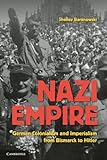
Shelley Baranowski. Nazi Empire: German Colonialism and Imperialism from Bismarck to Hitler. Cambridge: Cambridge University Press, 2010. 368 pp. $95.00 (cloth), ISBN 978-0-521-85739-0; $25.99 (paper), ISBN 978-0-521-67408-9.
Reviewed by Daniel Becker (University of Maine at Farmington)
Published on H-German (July, 2013)
Commissioned by Chad Ross
A Postcolonial Sonderweg?
"Ambitious" may be one of the best one-word epithets to characterize Nazi Empire. "Hybrid" is probably another. Shelley Baranowski seeks to provide a synthesis of recent research on German nationalism, colonialism, and imperialism; propose her own original, interpretive grand narrative of continuities and discontinuities in modern German history; and present this mix in the format of an undergraduate textbook.
On the first count, the breadth of Baranowski's reading is impressive. She draws on a broad array of research, in both English and German, published over the last two decades. She adeptly weaves threads from "new imperial histories" of Germany's overseas adventures and recent studies on nationalism, antisemitism, and political culture into a colorful tapestry of German mentalités before which she lets "the drama of German imperialist aspirations" unfold (p. 6). Unlike some other accounts of German imperialism, moreover, hers does not become too dangerously entangled in a self-referential, postcolonial universe and refreshingly approaches the subject from both fashionable "transnational" and seemingly more "traditional" national perspectives.[1] If nothing less, then, this synthesis of recent research should prove quite helpful--and not only to newcomers to the subject matter--even though it only offers little explicit historiographical discussion or relegates it largely to the footnotes when it does. (Unfortunately, the book also does not include a bibliography.)
Baranowski offers a rockier ride as she delves into the treacherous waters of the continuities question. Following a current inspired by Hannah Arendt's observations (in The Origins of Totalitarianism, 1951) on the emergence of modern "race" discourses during the heyday of "high imperialism" and recently heralded in particular by Jürgen Zimmerer,[2] Baranowski suggests that the unusual trajectory of German imperialism--which not only oscillated between continental and overseas directions but also teetered between "the aspiration to imperialist expansion and the simultaneous fear of dissolution at the hands of its imperialist rivals"--can explain why Nazism, the Second World War, and the Holocaust were unleashed by Germany and not by other imperialist powers (p. 4). "Comparative studies that explore the links between empire, colonialism, and genocide," she writes, "are offering new ways to historicize the Nazi regime's obsession with the biological endangerment of the German Volk and its mutually reinforcing remedies, the acquisition of 'living space' (Lebensraum) at the expense of the Slavs and the extermination of the Jews" (p. 3). Although she does not dare to speak its name, she seems intent on replacing the old Sonderweg argument with a new one, perhaps in an attempt to rebut Hans-Ulrich Wehler's question "why a phenomenon as secondary in actual history as the short-lived German colonial history can attract so much interest."[3]
And this is where Baranowski's troubles begin. For one, she does not in fact offer a comparative study. While she draws some interesting parallels between Germany's experience of becoming itself a "colony" after World War I and finding its "national liberation movement" in the Nazi Party on the one hand, and the American South under Reconstruction and the subsequent emergence of the Jim Crow social system on the other, she does not push this promising comparison beyond some anecdotal glosses. In other words, she does not muster a concerted effort to establish what distinguished Germany's extraordinary imperialism, which supposedly bred Nazism, from the ordinary imperialism of other European powers or the United States, which did not--but nevertheless shared some of the same obsessions that fueled the Nazi drive to the east: eugenics, fear of miscegenation, and even a kind of existential angst. Instead, one is sometimes left with what feels like a classic post hoc ergo procter hoc argument.
Furthermore, Baranowski struggles, like Zimmerer and others before her, with establishing clearly how racism and the philosophies of colonial administration in Africa before World War I (Qingdao and Germany's Pacific possession are barely mentioned) informed and laid the intellectual groundwork for the Nazis' genocidal quest for Lebensraum in eastern Europe several decades later. She points to certain similarities and parallels, but these often end up more coincidental than substantive under closer inspection: that Hermann Göring's father was the first governor of German Southwest Africa (present-day Namibia) does not a historical continuity make, despite the Nazis' obsession with hereditary health. One could argue, of course--and Baranowski hints at this--that German overseas colonialism was ultimately not much of an incubator of proto-Nazi ideas and that Hitler's "program" drew much more on the continental imperialist tradition. But that would require a more complicated, less tidy grand narrative in which German imperialism is not as uniform as Baranowski often portrays it. After all, German imperialism--or perhaps better, German imperialisms--contained fissures not only about where to expand but also by which means and to what purpose;[4] fissures which, moreover, were reflected in the strange phenomenon (which Baranowski acknowledges only in passing) that many of the staunchest advocates of overseas colonialism wanted little part in the violent Germanization of eastern Europe even when it was becoming abundantly clear that this was where the imperialist ship had sailed.[5] Baranowski seems quite aware of these interpretive and argumentative pitfalls, and this is reflected in her prose: she often dithers and opts for suggestions, not assertions--there are a surprising number of passages written in subjunctives and conditionals--and makes allusions, not connections. The grand narrative to explain whence Nazi imperialism came therefore remains somewhat murky.
One last point: if the purpose of a textbook is primarily to serve as a source of basic information on which to build further discussion and student research, Nazi Empire may be ill-suited to teaching undergraduates with little to no prior knowledge of German history. Structured chronologically and organized into a familiar sequence of chapters (the Bismarckian and Wilhelmine eras, World War I, the Weimar Republic, the "peace years" of the Third Reich, and two chapters on World War II and the Holocaust), it seems to provide a traditionally straightforward political history. Since it is interested in making a very specific (if somewhat muddled) point, however, it leaves out much context that one would like to have included in a textbook--whether for courses on modern German history more broadly or on the Third Reich or even on German imperialism more narrowly. While one learns quite a bit about the arcana of right-wing politics, for example, the Left receives but a cursory treatment. Other important topics--such as social policy and high and popular culture during Weimar's "crisis of classical modernity," or even consent, resistance, and Resistenz in the Nazi era--are barely touched upon. (As an aside, there are frequent and irritating misspellings and rather eccentric punctuation.)
All that leaves us with another one-word epithet: "ambivalent." Like other syntheses, Nazi Empire certainly has many strengths--and many weaknesses. It should not be read as the definitive summary statement of an interesting avenue of recent research, but as an important contribution to a debate that has lingered in the historiography on Germany at least since the period covered in the book. The Sonderweg may not be alive and kicking, but under a different name and in a different, "postcolonial" guise, it is not yet dead and buried either, despite Baranowski's (and others') claim to the contrary. For that reason, Nazi Empire is--perhaps because of its problems--a book that specialists in German and European history ought not to ignore.
Notes
[1]. In this sense, Baranowski's study mirrors Dirk van Laak's similarly conceived Über alles in der Welt: Deutscher Imperialismus im 19. und 20. Jahrhundert (Munich: C. H. Beck, 2005).
[2]. See the recent collection of Zimmerer's various essays on the subject, Von Windhuk nach Auschwitz? Beiträge zum Verhältnis von Kolonialismus und Holocaust (Berlin: Lit, 2011). See also the critiques by Robert Gerwarth and Stephan Malinowski, "Hannah Arendt's Ghosts: Reflections on the Disputable Path from Windhoek to Auschwitz," Central European History 42, no. 2 (2009): 279-300; and BirtheKundrus, "German Colonialism: Some Reflections on Reassessments, Specificities, and Constellations," German Colonialism: Race, the Holocaust, and Postwar Germany, ed. Volker Langbehn and Mohammad Salama (New York: Columbia University Press, 2011), 29-47.
[3]. Hans-Ulrich Wehler, "Transnationale Geschichte--der neue Königsweg historischer Forschung?," in Transnationale Geschichte: Themen, Tendenzen und Theorien, ed. Gunilla Budde, Sebastian Conrad, and Oliver Janz (Göttingen: Vandenhoeck & Ruprecht, 2006), 161-174.
[4]. See Woodruff D. Smith, The Ideological Origins of Nazi Imperialism (New York: Oxford University Press, 1986), which Baranowski cites somewhat selectively.
[5]. For example, see Klaus Hildebrand's old but important study--which Baranowski does not cite--Vom Reich zum Weltreich: Hitler, NSDAP und koloniale Frage 1919-1945 (Munich: Wilhelm Fink, 1969); and, more recently, Karsten Linne, Deutschland jenseits des Äquators? Die NS-Kolonialplanungen für Afrika (Berlin: Ch. Links, 2008).
If there is additional discussion of this review, you may access it through the network, at: https://networks.h-net.org/h-german.
Citation:
Daniel Becker. Review of Baranowski, Shelley, Nazi Empire: German Colonialism and Imperialism from Bismarck to Hitler.
H-German, H-Net Reviews.
July, 2013.
URL: http://www.h-net.org/reviews/showrev.php?id=36423
 | This work is licensed under a Creative Commons Attribution-Noncommercial-No Derivative Works 3.0 United States License. |

