



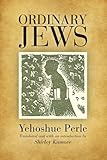
Iehoshua Perle. Ordinary Jews. Translated by Shirley Kumove. Albany: Excelsior Editions/State University of New York Press, 2011. xii + 344 pp. $29.95 (paper), ISBN 978-1-4384-3550-3.
Reviewed by Michael Berkowitz (University College London)
Published on H-German (May, 2013)
Commissioned by Chad Ross
Ordinary Jews is an odd book to review for a forum like H-German that typically considers scholarly monographs and anthologies. It is a new translation of a Yiddish Bildungsroman from interwar Poland, Yidn fun a gants yor (1935) by Yehoshue Perle (1888-1943), including a substantial introduction by Shirley Kumove. Although Perle is described as "[o]ne of Poland's most popular, prolific, and controversial Yiddish writers," he is mostly unknown, or a sketchy figure to modernists in Jewish studies. It is doubtful that German historians or even literary scholars are familiar with him. This volume should not, however, be received as simply a labor of love by a Yiddish enthusiast, or a memorial to a noteworthy victim of Auschwitz. Excelsior Editions of the State University of New York Press has performed a valuable service in publishing Ordinary Jews, and Kumove provides a fine introduction and notes that will be illuminating to students and scholars alike.
Kumove argues that compared to the work of Yiddish writers such as Chaim Grade and the Nobel Prize-winner Isaac Bashevis Singer, this book's distinctiveness derives partly from what it does not do: Perle does not dwell on the fierce politics of religious differences between Hasidim and their opponents (the Misnagdim), or quarrels over degrees of assimilation that often inform the fiction of Singer, Grade, and others. It mainly deals with daily life and the coming of age of a not-yet-teenage boy, Mendl Shonash, in a fictionalized Radom around 1900. The social location of its action is lower-class. While not the poorest of the poor, the Shonashes and many of their fellow Jews struggle to maintain a livelihood. The novel certainly is not vulgar, but there are situations and insinuations, many of which are central to the tale, which may be unsettling to those unfamiliar with Yiddish literature.
Even though Ordinary Jews is, relatively speaking, depoliticized and not mainly centered on religious divisions among Poland's Jews, scattered moments late in the novel confront politics and Jewish sectarianism, comprising excellent teaching moments. These surface mainly in Perle's characterization of his fellow students and teachers, such as Reb Menakhem the Bookkeeper, of whom it was said: "[H]e'd become a heretic from too much learning and that he'd also gotten interested in Zionism. Years earlier he'd become friendly with a Reb Yisroyel the Teacher who'd proposed the new school, and it was said that the only thing this school graduated was a generation of 'goyim,' that is to say, ignoramuses. Reb Menakhem and Reb Yisroyel talked about the sacred books all their lives. They carried on debates day and night and pulled at their beards while playing chess. But since Reb Yisroyel the Teacher's death, Reb Menakhem didn't bother getting to know anyone else, except for the Litvak teacher who drew on the shank of a tobacco pipe and kept asking: 'Is there a Master-of-the-Universe or isn't there a Master-of-the-Universe?' Was it any wonder that my friendship with Oyzeh, the youngest son of Reb Menakhem the Bookkeeper and Rayzeleh the Wine Dealer, made such a big impression on me?" (p. 309).
Instead of the religious/political battles as conducted by their heavyweights, we see how these play out from a child's perspective. Another important teacher of Mendl's was Rabbi Reb Duvid, who considered himself a Talmud scholar. At Slikhehs-time, he hustled himself to the pulpit and on Shabbes he read from the Torah scroll at the Zionist shul. It was said that this rabbi was a fierce Misnaged, an opponent of Hassidism, that he would have nothing to do with the Hasidic rebbes, and that he hated them: "He did have one virtue and because of it we forgave him, not only for his opposition to Hassidism but even for the cursed, round little strap. Nobody taught like Rabbi Reb Duvid did, ever. He taught with a melody but it wasn't a Misnaged one at all, and it also wasn't from someone who liked to flog either. He took the words apart like you peel the shell off a nut, and put the kernel into our mouths so that we'd feel the real taste" (pp. 291-292).
In emphasizing the coarse and daily-life aspects of the novel in the introduction, Kumove promises more than is delivered by Perle. It is not exactly racy or even consistently tart. But sexual appetites, adventures, and tragedies are indeed treated graphically, especially when compared to sanitized translations. Much of the novel is so mundane as to be not terribly interesting for those familiar with East European Jewish history. The writing is quite uneven, as one almost feels that Perle was being paid by the word, trying to squeeze out the greatest number of serial installments. But the plodding segments can be forgiven because some of the book is quite good. Readers must be wary, of course, that it remains a work of fiction, yet it can serve as excellent material for courses in Jewish history, literature, East European history, and modern European history generally. Ordinary Jews also is a means to engage an in-group perspective of the so-called Ostjuden, the thousands of Jews who passed through or settled in Germany from the 1870s to 1933, so masterfully analyzed by Steve Aschheim in Brothers and Strangers (1982). Perle's work is especially poignant, according to Kumove, for capturing a sense of Jewish life that was obliterated by the Holocaust, even though the story purportedly takes place around 1900. Ordinary Jews is a vivid portrait of the shtetl before the Holocaust, which certainly is a compelling justification for reissuing the book and drawing it to the attention of scholars. After all, the vast majority of Yiddish books are untranslated and inaccessible beyond a tiny public. Yet this might not be its greatest asset. Kumove makes the case that Ordinary Jews should be regarded as a "masterpiece" of literature, as it was received (with, however, a number of vociferous objections) in the mid-1930s on its own terms. It may be seen, as well, as an important and timely publication on the basis of its comparative value in Jewish studies, which is decidedly international. In the classroom context it may be presented in relation to works such as Abraham Cahan's The Rise of David Levinsky (1917), Henry Roth's Call it Sleep (1934), Michael Gold's Jews Without Money (1930), Louis Golding's Magnolia Street (1930), David Bergelson's At the Depot (1909), Simon Blumenfeld's Phineas Kahn (1937), Sholem Asch's Three Cities (1931), and Sammy Gronemann's Tohuwabohu [Utter Chaos] (1920). The latter three books each have multiple, dramatically different geographic foci, including Eastern Europe. One might see, then, that it is not necessarily the "troubling questions" (p. xi) that arise in Ordinary Jews that make it unique--but that such matters were common to Jews in the throes of massive upheaval worldwide. One may disagree with Kumove that Ordinary Jews is "one of the finest achievements of Polish-Yiddish literature" (p. 1) but still regard it as a formidable novel.
If there is additional discussion of this review, you may access it through the network, at: https://networks.h-net.org/h-german.
Citation:
Michael Berkowitz. Review of Perle, Iehoshua, Ordinary Jews.
H-German, H-Net Reviews.
May, 2013.
URL: http://www.h-net.org/reviews/showrev.php?id=36372
 | This work is licensed under a Creative Commons Attribution-Noncommercial-No Derivative Works 3.0 United States License. |

