



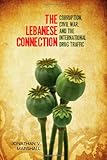
Jonathan V. Marshall. The Lebanese Connection: Corruption, Civil War, and the International Drug Traffic. Stanford Studies in Middle Eastern and Islamic Societies and Cultures Series. Stanford: Stanford University Press, 2012. 272 pp. $35.00 (cloth), ISBN 978-0-8047-8131-2.
Reviewed by Paul Gootenberg (Stony Brook University)
Published on H-Diplo (August, 2012)
Commissioned by Seth Offenbach (Bronx Community College, The City University of New York)
Jonathan V. Marshall’s The Lebanese Connection is a significant and substantive book--important for historians of modern drug trades, international and diplomatic historians at large, and one suspects also Middle East area specialists (a category in which neither the author nor this reviewer belong). Lebanon, from the 1970s to the early 1990s, was a precursor or model of what many pundits, national security experts, and drug-control officials today might call a “narco-state”--a government dominated or torn by the fiscal and political pressures of international drug trades. Yet at the height of its civil wars between 1975 and 1990, Lebanon was hardly a state at all, but an ethnically and territorially fractured and occupied shell of one. To my knowledge, save for a few cited essays, there is no seriously researched dispassionate book that takes on the Lebanese experience to unpack that hot intersection of civil conflict and international narcotics trafficking. Since the 1980s, epithets of “narco-state” or “narco-terrorism” (i.e., guerrilla wars fueled by illicit drug funds) have littered political discourse about drugs, and have been thrown at such cases as Bolivia and Colombia during the 1980s to Mexico and Afghanistan today. Lebanon thus makes a striking case for analysis. Given the severity of Lebanon’s strife and the heady pressures of outside actors (Syria, Israel, the Palestinian Liberation Organization [PLO], and the Central Intelligence Agency [CIA]) on the country’s fragile politics and crossroads geography, it was in some sense the mother of narco-state conflicts. I read this book avidly as a historian of drugs, and am convinced by Marshall’s critical perspective on the sensationalized narco-state label.
This is also an eloquently written and engrossing story for anyone who wants to learn about modern Lebanon and its two-decade reign as a major world drug growing and transit zone, largely of hashish and opiates from the fertile northern Bekaa Valley. Marshall is a lucid writer with a knack for incisively and economically contextualizing each chapter and the problems he approaches. The Lebanese Connection is also deeply researched in U.S. and international policing, diplomatic, and spy agency archives--although Marshall admits that he comes at the problem not as a regional specialist with Arabic or other area studies depth to balance his work with truly local perspective.
Besides telling a remarkable and tragic story, enlivened by real voices and actors, Marshall also produces sharp analysis and comparisons when needed. For example, the book’s conclusions address with nuance critical issues surrounding drug politics and regimes, including established political economy and political science paradigms, such as economist Paul Collier’s influential thesis of destabilizing “conflict goods.”[1] (I think this conversation has shifted lately, given the ferocious drama unfolding in Mexico, to broader questions about the relationships of drugs to violence.) Rather than a “failed state”--another shibboleth of international politics--Marshall offers the metaphor of Lebanon as a state “ravished” by meddling outsiders, presumably working with the vulnerabilities left by postcolonial ethnic, clan, and religious cleavages. Drugs did not cause Lebanon’s breakdown, Marshall argues, but once full-scale civil war erupted in 1975, punctuated by outside interventions, the availability of drug finance and related arms flows surely exacerbated and prolonged the bloodshed, by helping underwrite rival parties, territorial partitions and smuggling ports, protection rackets, and private armies.
A synopsis here cannot do justice to the rich narrative. A brief introduction sets out Lebanon’s national fragilities and aptness for exploring the relation of covert economies to civil conflict. Chapter 1, “Hashish: The Petroleum of Lebanon,” lays out the political geography of hemp production in the post-World War II Bekaa Valley, its ties to the country’s largely Christian political elite, and early U.S. attempts to foster local eradication policies. Chapter 2, “The French Connection,” draws out the 1950s-60s internationalization (and diversification to opiates) of Lebanese drugs via legendary Corsican smuggling rings and the rise of Lebanese “kingpins,” such as Sami Khoury. Chapter 3, “The Intra Bank Connection,” briefly focuses on the dramatic 1960s rise and fall of this Palestinian-founded financial circuit linked not only to drug monies but also to a gamut of intelligence operatives. Lebanon’s financial, business, casino, tourist, and cultural cosmopolitanism seemed to play into spiraling drug trades. Chapter 4, “The Path to Civil War,” outlines the country’s fatal sectarian gulfs after the collapse of Intra Bank, and the pressures of Richard Nixon’s expansive War on Drugs (such as crackdowns on Turkey and Marseille) that added to Lebanon’s predicament. Chapter 5, “The Civil War Drug Boom,” details not only the bewildering complexities of Lebanon’s 1970-90 civil war (and related Syrian and Israeli invasions) but also the graphic ways in which Lebanon’s balkanization intensified the dependence on illicit drug and cash flows. Chapter 6, “The Syrian Connection,” is a critical assessment of contemporary charges that Syria’s long occupation of such corridors as the Bekaa became entwined with official trafficking. Chapter 7, “The Drug Melting Pot,” evaluates the varied outside agents, refugee streams, and traditional diasporic traders active in Lebanon’s drug trades: Israelis, Palestinians, Hezbollah fighters, Armenians, Turks, and Bulgarians. Chapter 8, “From Narco-State to Failed State,” is a measured conclusion; Marshall even draws implications for contemporary politics and interventions in states as disparate as Afghanistan and Mexico.
Even superb books merit critique, and I hope mine are fair to the author’s intent. First, I found the book’s coverage somewhat uneven. For example, the climactic midsection of the book is a massive chapter on the “Civil War Drug Boom,” but with a skimpy analysis of its aftermath. In particular, many practitioners and drug scholars will want to know more about the apparently rapid process by which Lebanon was weaned off its dependence on drugs in the early 1990s. One factor was a coercive hand from the Syrian occupation army, which suddenly recalculated drug trades as a subversive threat. This has elsewhere in the world proved a trying, costly, and long process involving forced eradication of peasant livelihoods, workable crop substitution, state building, and rural service provision. Is this a rare “successful” instance of drug economy withdrawal with wider implications, or was it largely an accident of Lebanon’s geography and politics? But instead of focusing on substantive issues, Marshall expends much print refuting the many dubious politically inspired charges about Lebanese narcotics, from Senator Charles Schumer’s provocative 1980s anti-Syrian report, right-wing Washington DC columnists, Israeli intelligence and propaganda, or professional pundits of “narco-terrorism” like Rachael Ehrenfeld (graciously thanked in the acknowledgements). These political digressions distract from the book’s intellectual force.
I also have qualms as a historian of drugs who has long pondered this small but growing field’s methodological problems and possibilities. The Lebanese Connection is a fairly straightforward narrative, which, unlike many newer works in the field, takes for granted the existence of its subject matter: illicit drugs. There is little attempt here to show how psychoactive drugs (cannabis, opiates) became constructed or construed as illicit goods for Lebanon, and the cultural politics or political economy driving the international control movements: colonialism-decolonization; Orientalism; medical or modernist ideals; or the distorting optics of international and state control, save for the occasional geopolitical interest. “Drugs” as a category simply exist, and the reader just needs to add the adjective “dangerous” to swallow a prohibitionist anti-narcotics discourse. For example, an emerging historical literature on the making of drugs as a Cold War political menace is overlooked.
Relatedly, The Lebanese Connection is not particularly reflexive or critical about the main sources and anti-narcotics “archive” it exploits: international policing; anti-narcotics agents and agency reports (Federal Bureau of Narcotics [FBN], later Bureau of Narcotics and Dangerous Drugs [BNDD] and Drug Enforcement Administration [DEA], the State Department’s International Narcotics Control Strategy Report [INCSR], etc); and espionage and diplomatic papers (perhaps a weakness of the author’s language barrier). So, the book, like many diplomatic and drug histories before, becomes a patchwork of hundreds upon hundreds of allegations of drug running activities and corruption, even in context. Clearly, many such accounts are blown up or downplayed for political purposes, and these are intrinsically covert camouflaged worlds. So how is the historian to critically read and assess the drug-controller archive? In the main, Marshall does a credible job sorting truth claims; he even adds an amusing appendix collating the wildly disparate claims and estimates of the size of Lebanon’s 1980s drug economy, which range anywhere from 20 to 50 percent of the country’s GNP.[2]
Yet at other points, the book seems to take almost all the spook and political claims quite literally. It dips into what some writers self-depict as “deep politics” and others deride as “conspiracy theories.” This is the idea that Lebanon (or the sources of global drug trades) was essentially governed by secret illicit networks, mutually entangled intelligence forces, and secret armies, which fostered or tolerated such trades for their own agendas, undermining surface governmental policies of drug suppression. This has been a defined genre in drug history for quite some time--from the seminal early works of Alfred W. McCoy on heroin in Southeast Asia (he has since complicated his view to include the drug-inducing blowback of prohibitionist structures) to such drug conspiracy sleuths as Douglas Valentine, to populist West Coast theories of the 1980s U.S. “crack epidemic” as CIA plot.[3] Clandestine worlds, complicities, and plots surely do exist around drug money, but the analytical question is whether they have the power ascribed to them, for example, to actually drive drug use epidemics and stage coups and massive cover-ups. I suspect that drugs as a topic tends to produce exactly this kind of intellectual fetishization--magical powers awarded to drugs, and the invisible networks and shady entrepreneurs who sustain them--sometimes by design, as in the mythologizing representations of omnipotent, villainous “cartels” of Mexico and Colombia. And at times, the book falters by simply assessing trafficking truth claims by means of political providence: for example, readers may realize that virtually every charge of involvement of Mossad or Israeli forces in drug trades is taken at face value, whereas similar charges against Syria, Hezbollah, and the PLO are finely contextualized or refuted.
These quibbles aside, let me reiterate that The Lebanese Connection is a compelling book that teaches us a great deal about drug trades and the transnational and regional politics that, to use Marshall’s apt term, “ravaged” Lebanon in the two decades after 1970.
Notes
[1]. Paul Collier, V. L. Elliott, Harvard Hegre, Anke Hoeffler, Marta Reynal-Querol, Nicholas Sambanis, Breaking the Conflict Trap: Civil War and Development Policy (Washington DC: World Bank, 2003).
[2]. On this methodological note, see, for example, Peter Andreas, ed., Sex, Drugs and Body Counts: The Politics of Numbers in Global Crime and Conflict (Ithaca: Cornell University Press, 2010); and Paul Gootenberg, “Talking Like a State: Drugs, Borders, and the Language of Control,” in Illicit Flows and Criminal Things: States, Borders, and the Other Side of Globalization, ed. Willem van Schendel and Itty Abraham (Bloomington: Indiana University Press, 2005), 101-127.
[3]. Alfred W. McCoy, “The Stimulus of Prohibition: A Critical History of the Global Narcotics Trade,” in Dangerous Harvests: Drug Plants and the Transformation of Indigenous Landscapes, ed. Michael K. Steinberg, Joseph J. Hobbs, and Kent Mathewson (Oxford: Oxford University Press, 2004), 24-114; and Douglas Valentine, The Strength of the Wolf: The Secret History of America’s War on Drugs (London: Verso, 2004). The motley writings on CIA-crack connection are too vast for citation.
If there is additional discussion of this review, you may access it through the network, at: https://networks.h-net.org/h-diplo.
Citation:
Paul Gootenberg. Review of Marshall, Jonathan V., The Lebanese Connection: Corruption, Civil War, and the International Drug Traffic.
H-Diplo, H-Net Reviews.
August, 2012.
URL: http://www.h-net.org/reviews/showrev.php?id=36300
 | This work is licensed under a Creative Commons Attribution-Noncommercial-No Derivative Works 3.0 United States License. |

