



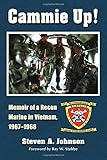
Steven A. Johnson. Cammie Up! Memoir of a Recon Marine in Vietnam, 1967-1968. Jefferson: McFarland, 2012. viii + 280 pp. $29.95 (paper), ISBN 978-0-7864-6600-9.
Reviewed by John Fitzmorris (University of Southern Mississippi)
Published on H-War (November, 2013)
Commissioned by Margaret Sankey (Air University)
As more and more Vietnam War veterans pen their memoirs and send them to publishers, readers want a narrative that as closely as possible brings them into the story with the veteran. Cammie Up! Memoir of a Recon Marine in Vietnam, 1967-1968 approaches such an ideal standard. Steven A. Johnson, who entered the U.S. Marines in 1967 when he was just seventeen, served in a Reconnaissance (Recon) Battalion with the 3rd Marine Division. Johnson came of age in boot camp at Camp Pendleton, California, and in the jungles of central Vietnam, first observing with and then leading a Recon Battalion team in such storied places as Phu Bai and Khe Sanh and lesser-known sites, such as Hill 950. The book derives its title from the first actions any Recon team undertook before heading into the jungle--camouflaging themselves. “Cammie Up!” was the call for marines to don their camouflage fatigues and paint their faces to blend into the jungles.
Johnson soon discovered that the Recon Battalion operated as deep in the brush and in enemy territory as did the more vaunted Force Recon--and saw just as much combat. He structures his narrative by making reference to the “Elephant,” which he leaves open to interpretation. It refers to either the Vietcong (VC), the North Vietnamese Army (NVA), or the arena of war in general. Throughout his story, Johnson intersperses letters home to his father to give readers a sense of his connection with home, called “The World” in the universal language of the military in Vietnam. He also periodically uses after-action reports to help readers understand how marines saw battles and then reported them to their commanders.
What Johnson lacks in prosaic style he more than makes up for in his careful attention to detail and an ability to convey his feelings of the battlefield in Vietnam. He offers a detailed description of the training, duties, and characteristics of a Recon Battalion team. He also discusses what the team encountered when it went out in the field. He gives the reader a real sense of being there with him as he trudges through the jungle, feeling various levels of fear while on patrol; enduring the grime of the red muck at the base camp; watching the murderous efficiency of “Puff the Magic Dragon,” the airplane with a machine that fired thousands of rounds in just a few moments; and seeing death up close for the first time. Johnson rails against the system that supplied marines with faulty M-16 rifles and angrily decries the lack of accountability among those who supplied them. He illustrates in detail the code lingo used by the marines as well as some of the obscene language employed by the leathernecks. He demonstrates how necessity became the mother of invention as he devised map cases, crafted bamboo scuttlebutts, built primitive hooches from banana leaves, and used silicone jelly to prevent trench foot. With typical marine understatement, Johnson vividly describes the tree rats that threatened the marines as they slept; warm beer and sodas; despised “ham and hockers” (ham and lima beans) C-rations; and supply sergeants who treated marines with contempt and supplies as their own personal fiefdom. With great emotion, he discusses seeing corpsmen administer aid to wounded NVA prisoners of war, dealing with a humorless and arrogant officer nicknamed “Lt. Hardhead,” and heading home on an airplane.
Despite offering such harrowing descriptions of the combat zone, Johnson lightheartedly narrates his story. He includes humor to help him deal with the difficulties that he and his fellow marines experienced. In addition to his penchant for understatement, Johnson regales his readers with self-effacing tales of “taking a shower” by means of a monsoon and nearly dissolving his insides by ingesting local hooch combined with “fizzies,” tablets that carbonated and flavored the often-chlorinated and distasteful water. He writes of a hilarious encounter with a Hispanic noncommissioned officer (NCO) who could not speak English without a pronounced accent and playing with him over the confusingly named Robert Sargent a.k.a. “Lance Corporal Sargent.” He also offers some emotional narrative as the unofficial counselor to other marines when they received one of the dreaded and hated “Dear John” letters, which came from wives or girlfriends who ended their relationships with soldiers.
The stories in Cammie Up! combine to make a human and emotional account that eschews the dramatic but conveys the anguish of combat and the indifference and hostility that these marines received from their fellow Americans when they got home. Now a policeman in upstate New York, Johnson returned from Vietnam, like many veterans, dazed and embittered. However, he remained in the reserves and was called up to active duty more than twenty years later during Operation Desert Storm. The reception that soldiers received both warmed his heart but also dredged up the resentment and hurt from his time in Vietnam. He translates this sorrow into a memoir that stands above the many published by veterans since the Vietnam War. Cammie Up! is an important and detailed contribution for those who continue to try and understand the lives and emotions of soldiers and marines as they faced death in the jungles of Southeast Asia.
If there is additional discussion of this review, you may access it through the network, at: https://networks.h-net.org/h-war.
Citation:
John Fitzmorris. Review of Johnson, Steven A., Cammie Up! Memoir of a Recon Marine in Vietnam, 1967-1968.
H-War, H-Net Reviews.
November, 2013.
URL: http://www.h-net.org/reviews/showrev.php?id=36274
 | This work is licensed under a Creative Commons Attribution-Noncommercial-No Derivative Works 3.0 United States License. |

