

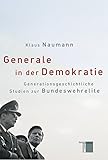
Klaus Naumann. Generale in der Demokratie: Generationsgeschichtliche Studien zur Bundeswehrelite. Hamburg: Hamburger Edition, 2007. 383 pp. EUR 28.00 (cloth), ISBN 978-3-936096-76-7.
Reviewed by Jörg Muth
Published on H-War (September, 2012)
Commissioned by Margaret Sankey (Air University)
The title of the book is carefully phrased because the subtitle calls it not a “study” but “studies” about the generations of the Bundeswehr--the armed forces of the German Federal Republic--military elite. The reason for that careful phrasing of the title becomes clear when looking at the rather diverse sources and the methodology used by the author Klaus Naumann. The book is divided into four parts, the first one a brief but concise and knowledgeable introduction about the topic and methodology, the last one a rather short ten-page summary.
Part 2, “Officers without an Army,” in its first portion, focuses on a reevaluation of sources, which were well known by experts in the field. In 1955, the Frankfurt Institute for Social Research initiated an empirical group experiment to understand the current German mentality. The sociologists wanted to generate an ambiance like that of strangers meeting in a railroad car. A total of 121 groups were created of 1,635 persons, with 7 of the groups made up of former officers. It is those 7 groups that Naumann reevaluates. To ignite a discussion, the sociologists composed a letter from a fictional U.S. Army Sergeant Coburn who commented on a multitude of German topics. Because the interview transcripts were correctly anonymized, it is unclear if any of the officers in the groups ever made it into the Bundeswehr. Naumann correctly points out, quoting one of the sociologists, that the Wehrmacht officer corps was anything but heterogeneous. Unfortunately, this well-known fact about the German officer corps has been “rediscovered” in other recent scholarship of the last two years about the German officers and sold to readers as a new finding.
The second portion of part 2 follows the journeys and interviews of the former German social scientist Hans Speier, who had to flee his home country because of the Nazis. Speier became a U.S. citizen and an employee and leading scientist of the RAND corporation. Between 1951 and 1955, he traveled several times to Germany to interview former Wehrmacht generals--most of them major players during the war. The timeframe of his interviews is especially relevant because it encompasses the beginning of the discussion about the German rearmament and the direct steps that were taken to do it. In this portion of the chapter, the author offers more than a reevaluation of Speier’s published works. While examining the original interview logs of Speier’s papers, he discovered some gems, including character assessments of the generals that had not been previously published. It is this part of Naumann’s book that was for this reviewer the most valuable.
In the third part, the author presents interviews that he conducted of five high-ranking former Bundeswehr generals of diverse backgrounds. The first interviewee was born in 1914 and was a former staff officer in World War II, and the last was born in 1939. They all gained the highest rank in the Bundeswehr, and between the retirement of the youngest and oldest men lay twenty-five years. The author asked the generals a standard set of questions to gain a better understanding of the mentality of their generations. Naumann probed when an opportunity arose, but typically was gentle with the officers. When an interviewee chose not to answer a question, Naumann did not insist on a reply. Instead he later commented in his assessment of the interview. Any inquisitorial questions are completely absent. Most of the generals knew each other either during their service time or by reputation, but Naumann did not ask them about their opinion of each other. As gentle as his questioning is the author’s assessment of the generals.
While much of the Bundeswehr’s foundation and history can be seen as a success story, it was also shaken repeatedly by scandals of political backwardness, corruption, and incompetence. Naumann hints at a few of these scandals in a footnote, but they usually appear as unconnected to the generals. This lack of criticism and dealing with controversial issues may well be the greatest flaw of the book. One reason for this might be that the author is a scholar of the Hamburger Institut für Sozialforschung that created the equally famous and infamous Wehrmachtausstellung which dealt with the atrocities of the German army in World War II. While the fundamental message of the exhibition was correct--soldiers of the Wehrmacht had committed countless crimes--much of the evidence presented was flawed and rather than pointing out the precise perpetrators the exhibition dispersed guilt everywhere. After scholars provided evidence of its flaws, the exhibition was recalled and newly rebuilt with the help of a board of historians. Nevertheless the exhibition earned the institute the everlasting enmity of many veterans and many Bundeswehr soldiers.
The book is clearly not written for laypeople even though the topic is relevant to all students of postwar Germany. Terms of sociology and historiography are left unexplained as are relevant issues of German history, and the writing style has a heavy academic touch. While the author is evidently an expert, the planting of footnotes can be described as rather “loose.” For a book of this size there are too few and occasionally there are no page numbers but entire books or chapters cited.
This book cannot be read in a glance or just by chapters, or its value will escape the reader. What looks like a collection of patchwork studies reveals itself at the end as a sound undertaking that paints a colorful picture of the German officer corps. Scholars who want to study the German rearmament and its protagonists will not be able to do without Naumann’s book.
If there is additional discussion of this review, you may access it through the network, at: https://networks.h-net.org/h-war.
Citation:
Jörg Muth. Review of Naumann, Klaus, Generale in der Demokratie: Generationsgeschichtliche Studien zur Bundeswehrelite.
H-War, H-Net Reviews.
September, 2012.
URL: http://www.h-net.org/reviews/showrev.php?id=36242
 | This work is licensed under a Creative Commons Attribution-Noncommercial-No Derivative Works 3.0 United States License. |

