



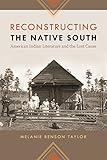
Melanie Benson Taylor. Reconstructing the Native South: American Indian Literature and the Lost Cause. Athens: University of Georgia Press, 2011. x + 253 pp. $59.95 (cloth), ISBN 978-0-8203-3884-2; $24.95 (paper), ISBN 978-0-8203-4066-1.
Reviewed by Gina Marie Caison (Georgia State University)
Published on H-South (October, 2012)
Commissioned by David Carlson (Troy University)
In another strong monograph from the University of Georgia Press’s New Southern Studies series, Melanie Benson Taylor lays substantial groundwork for the field of Native South literary studies. Reconstructing the Native South ambitiously synthesizes numerous literary and cultural texts alongside southern economic history in order to elucidate the precarious tethers between Native American studies and southern studies. The book generously contributes to previous literary Native South scholarship by other scholars, such as Eric Gary Anderson and Annette Trefzer.[1]
Following much of the same concerns as her first book, Disturbing Calculations: The Economics of Identity in Postcolonial Southern Literature, 1912–2002 (2008), this new work remains focused on the operations of capitalism in the region. Rather than simply rehash familiar notions of authenticity versus modernity or agrarianism versus industrialism, Taylor aims to “uncover the injurious ways that region, tribe, and nation fracture, suffer, and dissemble similarly under the pressures of capitalism” (p. 5). In doing so, she foregrounds the central issue that the book examines: the survival of multiple southern cultures is both dependent on and undermined by economic systems ranging from the plantation economy to the rise of global capitalism.
In the introduction and in the first chapter, Taylor examines the tenets of the region’s “lost causes.” The book interrogates the relationship between the southern civil religion of the lost cause and the losses experienced by Native people in the region. Noting the ways that both Native people and southerners are repeatedly “compelled to defend their own cultural integrity and autonomy” against notions of abject backwardness, Taylor takes on the task of exploring shared experiences without flattening the disturbing ways this real or perceived bond might play out (p. 20). Chapter 1 examines lost cause literary nostalgia as it incorporates ghostly Native signifiers alongside the southern specters in Native-produced literature. To do so, the book weaves together sustained close readings of works by several authors, including Barry Hannah, Stephen Graham Jones, Louis Owens, LeAnne Howe, and Diane Glancy, while touching briefly on numerous other texts. This investigation of haunted southern nostalgia combined with narratives of Native “retaliatory violence” leads the author to conclude that these dark fantasies reveal the ways in which global capitalism has “scripted us all into roles we can’t seem to refuse or rewrite” (p. 70). This circumstance, Taylor argues, contributes to the frequent appropriation of others’ identities in the region.
Chapter 2, “Red, Black, and Southern: Alliances and Erasures in the Biracial South,” follows much of the same method of chapter 1. Here Benson Taylor traces the ways that Native and African American identities in the South appear within narratives of both solidarity and disavowal. The chapter opens with an analysis of Julie Dash’s film Daughters of the Dust (1991). It continues with readings of poems by Honorée Fanonne Jeffers, Jennifer Lisa Vest, and Dale Marie Taylor, and concludes with analyses of novels from Geary Hobson, Owens, and Dawn Karima Pettigrew. Taken together, these readings contribute to the book’s argument that in the Native South the manufactured and naturalized economic forces of competition have repeatedly ruptured potential solidarities between Native and African Americans.
Chapter 3 picks up this critique and argues convincingly for the ways that “vectors of capitalism” produce and reproduce the commodification of identities in the region (p. 118). The book is strongest here, where it articulates the inherent contradiction of southern economies that both enable and undermine possibilities for strong communities and sovereign Native nations in the area. The closing analysis of Jerry Ellis’s travelogue Walking the Trail: One Man’s Journey along the Cherokee Trail of Tears (1991) really sings as it offers the powerful point that in the region, “‘freedom’ is just another word for the illusory agency of capitalism” (p. 161).
The final full chapter, “Excavating the World,” works in tandem with the book’s brief conclusion to open up new directions in Native South studies. Taking up works by Alice Walker, Allison Adelle Hedge Coke, Karenne Wood, Marilou Awiakta, Janet McAdams, and Belle Boggs, the book suggests possibilities for a productive and simultaneous past/present/future of the Native South. Despite what some readers might see as a potentially problematic metaphor of “excavation” for this promised future, the book’s closing offers a generous call for more work in the field. Even more important, it argues for the “real world” significance of cultural studies for living communities in the South.
This book marks another important initial step for literary studies of the Native South. It is impressive in its scope and generous in its opening of avenues for future research. While nonliterary studies scholars may feel overwhelmed by the book’s detailed close readings, literary researchers will enjoy Taylor’s many close examinations of key texts. In particular, her deft analyses of Owens’s understudied body of work are among the best in print. At times, however, the book’s urge to cover so much ground leaves several primary texts potentially under-examined where a more sustained or attuned reading might have offered a productive complication to the work’s overall argument. While the book makes frequent use of relevant work from ethnohistory and Native American studies, it tends to simplify some important conversations in those fields about such issues as racial identification in the early South, (trans)nationalisms, recognition, and hybridity. These moments, however, do not undermine the value of Taylor’s larger argument about southern economies and Native identity in the area. Ultimately, Taylor has offered the fields of southern studies and Native American studies an important contribution--one that interrogates a region’s difficult past and calls for its potentially boundless, and better, future.
Note
[1]. For example, see Eric Gary Anderson, “On Native Ground: Indigenous Presences and Countercolonial Strategies in Southern Narratives of Captivity, Removal, and Repossession,” Southern Spaces (2007), http://www.southernspaces.org/2007/native-ground-indigenous-presences-and-countercolonial-strategies-southern-narratives-captivity; Eric Gary Anderson, “Rethinking Indigenous Southern Communities,” American Literature 78, no. 4 (December 2006): 730-732; and Annette Trefzer, Disturbing Indians: The Archaeology of Southern Fiction (Tuscaloosa: University of Alabama Press, 2006).
If there is additional discussion of this review, you may access it through the network, at: https://networks.h-net.org/h-south.
Citation:
Gina Marie Caison. Review of Taylor, Melanie Benson, Reconstructing the Native South: American Indian Literature and the Lost Cause.
H-South, H-Net Reviews.
October, 2012.
URL: http://www.h-net.org/reviews/showrev.php?id=36192
 | This work is licensed under a Creative Commons Attribution-Noncommercial-No Derivative Works 3.0 United States License. |

