



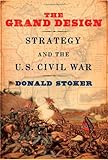
Donald Stoker. The Grand Design: Strategy and the U.S. Civil War. Oxford: Oxford University Press, 2010. viii + 498 pp. $27.95 (cloth), ISBN 978-0-19-537305-9.
Reviewed by Christian Keller
Published on H-War (July, 2012)
Commissioned by Margaret Sankey (Air University)
Donald Stoker’s The Grand Design is a book that all serious students of the war will ignore at their peril. It is not the first book-length study of strategy during the conflict, something the author claims in his introduction (think Herman Hattaway and Archer Jones’s How the North Won: A Military History of the Civil War [1983] and Richard E. Beringer, William N. Still Jr., Archer Jones, and Herman Hattaway’s Why the South Lost the Civil War [1986] as good examples of earlier works), but it is a powerful revisitation, update, and continuance of one of the most critical debates in Civil War historiography: why and how the Union ultimately won the war and the Confederacy did not. Stoker argues, convincingly for the most part, that the Northern political and military leadership slowly figured out the correct strategy to defeat the South, but that it took an excruciatingly long time to do so. This process of finally arriving at a “grand design” that would force the rebels to their knees cost far more lives than it needed to, especially considering the Union’s preponderance of war-making resources and repeated, egregious Confederate mistakes.
George B. McClellan and Henry W. Halleck, the Union’s first two generals in chief, quickly and unsurprisingly become villains early in this story, yet to Stoker’s credit he attempts to judge them in the historical context of what they knew, did not know, and could not have controlled as the war progressed from 1861 to 1863. Halleck gets a few nods, despite his addiction to military theory and personal foibles, as a general in chief who occasionally learned from his mistakes. This is a refreshing interpretation of “Old Brains,” who too frequently is dismissed as a pedant. McClellan, for all his vanity and myopic preoccupation with Virginia and Richmond, likewise emerges with a mixed report card. Stoker particularly commends him for coming up with what strategists today would call a “national military strategy” in 1861, that, if allowed to proceed in a vacuum (which of course it could not, considering Northern politics), might have ended the war earlier. The author gives Abraham Lincoln fairly high marks as commander--and strategist--in chief and awards the final plaudits, not surprisingly, to Ulysses S. Grant for being the general in chief who was able to work with him and finally execute the winning strategy in 1864-65. William Tecumseh Sherman, Grant’s right-hand man, also emerges as the ruthlessly effective leader he actually was, an unsurprising interpretation with which most readers will agree.
Stoker is kinder to Jefferson Davis than most previous historians, arguing that the Southern president possessed a modicum of strategic wisdom, but agreeing with them that Davis’s prickly personality and predilection to meddle in details, combined with the revolving door of secretaries of war and the absence of a true general in chief, conspired to handicap Confederate strategic vision. Joseph E. Johnston is one of the book’s whipping boys--at times it appears that the author personally delights in condemning him for egomaniacal quirks that proved strategically harmful to the Southern cause, such as his inability to take charge of his western department in the spring and summer of 1863. That failure, Stoker claims, almost foreordained the Confederacy to defeat. Stoker waffles on Robert E. Lee, handing him high marks as an operational and even strategic thinker in one chapter but disparaging him in the next, sometimes without enough convincing evidence. Most of that ire probably emanates from the author’s obvious disenchantment with the origins, prosecution, and outcome of the Gettysburg campaign. Why Stoker does not like Gettysburg--the section on it actually reads well and correctly assesses its results--is unclear, but he lambasts Lee for losing in Pennsylvania. One is left wondering what the author would have said had Lee triumphed; he probably would have acclaimed him a great visionary.
Therein lies the primary criticism of the book. Like most historians who view the past from the top down, Stoker is afflicted with 20/20 hindsight, and in a few too many sections of his book this issue jumps off the page. Because McClellan failed to take Richmond in 1862 or quickly pursue Lee after Antietam, his strategic vision was seriously flawed, we are told, but Lincoln had it right all along (at least by the Peninsular campaign) because he quickly identified Lee’s army as the principal Confederate center of gravity in the East. Of course, seasoned readers will realize that Lincoln only gradually came to comprehend the Union’s strategic assets and the enemy’s strategic vulnerabilities, and, like most of the generals he dismissed before Grant, often learned the hard way how difficult it was to marshal Federal power toward the great end of reunion. Sometimes, as in the case of Lee and Davis, leaders understood what needed to be done in a particular theater of war to move their nation closer to strategic victory, but simply could not find enough means--in the form of troop numbers, good subordinate leaders, or logistical infrastructure, for instance--to get there. Sometimes politics, that great arbiter in war, interfered. Does that mean their strategic acumen was inferior to that of their victors? Perhaps true geniuses would have found a way around the imposing obstacles, but just because a leader failed to execute what he intended to do does not necessarily make him incompetent--it makes him appear incompetent to us all these years later.
Lest we jump to conclusions and accuse Stoker of a sin most Civil War authors are guilty of, it is important to recognize that even the most respected historians have frequently judged the performance of leaders in particular battles, campaigns, and the entire war based on what they know actually occurred. The authors of the primarily strategic studies mentioned at the beginning of this review also made that mistake, and one can go back to David Donald, Allan Nevins, Bruce Catton, T. Harry Williams, Emory Thomas, and a host of the most esteemed Civil War historians writing during the Cold War and accuse them of the same thing. More recently, James McPherson, Gary Gallagher, Joseph Glatthaar, Daniel Sutherland, and Joseph Harsh, among others, have offered very balanced and contextually nuanced works that are laden with a proper respect for contingency, but even they fall victim from time to time to dispensing judgment. It is almost irresistible for the Civil War historian not to do so. It is part of our nature, and making a carefully analyzed, contextually fair, and scrupulously supported judgment can help us learn from the past. That is precisely what historians involved in Professional Military Education (PME) at our nation’s academies, staff colleges, and war colleges are charged to do for their students. As a member of that cadre and having mastered so much good Civil War literature, Stoker is quietly trying to accomplish that in the book.
To that end, the author frequently compares a strategic or operational decision or result during the Civil War to recent military events. Although such parallels may be useful in clarifying key arguments, sometimes Stoker goes too far, such as when he compares Johnston’s problems in controlling both the Tennessee and Mississippi regions in 1863 to modern American combatant commanders (p. 249). As far as the comparison of Johnston’s duties and that of U.S. Central Command’s (CENTCOM) commander goes, Stoker makes a good point. Where the parallel fails is in his indictment of Johnston for not having “the mental liquidity” to run a theater (p. 249). Modern combatant commanders have the benefit of 150 years of institutional experience, dazzling technology, and a far more mature command and control system than Johnston was afflicted with. Certainly, the Confederate commander had his flaws, but the task facing him was one almost unique in American military experience up to that time.
A few other minor issues are worth mentioning. Stoker alludes wherever he can to the great nineteenth-century military theorists Carl von Clausewitz and Antoine-Henri Jomini, as well as to the ancient Chinese text by Sun Tzu. His training and experience as an educator of military professionals is clearly evident here, and although admirable and understandable to many readers, those not as familiar with military theory may find this tendency off-putting. Others may be annoyed by Stoker’s constant evaluation of Union and Confederate strategic--and all too often, operational--decision making in light of Clausewitz’s maxims. This is a bit unfair to the historical actors. What they knew and understood as “strategy” in the 1860s was not nearly as pertly defined as what Clausewitz explained in his work, On War (1832). Even Clausewitz occasionally blended what we today would call the strategic and operational levels of war. Moreover, Clausewitz was not translated into English until well after Appomattox and Jomini was not explicitly taught at West Point before the war, although Professor D. H. Mahan sublimated some of his ideas for the antebellum cadets--ideas that may have stuck and resonated with the likes of Thomas “Stonewall” Jackson, Sherman, and McClellan. Sun Tzu might as well have been on the moon during the 1860s and references to him, although intriguing from a purely theoretical standpoint, distract from Stoker’s otherwise fine narrative.
A strategic study of the Civil War should have included more on the economic, political, and informational domains that the top Union and Confederate leaders had to confront as they strove to achieve their very different national objectives. To be fair, the book contains frequent allusions to diplomatic considerations and how they related to battlefield results, and Stoker does remind us of the political pressures placed on both Lincoln and Davis as they tried to direct strategy, as well as Lee’s reckoning of Northern public morale in his two great Northern raids. Too, the author does a good job including the naval aspects of the war, such as the Union blockade’s strategic significance, and the successful Federal riverine operations in the West from 1862 to 1864; and he demonstrates how Northern generals and admirals normally managed to work together in a joint manner to achieve certain key victories.
Like any comprehensive work on a broad strategic topic, The Grand Design occasionally delves too deeply into minutiae and at times appears to be a recounting of operational, not strategic, decision making. This flaw would have been nearly impossible to avoid, however, considering Civil War leaders’ own conflation of what we now understand as two separate levels of war (a conflation totally rooted in the military experience and theory of their day). The historical records that Stoker relies on, most of which are published primary sources (such as The War of the Rebellion: A Compilation of the Official Records of the Union and Confederate Armies, edited by Robert N. Scott [1880-1901]; The Papers of Jefferson Davis, edited by Haskell M. Monroe Jr. and James T. McIntosh [1971]; and The Personal Memoirs of Ulysses S. Grant [1885-86]), reflect that fusion of the operational and strategic levels of war, and the author can hardly be faulted if he follows the lead of his sources closely. That was an inherent challenge of this study about which Stoker must have thought deeply before embarking on the project, and indeed he acknowledges it in his introduction.
Moments of poetic hyperbole appear here and there, such as the following statement regarding the two great rebel offensives in the fall of 1862: “Moreover, both Lee and Bragg had stuck their heads into nooses, creating the potential for strategic disaster in the form of the destruction of the South’s two primary armies. They were fortunate their enemies refused to tighten the knot” (p. 205). For most authors who have specialized in either the Antietam or Perryville campaigns, such a characterization would sound strange. But such departures from otherwise solidly written prose are fortunately few, and those that stand out fail to derail Stoker’s line of reasoning.
That, in the end, is the great strength of the book. The author makes one, large, well-reasoned argument that is amply supported by countless secondary ones, all rooted in a good command of the key primary and secondary sources. After Richmond had fallen, Lee’s army surrendered, and Davis was captured. “The Union triumphed ... because it managed to develop strategic responses that addressed the nature of this particular war and the character of this particular enemy and then set about implementing them for as long as it took to achieve their political objective. The Confederacy never did--and perished” (p. 418). That is about as black and white an explanation for why the North won and the South lost as any yet conceived, and Stoker is to be commended for writing a book that clearly aims from its beginning to answer how and why those Union responses succeeded and the Confederacy’s did not. It is the best comprehensive, strategic-level study of the war to date, and although imperfect, is a work of compelling scholarship that will steer the debate on Civil War strategy for the foreseeable future.
If there is additional discussion of this review, you may access it through the network, at: https://networks.h-net.org/h-war.
Citation:
Christian Keller. Review of Stoker, Donald, The Grand Design: Strategy and the U.S. Civil War.
H-War, H-Net Reviews.
July, 2012.
URL: http://www.h-net.org/reviews/showrev.php?id=36187
 | This work is licensed under a Creative Commons Attribution-Noncommercial-No Derivative Works 3.0 United States License. |

