



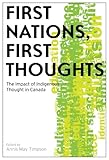
Annis May Timpson, ed. First Nations, First Thoughts: The Impact of Indigenous Thought in Canada. Vancouver: University of British Columbia Press, 2009. x + 323 pp. $94.00 (cloth), ISBN 978-0-7748-1551-2; $35.95 (paper), ISBN 978-0-7748-1552-9.
Reviewed by Omeasoo Butt (University of Saskatchewan)
Published on H-Canada (June, 2012)
Commissioned by Jane Nicholas (University of Waterloo/St. Jerome's)
At first glance, First Nations, First Thoughts, edited by Centre of Canadian Studies director Annis May Timpson, appears to be a direct reply to Thomas Flanagan’s maligned First Nations, Second Thoughts? (2000). However, the essay addressing Flanagan does not appear until near the end. First Nations, First Thoughts does much more than break apart Flanagan’s polemic. Instead, the “first thoughts” of the title are the ways in which the eleven authors strive in different ways to take first steps to decolonization in a variety of Euro-Canadian institutions. While each essay leaves us with many questions about how this process will continue, each also discusses attempts at decolonization in thoughtful, reflective ways. The contributions reveal various opportunities and often gaping holes where more indigeneity is needed, and deeper decolonization could create stronger systems. Thus the “first thoughts” are meant to begin a much-needed conversation through addressing many of Canada’s key social, political, and cultural institutions. With a variety of contributors including historians; governance analysts, such as Michael Murphy (whose task it is to answer Flanagan) and Kiera Ladner; and Canadian and Aboriginal government workers and commentators, a wide range of ideas and interactions with and of indigenous peoples is represented. First Nations, First Thoughts demonstrates that the long path to decolonization will always have more room in this conversation for indigenous voices.
First Nations, First Thoughts is divided into five sections, each representing one area of Canadian institutional culture. Part 1, “Challenging Dominant Discourses,” is about the academy; part 2, “Oral Histories and Narratives,” makes an effort to use and describe oral histories in the context of the museum and city; part 3, “Cultural Heritage and Representation,” concerns museum culture; part 4, “Aboriginal Thought and Innovation in Subnational Governance,” reviews provincial and Aboriginal government dilemmas; and part 5, “Thinking Back, Looking Forward: Political and Constitutional Reconciliation,” redirects Flanagan’s tirade and offers new decolonization options within the Canadian constitutional context.
Robin Jarvis Brownlie and Margaret Kovach meet one another from different angles of academia in part 1. Brownlie examines nineteenth- and twentieth-century Aboriginal written history. Brownlie comments on the difficulty accessing Aboriginal conceptions of history with a few exceptions. These difficulties include fundamental differences between what constitutes Aboriginal scholarship and what constitutes academic scholarship. Kovach, an indigenous woman who holds an academic position, describes the problems she faces because of the severely limited tools available to the Western scholar (and student) to begin to comprehend indigenous thought. Kovach also reminds us that indigenizing the academy with people is not the same as indigenizing the academy with thought. This is a challenge that all institutions discussed in this volume face with varying degrees of success.
The second section features Martin Whittles and Tim Patterson’s “Nápi and the City: Siksikaitsitapi Narratives Revisited.” Whittles and Patterson illustrate through unsatisfying use of oral histories much of the tension around academic and Aboriginal history and understanding across disciplines that Brownlie discusses in her opening chapter.
Two museums grapple with how to decolonize their collections in the third section. Stephanie Bolton’s “Museums Taken to Task: Representing First Peoples at the McCord Museum of Canadian History” is an overview of the slow changes that have come about at the McCord Museum where the founder’s objective was to make the museum “as Indian as I possibly can” (p. 153). By the 1980s, however, this noble objective had resulted in the complete disregard of both indigenous topics and artifacts. Bolton reviews the halting climb the McCord has taken since then toward the idealism of the 1992 report by the Task Force on Museums and First Peoples. Although more exhibits through the late 1980s and 1990s contained Aboriginal themes and content, Bolton’s essay focuses on the one long-term indigenous employee at the museum, and her dedication to Aboriginal engagement “petit è petit” (little by little) (p. 159). Alison K. Brown and Laura Peer’s piece focuses on the how the Pitt Rivers Museum in Oxford, Cambridge, interpreted its obligation to historical Kainai artifacts. This essay is refreshingly honest about the multiplicity of agendas affecting the use, storage, and knowledge of Kainai artifacts. Indigenous peoples, museum exhibitors, and scholarly researchers are often at odds. However, Kainai accessibility to their artifacts and ownership of the knowledge generated about their objects led to a somewhat satisfactory agreement among both the museum and the Kainai.
Essays in the fourth section, by Fiona MacDonald, Gabrielle E. Slowey, and Timpson, address the differences between the label “decolonized” and actual decolonization. MacDonald describes the disadvantage of “autonomy” and the lack of real power it leaves in Aboriginal hands. In Manitoba, funding structures for First Nations child welfare programs took a “neoliberal” shift away from government control, and toward supposedly First Nations controls (p. 175). However, this happened at the same time as need increased, resulting in dramatic underfunding of support for First Nations families. Slowey’s essay determines that it is wrong to assume that capitalism and modernism are antithetical to assertions of indigeneity and traditional governance. To round out this discussion on “subnational governance,” Timpson observes that in Nunavut, government administration can overwhelm the desire to create an organizational culture. MacDonald, Slowey, and Timpson agree that decolonization in governments is a monumental task that requires adequate resources in addition to committed visionaries.
In the fifth and final section of First Nations, First Thoughts, Murphy’s excellent review of Flanagan’s polemic includes a thorough examination of “civilizationism”: meaning the ranking of societies based on a European standard of development and the various theorists associated with these views (p. 253). Murphy demonstrates that Flanagan’s treatise is a whole-hearted attempt to return civilizationist ideas to their former hegemony. Murphy indicts Flanagan for willingly erasing the agency of both colonizer and colonized. Ladner concludes the volume with an assertion of sovereignty for Canadian indigenous peoples. Creatively, Ladner describes different creation myths held by First Nations and others, illuminating the true magic of Canada’s creation: the equitable relationships recognized in the treaties that allowed for the peaceful creation of Canada on the territories of indigenous peoples. For both Murphy and Ladner, Canada has not created something out of nothing, its history and future is tied strongly to its indigenous heartbeat.
First Nations, First Thoughts is a thoughtful collection of essays that will be useful to self-reflective scholars, Aboriginal administrators, policymakers, consumers and creators of culture, critically thinking students and individuals, and readers who are interested to know more about how Aboriginal people in Canada are actively engaged in a sometimes parallel but always underpinning, Canadian structure. Each essay individually and the pieces collectively demonstrate the complexities of the dual and intertwining movements that make up a colonized place, searching to untangle its history and future. Overall, the authors illustrate how calling something indigenous and decolonized takes much more effort, and many small steps in multiple directions, to fully represent an un-colonized space; a goal not only that is extremely difficult, but also one that in its own process, must constantly be analyzed and critiqued for its effectiveness to those it seeks to serve. The volume correctly calls itself First Thoughts because it serves as a discussion starter across Canadian institutions in how to practically, intellectually, and in a heartfelt manner begin to address decolonizing our colonized spaces. Thank you to the authors for their courage in sharing their “first thoughts.”
If there is additional discussion of this review, you may access it through the network, at: https://networks.h-net.org/h-canada.
Citation:
Omeasoo Butt. Review of Timpson, Annis May, ed., First Nations, First Thoughts: The Impact of Indigenous Thought in Canada.
H-Canada, H-Net Reviews.
June, 2012.
URL: http://www.h-net.org/reviews/showrev.php?id=36160
 | This work is licensed under a Creative Commons Attribution-Noncommercial-No Derivative Works 3.0 United States License. |

