



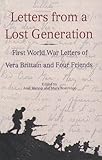
Alan Bishop, Mark Bostridge, eds. Letters from a Lost Generation: First World War Letters of Vera Brittain and Four Friends. Boston: Northeastern University Press, 1999. x + 427 pp. $29.95 (cloth), ISBN 978-1-55553-379-3.
Reviewed by Nancy Nygaard Gaynor (University of Wisconsin-Milwaukee)
Published on H-War (November, 1999)
Hinc illae lacrimae: Hence those tears
Hinc illae lacrimae: Hence those tears
Editors Alan Bishop and Mark Bostridge have brought together a thoughtful collection of the World War One letters of Vera Brittain, her brother, Edward, her fiance, Roland Leighton, and their friends, Victor Richardson and Geoffrey Thurlow. Spanning almost five years, from September 1913 to June 1918, these letters offer a poignant and valuable glimpse into the cataclysmic personal toll of the Great War on the lives of so many.
Of the five major correspondents included in this volume, Vera Brittain is certainly the best known. Brittain, a novelist and social activist, has been the subject of several recent biographies and much critical study on her feminist and pacifist writings. The memoir of her war years as a Voluntary Aid Detachment (VAD) nurse, Testament of Youth was made into a television production in the late 1970s, and she has, in many respects, become the token voice of British womanhood in many First World War collections. Both editors of Letters From a Lost Generation have done extensive work on Vera Brittain. Bostridge collaborated with Brittain's literary executor, Paul Berry on Vera Brittain: A Life (London: Chatto & Windus , 1995), and Alan Bishop is the editor of three volumes of her diaries. This knowledge of their subject is evident in their careful notes, chronology, and helpful introduction.
Letters From a Lost Generation is divided into eight chronological sections, each prefaced by excerpts from Vera Brittain and Roland Leighton's poetry. The first section (September 1913-July 1914) is made up of pre-war correspondence between the Brittains and Roland Leighton and includes their impressions of Uppingham School, where Edward, Roland, and Victor Richardson were classmates. The second chapter corresponds with the outbreak of war (August 1914-April 1915); the correspondence included is primarily between Vera and Roland and traces their early romance. The third section (April-August, 1915) again focuses on Vera and Roland. By this time Roland, Edward Brittain, Victor Richardson, and Geoffrey Thurlow had all enlisted in the British Army. Unable to concentrate on her studies at Oxford, Vera also volunteered for service as a VAD nurse. This chapter ends with Roland's leave and his engagement to Vera in August 1915.
The particularly moving fourth section, (August-December 1915) again mostly devoted to Roland and Vera, features letters from the twenty year-old Second Lieutenant as he attempts to come to terms with the horrors of trench warfare. To alert Vera of his movement to the front line, Roland agreed to quote the Roman playwright Terence in his letters to her, using their chosen phrase, "Hinc illae lacrimae" or "Hence those tears," before the battle of Loos in September 1915. Roland survived Loos, but his letters reveal his startling transformation from an idealistic school boy to a man torn by disillusionment, yet praying for the strength to die with "a strong man's agony" (p. 147). In England, Vera, also struggling to cope with the war's casualties in her nursing work, awaited Roland's leave, scheduled for Christmas Day. Answering the phone on the morning of 26 December, Vera learned not that Roland had arrived home on leave, but instead that he had been shot several days earlier while repairing barbed wire around British trenches, and had died of those wounds.
Geoffrey Thurlow and Victor Richardson's letters first appear in the fifth chapter (January-September 1916) as messages of condolence to Vera, and the four remaining friends grow closer. Here, as elsewhere, Bostridge and Bishop have chosen letters that reveal deeply personal moments that also demonstrate the experiences shared by so many of those affected by the war such as the return of a dead soldier's belongings. As Vera writes to Edward, "I had no idea before of the after-results of an officer's death or what the returned kit, of which so much has been written in the papers, really meant. It was terrible" (p. 211). Piece by piece, together Vera and the rest of Roland's family sifted through his possessions: packets of letters, his writing journals, books, pens, photographs, and even his mud-caked uniform, and the trousers and vest, "dark and stiff with blood" from his wounds (p. 212). The letters here narrate the ongoing battle of the four surviving friends to make sense of Roland's death and to try to find a way to commemorate his life while their own lives were in jeopardy. Here readers see evidence of Paul Fussell's argument that British iconography of the Great War frequently likened the death of soldiers to Christ's sacrifice on the cross. Indeed, almost immediately after Roland's death, Vera begins to elevate his memory to a quasi-religious dimension as indicated in her capitalization of every pronoun that refers to him.
Yet despite their grief, lives went on and the war continued. In February 1916 Edward was ordered to France, not far from where Geoffrey Thurlow was stationed. Victor Richardson and Vera remained in England, Victor on medical leave and Vera nursing in London. On the first day of the battle of the Somme, Edward Brittain was twice wounded and sent, by coincidence, to the First London General Hospital where his sister worked. Brittain received the Military Cross for his actions on the Somme.
The sixth section (September-December 1916) details Vera's decision to volunteer for foreign service and her reassignment to a hospital in Malta. Correspondence among the four continued, and again the editors have selected letters that convey more than the merely personal. These daily communications echo the feelings of a nation and illustrate, as little else can, widespread war weariness and the apprehension that accompanied every scanning of a newspaper column of casualties or receipt of a letter. Reports of relatives and acquaintances killed or wounded became horribly commonplace. As Chapter Seven (December 1916-June 1917) opens, Geoffrey Thurlow and Victor Richardson were still in France, Vera Vera Brittain in Malta, and her brother, Edward at Sunderland on light duty recuperating from his wounds and awaiting another posting nearer the fighting. The spring 1917 offensives on the Western Front brought heartbreaking loss to the Brittains; Victor Richardson was blinded at Arras, and less than three weeks later, Geoffrey Thurlow was killed at Monchy-le-Preux. Knowing that her brother would be overwhelmed by grief, Vera broke her nursing contract and returned to England to console him and to help Victor deal with his blindness. Within two weeks of her arrival however, Richardson died of a cerebral abscess from his head wounds.
In the final chapter (June 1917-June 1918), both Edward and Vera returned to France--Edward to the front, Vera to nurse in Etaples. Edward was later sent to Italy, and Vera again returned home to care for her family after her mother suffered a breakdown. On 15 June 1918, Edward Brittain was shot by a sniper during a counter offensive on the Asiago Plateau and died immediately. The volume ends with letters of condolence from Roland Leighton's parents to the Brittains.
In their introduction, Bishop and Bostridge stress the special character of this letter collection. Any one familiar with much World War One correspondence must agree. The sheer volume of letters aside, certainly all five of this correspondents came from privileged backgrounds. Both Roland Leighton's parents were well-known writers, and Thomas Brittain was the director of a paper mill firm. All five were headed for Oxbridge educations before the war intervened. Their background and the education it offered helps explain why this collection is indeed unusual. Both Edward and Vera Brittain, and certainly Roland Leighton as well were steeped in an atmosphere of language and literature, and this contributes to the erudite and insightful nature of their letters.
As the only survivor amongst these five, Vera Brittain felt compelled to tell their stories in her memoir, and she carefully constructed herself over the years as the voice of her generation. Yet Bishop and Bostridge maintain that their intention was to turn the focus of this volume away from Vera Brittain toward the four young men, and to some extent, they have succeeded. From this collection, readers discover Roland Leighton, Edward Brittain, Geoffrey Thurlow, and Victor Richardson in their own words, not merely through Vera Brittain's narration, thus this volume supplements the story that had begun to be told in Brittain's memoirs, diaries, and much of the recent biographical and critical work on her. The editors should also be commended for assembling a work that is both attractive and well thought out. The biographical notes, chronology, maps, photos, and excerpted poems add richness to the volume, while their editorial interjections add to, rather than disrupt, the letters' narrative flow.
If there is additional discussion of this review, you may access it through the network, at: https://networks.h-net.org/h-war.
Citation:
Nancy Nygaard Gaynor. Review of Bishop, Alan; Bostridge, Mark, eds., Letters from a Lost Generation: First World War Letters of Vera Brittain and Four Friends.
H-War, H-Net Reviews.
November, 1999.
URL: http://www.h-net.org/reviews/showrev.php?id=3616
Copyright © 1999 by H-Net, all rights reserved. H-Net permits the redistribution and reprinting of this work for nonprofit, educational purposes, with full and accurate attribution to the author, web location, date of publication, originating list, and H-Net: Humanities & Social Sciences Online. For any other proposed use, contact the Reviews editorial staff at hbooks@mail.h-net.org.

