

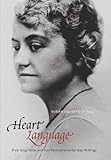
Susan Colestock Hill. Heart Language: Elsie Singmaster and her Pennsylvania German Writings. University Park: Pennsylvania State University Press, 2009. xviii + 281 pp. $40.00 (cloth), ISBN 978-0-271-03543-7.
Reviewed by Denise D. Kettering Lane (Bethany Theological Seminary)
Published on H-German (September, 2012)
Commissioned by Benita Blessing (Oregon State University)
Recovering a Forgotten Voice
Local-color stories from the early twentieth century provided glimpses into regionalized worlds that remained otherwise unknown in broader American culture. Without this literature, for example, a world of Pennsylvania German dialects and sectarian religious minorities might otherwise have disappeared without record. As scholars explore German ethnic identity, these tales can serve as helpful sources. Yet, a significant author of such stories has become a forgotten voice. In Heart Language, Susan Colestock Hill attempts to acquaint a new generation of scholars with the literary work of Elsie Singmaster (1879-1958). In this volume, she combines an extended introduction detailing Singmaster's life and work with the republication of sixteen of her stories.
Elsie Singmaster lived among Pennsylvania Germans throughout the majority of her life. After attending Cornell University and Radcliffe College, she returned to Pennsylvania and began writing about her Pennsylvania German neighbors. Singmaster started her writing career in 1905 and continued publishing until 1950. The daughter of a Lutheran minister, she knew intimately the diversity of religious beliefs present in Pennsylvania German communities and frequently represented these differences in her stories. She also recognized common German cultural threads, such as thrift and discipline, which she recreated in her writing without stereotyping the characters whose stories she told. According to Hill's analysis, Singmaster found among the Pennsylvania Germans many of the best American qualities, making subtle claims throughout her writing about the way immigrants could be solid, hard-working citizens, even if they maintained their own ethnic traditions.
Hill argues that Singmaster's stories continue to resonate because of the accuracy with which she researched and portrayed her rich and rounded characters. The stories in this volume were clearly chosen to demonstrate these qualities in Singmaster's writing. Although early-twentieth-century critics wondered at times if the characters accurately represented real people, Hill claims that Singmaster wanted to make her characters as realistic as possible. Hill ably demonstrates how Singmaster used "American" values such as peace, justice, and individual opportunity as cornerstones in her writing to demonstrate that Pennsylvania Germans exhibited high standards of character and civic values. In this way, Hill portrays Singmaster as countering stereotypes of Pennsylvania Germans as unfriendly and tight-fisted.
Hill highlights three factors in Singmaster's life that influenced her highly positive portrayal of Pennsylvania Germans: her own Pennsylvania German family heritage, her connection to the Lutheran Church in America, and the larger societal context of the Victorian era. For example, Hill demonstrates how Singmaster's strong connection to the Lutheran Church in America, from her father's presidency at the Lutheran seminary at Gettysburg to her own participation in the Luther quadricentennial, influenced her writing. Singmaster's characters are predominantly religious people set against a backdrop of churches and religious practices, as seen in the stories found in this volume. Religious piety informs the lives of the characters, whether they come from a sectarian background or from a more established Lutheran one. Hill also emphasizes that Singmaster's own religious views centered on religious choice, allowing her to present sectarians in a fair light, portraying their struggles with modernity often in a humorous way.
Singmaster's work also provides us with an interesting commentary on women's roles. Using Barbara Welter's work on the "cult of true womanhood" in Victorian culture, Hill stresses how Singmaster employed the virtues of piety, purity, submissiveness, and domesticity with her central female characters. Hill claims, however, that Singmaster walked a precarious line in her work between advocating traditional virtues and commenting on the social limitations women experienced within Victorian society. Singmaster promoted women's rights, albeit in ways that avoided discarding or destroying tradition. The female characters move towards full inclusion in American life within the story, but often retreat to family and familiarity.
Singmaster's received praise from many reviewers for her historical research and the straightforward manner in which she portrayed her characters, although the overall critical reception of her work was mixed. Hill indicates that criticism appeared to grow more consistent as the local-color and regional genres of writing began to pass out of style; Singmaster was criticize for being too sentimental, rather than exposing the harsh realities of life like many other writers in the post-World War I era. Singmaster, however, did not adapt her style to literary tastes, but rather persisted in the style and with the material that she cared about and that had made her a popular writer in both literary and women's magazines.
The introduction to this volume includes many pictures of Singmaster and her environs in Lehigh County, Pennsylvania, providing a helpful context for really seeing the creator of these works. The thorough footnotes in the introduction reflect extensive research in archival and print sources. Likewise, the shorter introductions provided by Hill for each of the short stories reprinted in the volume provide context for the story within the corpus of Singmaster's work as well as information about some of its unique features. According to Hill, Singmaster's work should be held in tension with Helen Reimensnyder Martin's more popular, but less complimentary portrayals of a Pennsylvania German world. A more thorough comparison between Singmaster and Martin would have proved welcome, as Hill mentions their differences repeatedly but does not discuss them at length. Such a discussion would have added additional relevance to her call for a reexamination of Singmaster's work. Perhaps, however, such analysis falls outside of this introduction and instead invites further scholarly work on Singmaster. Hill presents an overall balanced picture of Singmaster's life and contributions.
This collection provides resources for those interested in Pennsylvania German history and culture as well as those interested in literature from the early twentieth century. By repositioning Singmaster's stories within the context of women's history and the local-color genre, Susan Colestock Hill breathes new life and possibility into these stories for researchers interested in literature, religious culture and identity, gender issues, or Pennsylvania German heritage. Throughout the introduction, Hill provides constant reference to the stories in the collection to demonstrate how certain aspects of Singmaster's biography and interaction with literary genres can be found within the chosen literary samples. Hill's critical eye draws the whole collection together and clarifies why she chose these particular stories for republication. This book will be a welcome resource and will hopefully introduce Singmaster's work to a new generation of readers.
If there is additional discussion of this review, you may access it through the network, at: https://networks.h-net.org/h-german.
Citation:
Denise D. Kettering Lane. Review of Hill, Susan Colestock, Heart Language: Elsie Singmaster and her Pennsylvania German Writings.
H-German, H-Net Reviews.
September, 2012.
URL: http://www.h-net.org/reviews/showrev.php?id=36048
 | This work is licensed under a Creative Commons Attribution-Noncommercial-No Derivative Works 3.0 United States License. |

