

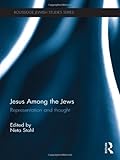
Neta Stahl, ed. Jesus among the Jews: Representation and Thought. Routledge Jewish Studies Series. New York: Routledge, 2012. 248 pp. $135.00 (cloth), ISBN 978-0-415-78258-6.
Reviewed by Michael Cook (Hebrew Union College - Jewish Institute of Religion, Cincinnati)
Published on H-Judaic (December, 2012)
Commissioned by Jason Kalman (Hebrew Union College - Jewish Institute of Religion)
Interdisciplinary Jewish Treatments of Jesus
This anthology of intriguing essays aims to chart how different disciplinary perspectives (e.g., rabbinics, philosophy, theology, poetry, and art) have represented Jesus in Jewish culture from antiquity to the present, even influencing Jewish self-understanding and expression.
Following the editor's introduction, Daniel Boyarin, in "A Jewish Reader of Jesus: Mark, the Evangelist," formulates Jesus as a Jewish suffering Messiah, rooted in pre-Christian messianic readings of the Son of Man (Daniel 7) and the Righteous Sufferer (Isaiah 53)--motifs that fostered emergence of a suffering Christology. Then Michael Swartz, in "The Magical Jesus in Ancient Jewish Literature," investigates the role of magic in what Hebrew/Aramaic Jewish sources say about Jesus from the second through eighth centuries. Avigdor Shinan's "Where Is Jonah From?" brilliantly reveals rabbinic texts that subtly aim to refute Christian typological application of the Jonah tale. In the following chapter, "Celsus' Jew and the Theological Threat from Christianity," Adam Gregerman sophisticatedly looks beyond Jewish-authored texts to reconstruct ancient Jewish views of Jesus; here he focuses on Contra Celsum, Origen's third-century critique of attacks on Christianity by Celsus, a late second-century pagan, and by a (possibly hypothetical) Jew whom Celsus quoted for support.
Moshe Idel, in "Abraham Abulafia: A Kabbalist 'Son of God' on Jesus and Christianity," lays out Abulafia's comfortable integration of Christian theology into his work, and his initiation of discourse with not only Jews but also Christians (even seeking to reach the pope); thereby, Abulafia represents an exceptional moment in Jewish-Christian dialogue. In "From Joshua through Jesus to Simeon bar Yohai: Towards a Typology of Galilean Heroes," Elchanan Reiner connects the figure of Joshua ben Nun in Galilean myth with another son of Galilee, Jesus of Nazareth. He then conjectures that the dissipation of the Joshua foundation myth opened the way to incorporate Simeon bar Yochai, initially as replacing Joshua but ultimately as coming to resemble Jesus.
Matt Goldish, in "The Salvation of Jesus and Jewish Messiahs," unravels why Jewish messianism was attracted to Christianity (instead of ignoring it), even seeking to redeem Jesus! Next is Pawel Maciejko's "Jacob Frank and Jesus Christ," revealing how Frank intertwined kabbalistic, gnostic, and Catholic ideas, and explored interrelationships among Frank's views, Sabbatianism, and the figure of Jesus. Yitzhak Melamed, in "'Christus secundum spiritum': Spinoza, Jesus and the Infinite Intellect," presents Spinoza as sympathetic to Christianity's universal moral teachings yet impatient with miraculous and superstitious elements appealing to believers with limited intellectual capacity. Warren Zev Harvey unfolds the fullest ramifications of what "reclamation" means in "Harry Austryn Wolfson on the Jews’ Reclamation of Jesus." Leora Batnitzky's "Jesus in Modern Jewish Thought" evaluates why, in contrast to medieval Jewish philosophy and classical Jewish thought, Jesus poses fewer problems--indeed, even provides solutions--for some modern Jewish philosophers and theologians.
Several essays from the arts commence with Glenda Abramson's "The Crucified Brother: Uri Zvi Greenberg and Jesus," canvassing this poet's changing representations of the Jesus figure and the crucifixion, and Greenberg's metaphorical applications of them to the Jewish plight within post-World War I Christian Europe. Neta Stahl analyzes poems by Lea Goldberg, Yocheved Bat-Miriam, and Avot Yeshurun in "'We Left Yeshu': On Three Twentieth Century Hebrew Poets' Longing for Jesus"--where Jesus's image served to express their yearning for the European cultural world that they left behind upon immigrating to Palestine. Closing the collection is Amitai Mendelsohn's study of visual representations of Jesus in "Jesus of the Sabra Thorns: The Figure of Jesus in Israeli Art"; these pictorials commonly correlate Jesus's crucifixion with the Jews' collective sacrifice during the Holocaust and also during the State of Israel's wars.
These essays are ably introduced, and are followed by an ample bibliography, but the subject index, while adequate, is not full enough to be sufficiently helpful, and a primary text index is most sorely missing, thereby significantly reducing the book's usability. Collections of essays are often unfairly maligned for what they lack rather than extolled for what they offer. In the present case, however, we confront what appears to be a severe let-down occasioned by a marketing decision. We are nowhere directly told that these essays reproduce the (revised) papers delivered at The Fifth Lavy Colloquium at Johns Hopkins University sponsored by the Leonard and Helen R. Stulman Jewish Studies Program (November 18-19, 2009). Such awareness would have materially enhanced the way the book deserves to be viewed. Only because one contributor (Swartz, p. 18), by innocent happenstance and merely in passing, alludes to some unidentified "conference" did this reader track down what he meant--information, it turns out, that would have redounded to the book's favor (not to mention the sponsors' honor) had it only been mentioned.
If there is additional discussion of this review, you may access it through the network, at: https://networks.h-net.org/h-judaic.
Citation:
Michael Cook. Review of Stahl, Neta, ed., Jesus among the Jews: Representation and Thought.
H-Judaic, H-Net Reviews.
December, 2012.
URL: http://www.h-net.org/reviews/showrev.php?id=35962
 | This work is licensed under a Creative Commons Attribution-Noncommercial-No Derivative Works 3.0 United States License. |

