



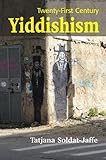
Tatjana Soldat-Jaffe. Twenty-First Century Yiddishism. Brighton: Sussex Academic Press, 2012. viii + 178 pp. $59.50 (cloth), ISBN 978-1-84519-406-2.
Reviewed by Sarah Benor (Hebrew Union College-Jewish Institute of Religion, Los Angeles)
Published on H-Judaic (June, 2013)
Commissioned by Jason Kalman (Hebrew Union College - Jewish Institute of Religion)
Discourses in Contemporary Engagement with Yiddish Language and Culture
What do early twentieth-century Czernowitz, 1970s Mexico City, and today’s London, Berlin, and the United States have in common? Each location had or has people teaching, studying, debating, and creating music in Yiddish. Tatjana Soldat-Jaffe refers to these activities as “Yiddishism,” which she defines as “a field of Yiddish advocacy, an incomplete discursive project for legitimacy for the Yiddish language” (p. 13). This focus on discourse serves as a reminder to researchers that language ideology--individuals’ views about language--drive our use of and engagement with language. This is true for any speech community in any time and place, but, as Soldat-Jaffe reminds us, it is especially true in the case of Yiddish in the twenty-first century.
This book is a slightly revised version of the author’s 2006 dissertation from the University of Illinois. Its main contribution is to point to the wide range of engagement with Yiddish today and show how it is influenced by discourses about Yiddish from the past century. It does this mostly by relying on previously published materials and, contrary to what is promised in the introduction, does not add much original research on the current state of Yiddishism.
The introduction situates the book within academic discourses on Yiddish. Like a recently published edited volume, Choosing Yiddish: Studies on Yiddish Literature, Culture, and History (2012), coedited by Lara Rabinovitch, Shiri Goren, and Hannah Pressman, this book makes the case for expanding the research focus from high literature and linguistic analysis to an interdisciplinary approach and emphasis on pop culture and cultural studies. Soldat-Jaffe characterizes the three sites of contemporary Yiddish activity that are the focus of this book in different ways: Haredi textbooks are an example of “Yiddish without Yiddishism,” American popular culture is an example of “Yiddishism without Yiddish,” and German university classes are an example of “Yiddishism without Jews” (p. 5). This is a helpful categorization of the diversity of twenty-first-century Yiddishism, one that could have been explored more in various parts of the book.
Chapter 1, “Yiddishism and Its Discontents,” offers strong analysis of the debates between Yiddishists and Hebraists at the 1908 Czernowitz conference. It contextualizes Matisyohu Miese and others’ advocacy for Yiddish in light of linguistic minorities across Europe seeking autonomy. And it concludes that the legacy of Czernowitz was to establish “the Yiddish language as a cultural symbol” with a focus on nationalist sentiment (p. 42). This chapter serves as a useful addition to the scholarship about the Czernowitz conference; for a more comprehensive approach, readers should turn to the edited volume Czernowitz at 100: The First Yiddish Language Conference in Historical Perspective (2010), coedited by Kalman Weiser and Joshua A. Fogel, and some of the references cited in that book.
Chapter 2, “Anti-Yiddishism and the Erlikhe Yidn in the United Kingdom,” focuses on textbooks that the author bought in a Haredi neighborhood in London. She connects the discourses surrounding Yiddish in the textbooks with ideologies about secular Yiddish education from a 1970s conference in Mexico and other sites of secular Yiddish pedagogy: “For Yiddish educators of all sorts, advocacy of Yiddish is tied to a narrative about a Jewish way of life in jeopardy from cultural contact and moral virtues of resisting assimilation” (p. 53). These comparisons are useful, but the author does not sufficiently analyze the differences. Haredim use Yiddish as a vernacular, while secular Jews engage with “postvernacular” Yiddish (Jeffrey Shandler’s term in Adventures in Yiddishland: Postvernacular Language and Culture [2006]) as an ethnic marker and for cultural enrichment. Although Soldat-Jaffe characterizes Haredi Yiddishism in the introduction as “Yiddish without Yiddishism,” in this chapter she reads too much Yiddishism into the Yiddish publications of one Haredi community. At the same time, this chapter does give the reader a sense of language mixing in the textbooks of Haredi Jews--including Anglicized Yiddish, Yiddish-influenced English, and Hebrew--confirming and building on previous research on Yiddish children’s books and moral education among current Hasidim.[1]
Chapter 3, “Complexity and Contradiction in Postmodern American Yiddishland,” brings together analysis of newspaper articles about Yiddish words used within English, today’s klezmer musicians, mid-twentieth-century secular Yiddish education, and a curriculum on Eastern European Jewish history and culture recently released by YIVO. Soldat-Jaffe writes that these cultural and pedagogical engagements with Yiddish privilege the status and meaning of Yiddish over competency in the language, a phenomenon that Shandler explores in greater depth in Adventures in Yiddishland.
Chapter 4, “Yiddish or Yidishkayt: Can Yiddish ‘Revive’ in Germany?” offers data from the author’s original survey to explore the motivations of university students studying Yiddish in Germany today. These seventy students (whom the author characterizes as non-Jews without indicating that she asked about their heritage) are mostly interested in Yiddish as a gateway or complement to literature and klezmer music, not as a way of memorializing the Holocaust. This chapter does add a new perspective to the field of Yiddish studies, but it is hard to know how to interpret the survey data without the additional ethnographic data that the author promised in her description of her methodology.
The conclusion offers some closing remarks, including a nice summary of Soldat-Jaffe’s findings about Yiddishism: “the pedagogical complex ... posits Yiddish as a means and ends of linguistic and cultural transmission, resistance, contradiction, complexity, and alterity” (pp. 124-125). The author also connects this study to broader discourses. She writes that “we need to rethink how we talk about minority languages, and opening the sociolinguistic toolbox to methods of cultural studies lets us configure new pathways” (p. 134).
When I read the introduction to this book, I had high hopes. It promised original research about engagement with Yiddish language and culture in several sites around the world today. It promised data from interviews with German students and their teachers. And it promised historical analysis based on archival research. Upon finishing the book, I found very little of those. I was also surprised to find claims with insufficient evidence and inappropriate analysis of quotations presented. For example, she analyzes a quote by Mahmoud Ahmadinejad about the Zionists’ connection to Europe as evidence of the “strong link between Yiddish and Europe” without giving evidence that Ahmadinejad mentioned Yiddish (p. 130). Other examples of problematic analysis can be found throughout the book.
In short, Twenty-First Century Yiddishism is a study of language ideology that makes some important points but fails to move the field forward in significant ways. If you are looking for analysis of neo-klezmer music, Yiddish words in English, or secular Yiddish curricula, this book will disappoint. If you are looking for analysis of discourse about neo-klezmer music, Yiddish words in English, or secular Yiddish curricula, it may be of interest. Despite its shortcomings, Soldat-Jaffe’s book brings attention to the fascinating phenomenon of Yiddish pedagogy and culture in postvernacular mode.
Note
[1]. On children’s books, see Miriam Isaacs, “Languages Sometimes in Contact: Components in Yiddish Hasidic Children’s Literature,” in Yiddish after the Holocaust, ed. Joseph Sherman (Oxford: Boulevard Books, 2004): 131-148. On moral education, see Ayala Fader, Mitzvah Girls: Bringing Up the Next Generation of Hasidic Jews in Brooklyn (Princeton: Princeton University Press, 2009).
If there is additional discussion of this review, you may access it through the network, at: https://networks.h-net.org/h-judaic.
Citation:
Sarah Benor. Review of Soldat-Jaffe, Tatjana, Twenty-First Century Yiddishism.
H-Judaic, H-Net Reviews.
June, 2013.
URL: http://www.h-net.org/reviews/showrev.php?id=35886
 | This work is licensed under a Creative Commons Attribution-Noncommercial-No Derivative Works 3.0 United States License. |

