



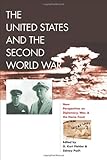
G. Kurt Piehler, Sidney Pash, eds. The United States and the Second World War: New Perspectives on Diplomacy, War, and the Home Front. New York: Fordham University Press, 2010. xii + 400 pp. $45.00 (cloth), ISBN 978-0-8232-3120-1.
Reviewed by Michella Marino (Hastings College)
Published on H-War (December, 2014)
Commissioned by Margaret Sankey (Air University)
Exploring War, Peace, and Society: An Intellectual Tribute to John Whiteclay Chambers II
G. Kurt Piehler and Sidney Pash’s anthology The United States and the Second World War: New Perspectives on Diplomacy, War, and the Home Front serves a twofold purpose. Like many edited essay compilations, this book provides fresh takes on timeworn topics while also presenting new research that addresses gaps in the historiography. But this book also serves as an intellectual tribute to respected historian John Whiteclay Chambers II, a Distinguished Professor of History at Rutgers University. Each contributor studied with or worked alongside Chambers (mostly but not exclusively at Rutgers) and has been influenced by his scholarship, mentorship, and friendship. Piehler conceived the book as a way to honor Chambers and demonstrate his impact on the “writing and teaching of history” (p. x).
In some way, each essay reflects at least one aspect of Chambers’ wide-ranging interests in the interplay between war, peace, and society. Offering a topic for almost any scholar interested in the American war experience, the essays broadly span the origins and conclusion of World War II, the home front, the military at war, oral history and the experience of the individual soldier, and the peace movement. More specifically, the essays cover the following topics: the U.S. Navy’s convoying of merchant ships in 1941, American containment of Japanese expansion prior to Pearl Harbor, the Office of War Information’s role in postwar foreign policy, the sexual morality and fidelity of American military wives during wartime, the defense and criticism of the Sherman tank, how lessons from the Mediterranean amphibious assaults led to the navy’s success on D-day, the importance of the army’s usage of oral history in documenting the war effort, the role of the U.S. Coast Guard in overseas amphibious operations, the wartime reactions and contributions of both secular and religious pacifists, the national and international discussion and debate over the postwar occupation of Japan, and the influence antinuclear activists wielded in molding public memory of the dropping of the atomic bombs.
Since Chambers played an integral role in helping found the Rutgers Oral History Archives of World War II, it is only fitting that the importance of oral history be addressed in the book. Piehler’s essay, “Veterans Tell their Stories and Why Historians and Others Listened,” does this most directly, but Mark Snell draws heavily on oral histories in his essay “Semper Paratus: The U.S. Coast Guard’s Flotilla 10 at Omaha Beach.” Snell helps fill a gap in the historiography regarding the importance of the Coast Guard during the war. He uses oral histories of a variety of Coast Guardsmen, among other sources, to tell the story of the Coast Guard’s overseas military contributions on D-Day in particular, which creates a more nuanced account of their wartime duties.
Piehler, on the other hand, takes a look at the early practitioners of modern oral history and their importance in documenting the war for the military. He shows how combat historians, most notably S .L. A. Marshall and Forrest Pogue, embraced oral history as a valuable methodology and practice much sooner than the rest of the academic world and were integral to the creation of the official history of World War II. In fact, as Piehler asserts, “Marshall provided the Army a usable past by offering important lessons learned regarding the nature of combat. His work solidified institutional support within the U.S. Army for military history, especially oral history” (p. 217). Piehler reveals how the army trained their historians to gather and value the individual testimony of the American solider, i.e., bottom-up history, well before the New Left embraced this methodology in the 1960s and 1970s. This is an important fact, as many early oral historians such as Allan Nevins used oral history in its academic infancy to document the “great men.” Piehler explains how Marshall’s work “not only influenced scholarly debates [on oral history], but in the aftermath of the Second World War, shaped army doctrines” (p. 217).
Overall, the book flows nicely from topic to topic despite its lack of chronology. This flow provides the reader with an easy transition from essay to essay while simultaneously allowing her to jump around to individual pieces of particular scholarly interest. Each of the eleven essays ranges in length from twenty to thirty-five pages, including footnotes, with one major exception. The piece by Barbara Brooks Tomblin entitled “Naval Gunfire Support in Operation Neptune: A Reexamination” bogs down the reader mid-book with its seventy-five pages of what is an exceptionally meticulous exploration of naval gunfire support of the amphibious landings on D-Day. Tomblin draws on an impressive array of archival and secondary sources, but the detailed and often unexplained naval terminology makes the essay largely inaccessible to those without an extensive naval background.
One of the major strengths of the book lies in its reexamination of well-worn topics, such as women’s roles on the home front or America’s responsibility in instigating the war with Japan. For instance, Pash’s essay “Containment, Rollback, and the Onset of the Pacific War, 1933-1941” provides a fascinating look into the gamble the Japanese took in declaring war on Russia in 1904 and their similar gamble in declaring war on the United States four decades later. Japan’s second attempt to defeat a much larger nation ended in a drastically different outcome. Using terms most often associated with the Cold War era, Pash shows how the American policy shift from one of containment to rollback unintentionally accelerated the coming of the war. While the steps leading up to war between the United States and Japan described by Pash are not new discoveries, i.e., the United States freezing Japanese assets and the severing of diplomatic ties between the two nations, Pash’s concise explanation of the history behind these decisions and the larger policy shifts on both the American and Japanese sides shows how both nations came to their decisions regarding war. He adopts a much less conspiracy-minded approach than some modern historians who claim the Roosevelt administration intentionally led us into WWII.
The diversity of the book’s topics is simultaneously a major strength and weakness. Pash and Piehler have amassed a wide array of essays in this anthology, many topics of which are too narrow to include in general overviews of World War II. The book offers snippets of topics one might not get without reading a specialized book on a very narrow aspect of the war. Realistically, as a social and cultural historian, I am unlikely to pick up a tome on military strategy or technology, yet because of the short and accessible essays provided here, I found myself engaged with subjects I otherwise might have overlooked and that surprisingly tied to my fields. For example, Nicolas D. Molnar’s essay “General George S. Patton and the War-Winning Sherman Tank Myth” explains why combat tankers denounced the Sherman tank, why General Patton defended its public “mythical stature” in light of these critiques, and how his defense went far in shaping the public memory of the tank in popular culture, despite the reality of its faults. Molnar’s essay kept me engaged with his interesting narrative, brevity, and ties to past and contemporary popular culture.
At the same time, because of the diversity of topics, a certain level of background knowledge of World War II is needed to appreciate the essays for their contributions to the historiography. Without a general understanding of the complications over the American insistence on unconditional surrender from the Japanese, as discussed in such works as Ronald Takaki’s Hiroshima: Why America Dropped the Atomic Bomb (1995), a reader will not value the debate concerning the Japanese imperial system discussed in Yutaka Sasaki’s essay “Foreign Policy Experts As Service Intellectuals: The American Institute of Pacific Relations, the Council on Foreign Relations, and Planning the Occupation of Japan During World War II.” Or without a working understanding of President Roosevelt’s Lend-Lease programs, one cannot easily follow J. Garry Clifford and Robert H. Ferrell’s essay, “Roosevelt at the Rubicon: The Great Convoy Debate of 1941.” Thus this book is not necessarily accessible to a wide public audience, which is something that is important to Chambers himself, as Piehler declares in the preface: “As a professional scholar, John has stressed the need for historians to communicate their knowledge not only to the academy but also to policymakers and to the general public” (p. xi). The book would serve well in a graduate seminar focused on the war but is too detailed and lacks the requisite background information to assign for undergraduates. Still, this book offers much for scholars interested in America’s role in the Second World War and stands as both an intellectual and touching personal tribute to John Whiteclay Chambers II.
If there is additional discussion of this review, you may access it through the network, at: https://networks.h-net.org/h-war.
Citation:
Michella Marino. Review of Piehler, G. Kurt; Pash, Sidney, eds., The United States and the Second World War: New Perspectives on Diplomacy, War, and the Home Front.
H-War, H-Net Reviews.
December, 2014.
URL: http://www.h-net.org/reviews/showrev.php?id=35786
 | This work is licensed under a Creative Commons Attribution-Noncommercial-No Derivative Works 3.0 United States License. |

