



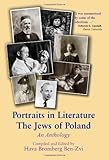
Hava Bromberg Ben-Zvi, ed. Portraits in Literature: The Jews of Poland: An Anthology. Portland: Vallentine Mitchell, 2011. 380 pp. $74.95 (cloth), ISBN 978-0-85303-873-3.
Reviewed by Justine Pas (Lindenwood University)
Published on H-Judaic (May, 2012)
Commissioned by Jason Kalman (Hebrew Union College - Jewish Institute of Religion)
Images of Polish Jewish Literature
In her introduction to Portraits in Literature: The Jews of Poland, Hava Bromberg Ben-Zvi writes that “Jewish literature and culture did not perish from the face of the earth. Inherited and transformed by a new generation of writers, it was reborn, changed and enriched, finding new configurations, images and expressions” (p. xxxv). This sense of homage to a literature and culture of Polish Jews permeates the entire anthology, beginning with Bromberg Ben-Zvi’s essay on the historical context of Jewish life in Poland and ending with selections from writers like Anna Cwiakowska, who continues to write and publish in Polish in Israel. Hailing the cultural and literary continuity as the central idea of her collection, Bromberg Ben-Zvi’s anthology offers a diverse cross-section of Polish Jewish literature, including memoirs, fiction, and poetry. While the selections appear in English, they originate in a multilingual Polish Jewish milieu and include authors who wrote in Yiddish and English, like Abraham Cahan, and Polish-language writers like Janusz Korczak, as well as those like poet Itzhak Katzenelson, who wrote in Hebrew and switched to Yiddish in response to the German invasion of Poland. Bromberg Ben-Zvi’s editorial selections are thus an excellent representation of what literary scholars and historians have acknowledged as modern Jewish multilingualism. Aside from its linguistic diversity, the volume brings together a remarkable variety of authors and genres, reminding us of the stunning breadth and quality of Polish Jewish literary output.
Portraits in Literature is divided into three major sections, each devoted to a particular time in Polish Jewish history and literature. The first, “Our World of Yesterday,” contains seventeen selections of prose and poetry, beginning with fragments of Sholem Asch’s novels. As Bromberg Ben-Zvi points out, while Asch defended himself throughout his life against charges of fostering anti-Semitism for his so-called Christological novels, he should be read and remembered for his sensitive and sympathetic portrayals of Jewish women, whose lives he depicted “with deep understanding, sensitivity sympathy, without minimizing the pressures and values of the times” (p. 10). In fact, and perhaps not entirely by accident on Bromberg Ben-Zvi’s part, the two fragments from Asch’s Children of Abraham (1942) set the tone for the collection as a whole, in that they portray female characters as active agents of their fate, who struggle against traditional prescripts, while attempting to remain part of their respective Jewish communities. This first part also includes a subsection titled “Polish Voices,” with four selections, two from fiction writers (Maria Konopnicka and Eliza Orzeszkowa) and two from Nina Luszczyk-Ilienkowa, whose autobiographical reminiscences about prewar life, translated by Bromberg Ben-Zvi, appear in English for the first time. The remaining two sections, “Years of Flame and Fury” and “To Live Again,” echo the first part’s focus on women and continue to represent powerful female characters, as well as women writers and memoirists who all took an active part in Jewish political, social, and literary life.
The second part of the collection, which focuses on the Holocaust years (“Years of Flame and Fury”) is subdivided into four shorter sections: “The Ghettos,” “Children,” “Resistance,” and “Other Voices: Testimonies of Those Who Helped.” These sections include thirty selections of prose and poetry about those who perished, those who survived, and those who helped during the Holocaust. As in “Our World of Yesterday,” female authors and characters are also prominently featured. For example, “Rosa Robota,” a biographical vignette by Yuri Suhl, poet, writer, and author of the seminal 1967 They Fought Back: The Story of Jewish Resistance in Nazi Europe, tells the story of the hero who supplied the Auschwitz resistance with dynamite from the German factories where she and other young women were forced to labor. As Suhl tells us, when the Germans came upon the trail of the explosives and arrested Robota along with three other female prisoners (Esther, Ella, and Regina), the four, despite hours of torture, revealed nothing of the plot or others involved in it. These brave women paid for their resistance with their lives. Similarly, “Little Wanda with Braids,” also by Yuri Suhl, tells the story of Niuta Twitelboim (underground name, “Wanda”), who carried out many of the most dangerous missions against the Germans in Warsaw. As Suhl writes, “Wanda became a legendary name throughout Poland, a symbol of fearless resistance to the German occupation forces” (p. 189). Twitelboim was tortured and executed by the Gestapo in 1943. On the second anniversary of the Warsaw Ghetto Uprising, the Polish government honored her memory with the highest medal for valor in battle. This powerful section can be perhaps best summarized by a fragment from a selection titled “Jewish Resistance in the Warsaw Ghetto,” by Vladka Meed, who published one of the first eyewitness accounts of the Warsaw Ghetto Uprising. At the end of her tribute, Meed writes that “What must be remembered is that, throughout the Holocaust, every Jew in his or her own way resisted the Nazis; each act of resistance was shaped by its unique time and place” (p. 223). In this section, Bromberg Ben-Zvi gives ample evidence of just such a resistance. Whether it is the well-known story of Janusz Korczak, who voluntarily accompanied the children of his orphanage to their deaths, or the lesser known voices of children in the Warsaw Ghetto, like eight-year-old Natasha, who wrote poems about her experiences, the section testifies to the powerful and sustained Polish Jewish resistance to the German destruction.
While illustrating the continued Polish Jewish literary creativity in the aftermath of World War II, the third and last part of Bromberg Ben-Zvi’s Portraits in Literature, “To Live Again,” includes nine selections. The section is, however, somewhat confusing because it includes material published both before and after the war. There are, for example, two fragments from Abraham Cahan’s famous The Rise of David Levinsky, published in New York in 1917, as well as three poems by Morris Rosenfeld, one of the best-known Yiddish poets who lived in the United States before the start of World War II. Most appropriately, these selections belong in the first section of the anthology, since the volume is organized chronologically. The section is also far too short, with only nine selections, and an absence of authors such as Hanna Krall, Irena Klepfisz, Eva Hoffman, Jadwiga Maurer, Ida Fink, or Henryk Grynberg, to name but a few. It is possible, as Bromberg Ben-Zvi intimates in her introduction, that she had difficulty obtaining copyright permissions for some of the more contemporary texts. As she explains, she had to make choices based not only on “authenticity” of characters, situations, and relationships within Jewish and Polish Jewish communities, but also on much more mundane and pragmatic grounds: “the availability of copyright heirs and the cost of permissions” (p. xxxv). Perhaps the most notable inclusion in this section is that of an author little known in English, Anna Cwiakowska, whose short story “The Polish Wife” (originally published in 1999 in Zony i inne opowiadania [The Polish Wife and Other Stories]) concludes the pages of the anthology. In 1968, Cwiakowska emigrated from Poland to Israel, where she has continued to publish novels, essays, and short stories. Bromberg Ben-Zvi translated the story from the Polish and its intricacy and uniqueness should certainly spark English-speaking scholars’ interest in Cwiakowska’s writings.
Bromberg Ben-Zvi’s anthology provides a rich resource for literary and women’s studies scholars as well as historians. It is a resource that provides samples of many valuable texts and, perhaps even more importantly, directs readers to further study through the bibliographic and biographical notes at the end of each of the selections. Even if such an anthology could rightly contain multiple volumes, Bromberg Ben-Zvi has gone a long way in recapturing and preserving “the memory of a rich life that is no more” (p. xxxv). One of its main strengths, aside from the selection of distinctive texts and emphasis on Jewish life and creativity in Poland, is the volume’s foregrounding of stories by women and about female characters before, during, and after World War II. Most importantly, the book emphasizes the rich and long history of Polish Jewish literature and particularly its rebirth in the aftermath of World War II. It is indeed undoubtedly true, as Bromberg Ben-Zvi’s Portraits in Literature: The Jews of Poland powerfully illustrates, that Polish Jewish culture did not perish, but changed and found new avenues of expression.
If there is additional discussion of this review, you may access it through the network, at: https://networks.h-net.org/h-judaic.
Citation:
Justine Pas. Review of Ben-Zvi, Hava Bromberg, ed., Portraits in Literature: The Jews of Poland: An Anthology.
H-Judaic, H-Net Reviews.
May, 2012.
URL: http://www.h-net.org/reviews/showrev.php?id=35745
 | This work is licensed under a Creative Commons Attribution-Noncommercial-No Derivative Works 3.0 United States License. |

