



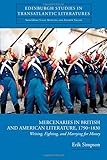
Erik Simpson. Mercenaries in British and American Literature, 1790-1830: Writing, Fighting, and Marrying for Money. Edinburgh Critical Studies in Transatlantic Literature Series. Edinburgh: Edinburgh University Press, 2010. vii + 199 pp. $90.00 (cloth), ISBN 978-0-7486-3644-0.
Reviewed by Timothy C. Hemmis (University of Southern Mississippi)
Published on H-War (May, 2013)
Commissioned by Margaret Sankey (Air University)
Mercenaries in Anglo-American Literature
Erik Simpson’s Mercenaries in British and American Literature, 1790-1830 examines the concepts of mercenaries and warfare in British and American fiction during the late eighteenth and nineteenth centuries. In five chapters, Simpson explores a variety of fictional works, including Charles Brockden Brown’s Ormond (1799), Lord Byron’s Don Juan (1819), and James Fenimore Cooper’s The Spy (1821) and The Bravo (1831). Simpson uses these case studies to prove his argument that with the development of new economic and political systems (capitalism, republicanism, and nationalism) during the close of the eighteenth century, the idea of mercenaries provided a way to break free of ideas of nationalism, loyalty, and identity. Simpson contends that the authors in his study demonstrated a “keen interest in defining their respective relationships to the commercial environment of their times and places, and the authors examined those relationships by writing about multiple, overlapping spheres of mercenary actions” (p. 21). Analyzing fictional mercenary characters in Anglo-American literature, the author illuminates the idea of mercenaries in writing, fighting, and in marriage. His study suggests that there is a connection between nineteenth-century romanticism and the individualism of the mercenary character.
In the introduction, Simpson wrestles with the varying definitions of “mercenary” over time. Citing several important political tracts, such as Adam Smith’s The Wealth of Nations (1776) and the Declaration of Independence, Simpson discusses the eighteenth-century discourse on mercenaries. He suggests that the American War for Independence ushered in a new commitment to a “volunteer defense as a new system displacing the European mercenary trade according with anti-mercenary folk nationalism within Europe” (p. 8). Ultimately, Simpson shows that within the literature the debates about mercenaries, standing armies, and militias had a “transatlantic common ground in the period” (p. 10). Along with wading into a large historical debate about military policy, Simpson also draws analogies between marrying for money, freelance writing, and mercenaries. On the surface, these analogies make a historian cringe, but with some liberty the author highlights the connections between these social and professional activities and mercenary work. As the author demonstrates, mercenaries embodied an inherit individualism distant from a specific authority. This personal individualism can be seen within the “literary presentation of eligible young women in eighteenth and early nineteenth century transatlantic literature” (p. 11). Simpson indicates that young people increasingly (especially unmarried women) had some agency when choosing a potential partner. In British and American literature, he sees a connection between the social autonomy of young women and the rugged individualism of soldiers of fortune.
Each chapter is an independent essay rather than a flowing narrative. Simpson’s organization of his book allows him to cover a large scope, showing connections between mercenaries, literature, and marrying for money. For example, he demonstrates that a large number of male British authors had some link to the military and armed conflict, unlike female writers. The author argues that men like Walter Scott and Lord Byron “stand out for engaging most thoroughly the transnational dimensions, especially the transatlantic and European dimensions, of military service” (p. 90). He goes on to suggest that authors like Scott and Byron influenced American writers, specifically Cooper.
The author dedicates his last two chapters to the analysis of Cooper’s fictional characters--Harvey Birch of The Spy and Jacopo Frontoni of The Bravo. Simpson argues in this chapter that Cooper approached the ethic and modern debates about mercenary warfare. Furthermore Simpson explores the aspect of personal and national loyalty displayed in Cooper’s stories. He also suggests that mercenaries represented “a kind of independence that breaks the bond between military service and national loyalty, and Cooper constructed his vision of the [American] Revolution in part by placing its actors among many kinds of mercenary warriors” (p. 131). Simpson details his argument by dissecting different passages of the fictional works and demonstrates how they relate to writing, fighting, and marrying for money.
Simpson’s Mercenaries in British and American Literature is not a typical history monograph because it is not one. However, it is a true example of how war and the study of warfare can transcend all aspects of society, including literature and the arts. The author analyzes eighteenth- and nineteenth-century fiction to answer questions about fighting and marrying for money. Simpson is successful in providing a new way to examine warfare and its influence on society. Nonetheless, there are some areas left unanswered. For example, are these fictional stories linked to contemporary events of the authors? Further connection to the real historical events would have helped solidify his argument. In addition, there are some questionable comparisons that seemed a bit of a stretch. Simpson sees parallels between British fiction and American history. He suggests that Scott’s works contained Scottish Highlanders who were analogous to American Indians because the Highlanders did not fight in a modern style but used guerilla tactics. He describes Native Americans and Scottish Highlanders as mercenaries in these works. At least to this reviewer, Simpson’s analogy seems tangential at best; however, these shortcomings are few.
In conclusion, Simpson proves his argument that with the development of capitalism, republicanism, and nationalism during the close of the eighteenth century, fictional mercenaries represented a freedom from national loyalty and identity. Overall, Mercenaries in British and American Literature is well written and adds a new perspective to the study of war and society. It is an interesting and thoughtful work that should be read by historians and literature scholars alike.
If there is additional discussion of this review, you may access it through the network, at: https://networks.h-net.org/h-war.
Citation:
Timothy C. Hemmis. Review of Simpson, Erik, Mercenaries in British and American Literature, 1790-1830: Writing, Fighting, and Marrying for Money.
H-War, H-Net Reviews.
May, 2013.
URL: http://www.h-net.org/reviews/showrev.php?id=35666
 | This work is licensed under a Creative Commons Attribution-Noncommercial-No Derivative Works 3.0 United States License. |

