



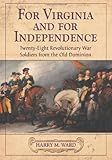
Harry M. Ward. For Virginia and for Independence: Twenty-Eight Revolutionary War Soldiers from the Old Dominion. Jefferson: McFarland, 2011. vi + 219 pp. $35.00 (paper), ISBN 978-0-7864-6130-1.
Reviewed by Timothy C. Hemmis (University of Southern Mississippi)
Published on H-War (December, 2012)
Commissioned by Margaret Sankey (Air University)
Forgotten American Heroes
Larger than life heroes and heroines appear throughout American history, especially in early America. American Revolutionary War figures, like George Washington, John Paul Jones, and Daniel Morgan, have captured the attention of scholars and history buffs alike. Harry M. Ward’s For Virginia and for Independence outlines wartime activities of twenty-eight Virginian soldiers. Telling the untold stories of twenty-seven men and one woman, Ward’s small but potent collection highlights the extraordinary feats of largely unknown American heroes.
Ward divides his book into eleven sections based on the soldiers’ services: “Marines,” “Coast Guard,” “Continental Infantry,” “Continental Cavalry,” “Continental Artillery,” “Militia,” “State Legion,” “Overmountain Men,” “Spy,” “Quartermaster,” and “Commissioner of War.” The bulk of his biographies come from soldiers in the ranks of the Continental army, especially officers. Upfront, the author explains his reasons for focusing on officers: “This book by necessity has to award most of the hero citations to officers rather than to the enlisted men, though it was the latter who were most expected to sacrifice their lives” (p. 1). Ward admits that only four of his twenty-eight short biographies are from enlisted ranks because there are inadequate records for these heroes. Despite his limited number of enlisted men, Ward successfully sheds light on the lives of some deserving Virginian heroes.
Ward’s focus is the hero worship of these semi-legendary figures in Virginian revolutionary history. Heroes include William Grayson, William Washington, the Overmountain Man William Campbell, James Armistead Lafayette, and several more. Each of the twenty-eight mini-biographies tells a similar story with a familiar formula. Ward begins each vignette with a short background of each hero and then depicts their wartime activities highlighting the actions that made each hero stand out.
One of the most intriguing biographies is the story of the legionary Peter Francisco, one of the four enlisted men whom the author includes. Ward highlights the wartime activities of Francisco and dubs him the “Paul Bunyon of the Revolution” (p. 39). The story of Francisco reminds this reviewer of other larger than life early American heroes, like Davy Crockett and Jim Bowie. It is hard to tell the difference between myth and reality with characters like Francisco. For example, Ward tells the story of when Francisco fought wounded at the Battle of Brandywine and when later he saved a vital cannon from being taken from the British by carrying the “1,100-pound cannon ... on his shoulder to safety” (p. 41). Francisco’s other superhuman accomplishments include killing eleven British soldiers during the Battle of Guilford Courthouse in close quarters combat. After the war, Francisco was credited with other epic deeds, including saving thirty or more people from a burning theater by catching them as they leapt from the building.
Two other figures stand out in this collection: a woman (Anna Maria Lane) and an African American slave (Lafayette). Lane, according to Ward, went above and beyond what other women did during the War for Independence and represents the extraordinary efforts of Virginian women. A large part of her brief biography, especially her involvement in the Battle of Germantown, comes from legend and the author’s own speculation. As other female figures, such as Margaret Corbin, Lane resembles the mythical Molly Pitcher. Lafayette, an American spy, volunteered to go behind enemy lines and conduct espionage on the British Army. Acting as a double agent, he effectively relayed reliable intelligence to the Continental army and less helpful information to the British counterparts. Ward touts Lafayette’s valiant courage and heroism as a spy. After the war, the General Assembly granted Lafayette his freedom and provided a small pension to him for the rest of his life.
Ward meticulously highlights the lives of these twenty-eight heroes of Virginia and America. Not focusing on the major characters of the American Revolution, he sheds light on the lesser-known figures who rightly deserve attention in the narrative of Virginian and American histories. Nonetheless most good works are not without flaws. At some moments, this collection flirts with hero worship and spinning great yarns about American legends instead of academic analysis. However, these shortcomings do not detract from its overall quality and its contribution to the field of American Revolutionary War history.
If there is additional discussion of this review, you may access it through the network, at: https://networks.h-net.org/h-war.
Citation:
Timothy C. Hemmis. Review of Ward, Harry M., For Virginia and for Independence: Twenty-Eight Revolutionary War Soldiers from the Old Dominion.
H-War, H-Net Reviews.
December, 2012.
URL: http://www.h-net.org/reviews/showrev.php?id=35665
 | This work is licensed under a Creative Commons Attribution-Noncommercial-No Derivative Works 3.0 United States License. |

