



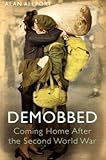
Alan Allport. Demobbed: Coming Home after World War Two. New Haven: Yale University Press, 2009. Illustrations. x + 265 pp. $38.00 (cloth), ISBN 978-0-300-14043-9.
Reviewed by Lynne Taylor (University of Waterloo)
Published on H-War (August, 2012)
Commissioned by Margaret Sankey (Air University)
The subject of Alan Allport’s book, the demobilization of British troops at the end of the Second World War and the soldiers’ experiences upon return to “civvy street,” resonates all to clearly with us today--and not just in Great Britain, but across the Western world, as young men and women have returned home from tours of duty in the Persian Gulf, Iraq, and Afghanistan, to mention just a few of the more recent sites of conflict. His story, told with grace, humor, and sympathy, is all the more telling and powerful as it becomes clear as you read that the situation facing returning servicemen and servicewomen has not changed since 1945.
In a nutshell, although it sounds like a truism, the returning men (for largely men it was in 1945) found adjusting to civilian life a challenge. Initially, they were desperate to get home. Demobilization did not go as smoothly or as quickly as first anticipated, for a number of reasons. Many men found themselves held in the field either because their skills and trades were still needed there or the British government feared too quick a demobilization would create a labor glut at home. Others were transferred to another zone of conflict where the war was not yet over, or to the British occupation zone in Germany once peace had been achieved. The men reacted angrily, frustrated by a life of boredom, seemingly needless military discipline (at a time of peace), waste, inactivity, and muddle. The result was a demobilization process that dragged on, releasing men in dribs and drabs, which meant that their actual homecoming was often distinctly anticlimactic, with little fanfare or celebration of their return.
Both at home and at work, the men had difficulty acclimatizing to the new world. As Allport repeatedly points out, the Britain of 1945 was not what it had been before the war, a “land of nerves fraught by the day-to-day cheerlessness of years of austerity and overwork” (p. 80). It was a country with a “physical and mental landscape [that] had become ... so much ‘smaller’ and ‘shabbier’... after six years of gruelling attrition” (p. 110). The people were “thin, threadbare and exhausted,” mean, short-tempered, and aggressive (p. 111). Neither the civilian population nor the ex-servicemen had much understanding of the others’ experiences or much sympathy. The fact was that many British troops were stationed at bases in rural Britain for much of the war, where they were comfortable, safe, and well-fed, while civilians in major cities bore the brunt of the Axis bombings and the imposed rationing system--an odd reversal of fortune. The stories of those who had been in the Asian theater and prisoners of war of the Japanese for years (an especially brutal experience) were lost in a general dismissal by civilians of the British forces as secondary to the “main show” of the war in the East and thus “miss[ing] out on the ‘real’ war” (p. 118). The ex-servicemen were “so clueless about the difficulties of ordinary postwar life back in Britain that civilians weren’t sure whether to mock them, condemn them, or pity them” (p. 125).
The “disconnect” (this reviewer’s term) between servicemen and civilians carried through into the home. When ex-servicemen appeared on their familial doorstep, many arrived unannounced due to the complexities of demobilization and problems of communication and transportation. Blinded by the “mythology of marital homecoming,” many were shocked by both the reality of daily life at home and by the challenges of renewing their relationship with their wives. Both partners had changed significantly over the course of the war and “some couples were, in short, a complete mystery to one another” (p. 61). Children had to adjust to the reentry of this stranger, their father, into their home. The men had expected to return to domestic bliss--a warm, comfortable, quiet home. The reality was sometimes shockingly different. And it was not just material conditions that shocked them. Britain in 1945 was a country “quietly tormented by sexual suspicion” by both sides and the divorce rate skyrocketed after 1945 (p. 85), although not just for reasons of the war (a recent reform to divorce law made it easier to obtain; and legal aid schemes made available to the forces made it economically possible). Allport’s discussion of the deep suspicions on the part of both servicemen and their wives about their partners’ infidelity, and the consequences of that suspicion, is both particularly gripping and distressing.
That “disconnect” also played out in the workplace. Many of these men had learned new skills and trades and discovered latent talents while in service, and they wanted to put them to use. They had received rank, training, and responsibilities far beyond anything they had ever enjoyed in civilian life. As officers, they had become “temporary gentlemen,” whose place in civilian society was particularly indeterminate (p. 150). While the law required that a man’s prewar job be made available to him, under certain conditions, many did not want to return to their old job, having grown beyond it in a number of ways. Nor did their previous employers necessarily want them back. In one case, a Royal Artillery officer who had commanded a gunnery school in occupied Austria found himself “back making tea at his bank branch in rural Oxfordshire” (p. 138). Another, a Royal Marine commando, found himself being treated like an office boy when he returned to his old job. None of the alternatives--starting their own business, finding alternate work, or retraining for a profession--proved simple or easy. It was a serious blow to their egos and to a whole generation whose intelligence and talents went “unrecognized, untapped, underutilized” (p. 158). Some ex-servicemen tried to recreate the military experience and environment in a variety of ways--from organizing a paramilitary commando organization to battle the British League of Ex-Servicemen and Women, the postwar iteration of Oswald Mosley’s British Union of Fascists; to creating veterans’ colonies (communes for vets, organized along lines that echoed the military structure); and for a few, to embracing a life of crime.
Allport ends his impressive and sensitive discussion of demobilization with a chapter dealing with posttraumatic stress disorder (PTSD), although it was not recognized as that in 1945. His analysis of the military’s slow and reluctant recognition of this very serious and ongoing challenge facing service personnel is an informative one, but it is surprising that he treats it as a separate factor. While this might make it easier to tackle in terms of organizing the book, to separate it from the service personnel’s postwar interaction with civilians--be they wives, children, friends, or employers--is, I think, a mistake. Some acknowledgement that at least part of the “disconnect” had to have been due to the effects of PTSD, even if this was not recognized at the time, would have added an important layer to that discussion. Granted, the sources may not permit this kind of insight (especially given the then-current explanations for the numerous instances of “mental trauma” [p. 193]), so I may be condemning Allport for something beyond his control, but some attempt to address this possible root cause of the service personnel’s difficulty in acculturating after the war is important. It is too significant a contributing factor, and too integral to the lives of many, to be isolated in the explanation of the soldiers’ postwar reintegration into civilian society. As Allport points out in his epilogue, “One prisoner in ten in a British jail today is an ex-serviceman. Amongst the homeless, it is one in four. Young men who have served in uniform are three times more likely to commit suicide than their peers. The country’s highest-decorated soldier, Johnson Beharry,... has called the lack of mental health care provision for veterans ‘a disgrace’” (p. 221). Surely this held true for the late 1940s as well? The mental health of those men undoubtedly shaped their ability (or inability) to make the shift back to “civvy street” just as much as it does today.
Allport’s admiration for men and women in uniform, his distaste for what he describes as mid-century Britain’s “ossified ... social and economic order,” his frustration with the opportunity lost in 1945 to “shake up Britain’s sclerotic mid-century social system,” and the implications of that choice for Britain’s subsequent economic and political history are palpable (pp. 220, 58). Allport offers the American GI Bill as the alternative that proves his point. This piece of legislation, passed in the United States in 1944, provided an array of financial benefits for returning vets ranging from low-cost mortgages, business loans, and tuition and living expenses if they returned to school. It made, according to Allport, a critical difference for this generation of men, allowing many to move into the middle class and providing all with a chance at a degree of social and economic mobility hitherto unimaginable. Allport recognizes that Britain was in no position to offer such a generous and expensive program to its ex-servicemen, unlike the United States, but still bemoans the lost opportunity.
Allport’s is a story that resonates today, if simply because we read about distressingly similar issues and concerns in our newspapers on a daily basis. He writes engagingly, sometimes with a wry humor that brings home his point even more effectively than might a more somber, dour accounting of what was, in the end, a transition badly handled by the British government. In the process, he offers a wake-up call to us all, to take seriously the challenges facing servicemen and servicewomen today who are facing much the same obstacles as the men of 1945.
If there is additional discussion of this review, you may access it through the network, at: https://networks.h-net.org/h-war.
Citation:
Lynne Taylor. Review of Allport, Alan, Demobbed: Coming Home after World War Two.
H-War, H-Net Reviews.
August, 2012.
URL: http://www.h-net.org/reviews/showrev.php?id=35486
 | This work is licensed under a Creative Commons Attribution-Noncommercial-No Derivative Works 3.0 United States License. |

