



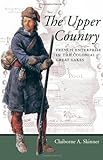
Claiborne A. Skinner. The Upper Country: French Enterprise in the Colonial Great Lakes. Baltimore: Johns Hopkins University Press, 2008. xiv + 202 pp. $50.00 (cloth), ISBN 978-0-8018-8837-3; $25.00 (paper), ISBN 978-0-8018-8838-0.
Reviewed by Gina Martino-Trutor (University of Minnesota)
Published on H-War (September, 2012)
Commissioned by Margaret Sankey (Air University)
Claiborne Skinner’s lively synthesis, The Upper Country, is a welcome addition to Jack P. Greene and J. R. Pole’s series of undergraduate syntheses, Regional Perspectives on Early America. Drawing from the work of historians such as William Eccles, Gilles Havard, and Dale Miquelon, Skinner deftly weaves stories and quotes from primary sources into the larger history of the French empire’s presence in the Great Lakes region. Although much of his synthesis will be familiar to historians and students of the region, The Upper Country provides much-needed balance to portrayals of the French presence in North America as peripheral to British projects in the south and east. The book’s strength lies in its ability to orient the reader as if observing imperial clashes from the region Skinner refers to as the “Middle West.” In this model, battles, diplomacy, and trade in the periphery helped drive events in New England, the mid-Atlantic colonies, eastern New France, and even Europe. Native-French alliances--sometimes idealized and juxtaposed against England’s often troubled relationships with Indian nations--are portrayed as imperfect, unstable partnerships vital to the French project in North America and a larger goal of English containment.
The Upper Country also emphasizes military history, an important contribution to a topic often dominated by discussions of missionaries and traders. Indeed, the author’s stated goal is to explain the origins of the Seven Years’ War, though he wisely devotes the first half of the book to the seventeenth century. This allows Skinner to explore the early decades of the fur trade, the development of France’s North American policies, and its first large-scale imperial wars with Britain. The prologue briefly discusses the evolution of the French fur-trading system and the mid-century wars fought with their allies against the Iroquois. Following this overview, the first two chapters describe France’s growing imperial presence in the colony after the royal takeover in 1663. The takeover and accompanying military assistance led to a temporary defeat of the Iroquois. It also prompted further French exploration and expansion into the interior of the continent.
“War and the Wilderness,” the book’s third chapter, examines both King William’s War and renewed hostilities between the French and the Iroquois. Skinner convincingly argues that events in western Canada and the Great Lakes region propelled the escalation of the war in the east. The culmination of the chapter is the Great Peace with the Iroquois in 1701. Skinner referred to this treaty as “the high noon of New France,” a substantial military and diplomatic victory for France that nevertheless created a new set of potentially fatal problems for the colony (p. 89).
The final four chapters of the book describe the new international system created by the Great Peace of 1701. As Skinner explains, the treaty changed the dynamics of the fur trade, allowing Indians from the Middle West to bypass French markets. In their attempt to assert control over the situation, the French would press ever deeper into the interior. Creating and maintaining new alliances in the central Great Lakes and Mississippi River system proved costly for an increasingly militarized New France. The importance of warfare in France’s North American empire--particularly in New France’s development into a military state in the mid-eighteenth century--has recently received more attention in monographs such as Louise Dechêne’s Le peuple, l'État et la guerre au Canada sous le Régime français (2008). Unlike Dechêne’s hybrid social, political, and military history, The Upper Country is decidedly a history of important European and Euro-American men. This is, however, perhaps a necessity given the scope of the book and its mission. (Readers hoping for an introduction to the social history of New France should look at Allan Greer’s 1997 book, The People of New France.)
The charisma and abilities of these men in their dealings with Native allies is central to Skinner’s understanding of French military strategy and diplomacy as the empire’s presence in the Middle West expanded. The author rightly emphasizes the importance of Native-French alliances to the survival of New France. However, his descriptions of Native motives and actions fall somewhat flat. His reliance on a relatively small number of historians is most evident when discussing Native nations. Skinner tends to underestimate the power of Indian polities such as the Iroquois Confederacy, portraying the Iroquois more as game pieces manipulated by British imperial interests than as actors in their own right (pp. 11, 23).
Skinner’s descriptions of Native ways of life also suffer from a lack of engagement with the historiography. In an otherwise engaging chapter on the French presence in Detroit, the Huron are praised for “the care they took with their fields” and their impressive, double-palisaded town (p. 140). In contrast, the Potawatomi are described as “perhaps less industrious” but “great lacrosse players” (p. 141). In these sections, drawing from historians such as Daniel Richter and James Merrell would have helped to balance the strong French perspective and bring nuance to his portrayals of Native diversity.
One major strength of the book is Skinner’s emphasis on continuing warfare in the Great Lakes region during the years following the Treaty of Utrecht in 1713. This period is often seen as a time of peace leading up to the decisive wars of the mid-eighteenth century. Skinner argues that New France’s largely unsuccessful wars in Wisconsin and Illinois damaged relations with its Indian allies and laid a foundation for future military failures. Perhaps as a result of Skinner’s success in setting up New France’s military and diplomatic blunders in the 1730s and 1740s, it is disappointing when the book concludes without exploring how these events played out in the Seven Years’ War. For example, after reading how New France lost much of its stature with its Indian allies in the Middle West, I had hoped to see how Skinner would interpret later conflicts between Montcalm and Vaudreuil over the value of Native alliances. Still, these are minor quibbles with a book that covers so much ground in such a short amount of space.
This engaging introduction to France’s activities in early America holds appeal for both general and scholarly audiences. Students in undergraduate courses focusing on American frontiers, borderlands, and empires will appreciate Skinner’s sense of narrative as well as the concise, yet informative nature of the book. The Upper Country would also be a useful refresher or brief introduction to the topic for scholars at the graduate level and beyond. In short, The Upper Country is a fine introduction to a rich, complex, and often underappreciated topic.
If there is additional discussion of this review, you may access it through the network, at: https://networks.h-net.org/h-war.
Citation:
Gina Martino-Trutor. Review of Skinner, Claiborne A., The Upper Country: French Enterprise in the Colonial Great Lakes.
H-War, H-Net Reviews.
September, 2012.
URL: http://www.h-net.org/reviews/showrev.php?id=35460
 | This work is licensed under a Creative Commons Attribution-Noncommercial-No Derivative Works 3.0 United States License. |

