



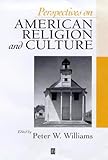
Peter W. Williams, ed. Perspectives on American Religion and Culture. Oxford and Malden, Mass.: Blackwell Publishers, 1999. Xii + 418 pp. $52.95 (paper), ISBN 978-1-57718-118-7; $85.95 (cloth), ISBN 978-1-57718-117-0.
Reviewed by Jeffrey D. Marlett (Department of Religious Studies, The College of Saint Rose)
Published on H-AmRel (November, 1999)
Negotiating Wine and Wineskins: Perspectives on American Religion and Culture
American religious history studies the past. However, what to do when the very methods by which that past is studied have proliferated in seemingly exponential fashion? For roughly twenty years Sydney Ahlstrom's A Religious History of the American People has stood as the reigning study. However, Peter Williams writes, "Not only does our interpretation of the past change as more past accumulates out of the erosion of the present, but new angles of interpretation continue to arise in response to shifts in social and intellectual perspective" (p. 1). This is certainly the case with American religious history--where earlier studies, including Ahlstrom's, focused mostly on institutional and theological (often specifically Protestant) historical issues. While single-theme studies still exist, studying American religion today often utilizes regional and popular culture studies, social history, and specific attention to issue of race, class, and gender.
This provides the background for Perspectives in American Religion and Culture. Edited by Williams, this anthology presents twenty-seven briskly written essays grouped into seven sections covering diversity and pluralism, the religious roots of American culture, religious cultures in transition, popular and material culture, race and ethnicity, gender and family, and intellectual and literary culture. These groupings testify to the astonishing diversity of American religious experience and the accompanying diversity of those studying them. The primarily Puritan and intellectual focus of the grand narrative tradition is still present, but its dominance has been emphatically decentered by essays concerning, among things, Catholic religious artifacts, Mormon expansionism and cultural assimilation, the difficulties facing African-American evangelicals, and the feminization of Jewish sacred space.
The ones studying New England Puritanism (there are four) provide a good example of how the book, to use a biblical metaphor, offers more than just new wineskins but certainly new wine as well. Traditional topics such as conversion experience and the development of theological education no longer dominate. Mary Kupiec Clayton addresses how the very climate and geography of western Connecticut combined with the agricultural economy to foster the popular of New Divinity revivalism. Mark Valeri challenges a simplistic reading of the Weberian thesis by demonstrating the Calvinist divines embraced Calvinism only gradually. In a consciously theological piece, Ava Chamberlain traces Jonathan Edwards' development of hypocrisy's role in salvation. Puritanism's influence remains strong, as Amanda Porterfield shows in her comparison of Anne Hutchinson's religious individualism with contemporary expressions of Buddhism and American Catholicism.
This book shines brightest when it studies what the older narratives ignored. Stephen Stein remarks that "one religious community's orthodoxy is often another religious community's heresy" (p. 23). Other essays examine both sides of Stein's comment, revealing that there is plenty of each to go around. Leonard Primiano discusses Catholic material culture (devotional statues, candles, rosaries, etc.) because "it is still possible to study American religious history and never touch any artifact, see any image, or even visit a site that relates to the lived religion of the people who are the subjects of discussion" (p. 188). Anne C. Rose shows that a mixed religious heritage is not a recent phenomenon; it was in fact quite common in the nineteenth century due to marriage and conversion. Commenting that "we can learn more from Protestant church meals than just a good Jell-O salad recipe," Daniel Sack rescues from oblivion one of America's most mundane religious rituals to demonstrate how food and its preparation function in community relations (p. 204). Lawrence Snyder's contribution on free thought and "the religion of humanity" expands the notion of "religious community" to include primarily intellectual, and in some cases anticonfessional, groups. Paula Kane, whose essay closes the book, offers a wide-ranging study of twentieth-century American Catholic culture. She includes "high" as well as popular examples, such as Catholic literature (which, Kane admits, receives little notice from literary scholars) and Kevin Smith's cult movie classic Clerks (pp. 392-98, 401). The most suggestive of all, though, must be Bill Leonard's use of Catholic theologian David Tracy's hermeneutics to explain the sacramentality of West Virginia snake-handlers.
However, what is omitted lends the work a certain uneven character. The religious investiture of sports goes unnoticed, but surely this is a readily accessible encounter between religion and culture. The popularity of football at Notre Dame and large southern universities, its competition with Sunday morning religious activities, basketball's dethronement of baseball as a national pastime, and even Generation X's embrace of "extreme sports" indicate that many Americans value such activities as religious ones. Another significant oversight concerns the influence of region. For all the concerted effort to move away from Ahlstrom's New England orientation, few contributions consciously move beyond the northeast. Laurie Maffly-Kipp's contribution on religious Gold Rush-era California provides one exception. The particular sensibilities of the Deep South, the Midwest, and the Southwest receive surprisingly little specific attention. Finally, Roman Catholics receive concerted attention in only four articles, even though their numbers have constituted a growing portion of the population.
Some of this might be due to the shift from one author's narrative to the necessarily polyphonous character of an anthology. The essays themselves exhibit quality scholarship. Perspectives in American Religion and Culture- should provide several resources for anyone teaching, or simply interested in, American religious history. At the beginning of my American Religious History course I often haul in my worn copy of Ahlstrom's book. This attempt at humor ("Look at what we could be reading!") also conveys a point about the scholarship concerning the field. Things are different now, and they should be aware that there are many ways to tell the story. In the introduction to each section Williams suggests how the essays there relate to others in the book. A bibliography accompanies each essay. For the material covered, this will give students some sense of the contemporary methodological diversity. Those seeking a traditional overview, of course, might not satisfied. Williams makes it clear that recognizing the discipline's conspicuous diversity offers the clearest path to future insight. The book successfully achieves this goal.
Copyright (c) 1999 by H-Net, all rights reserved. This work may be copied for non-profit educational use if proper credit is given to the author and the list. For other permission, please contact h-net@h-net.msu.edu.
If there is additional discussion of this review, you may access it through the network, at: https://networks.h-net.org/h-amrel.
Citation:
Jeffrey D. Marlett. Review of Williams, Peter W., ed., Perspectives on American Religion and Culture.
H-AmRel, H-Net Reviews.
November, 1999.
URL: http://www.h-net.org/reviews/showrev.php?id=3543
Copyright © 1999 by H-Net, all rights reserved. H-Net permits the redistribution and reprinting of this work for nonprofit, educational purposes, with full and accurate attribution to the author, web location, date of publication, originating list, and H-Net: Humanities & Social Sciences Online. For any other proposed use, contact the Reviews editorial staff at hbooks@mail.h-net.org.

