

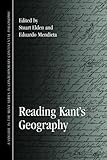
Stuart Elden, Eduardo Mendieta, eds. Reading Kant's Geography. Contemporary Continental Philosophy Series. New York: SUNY Press, 2011. 392 pp. $90.00 (cloth), ISBN 978-1-4384-3605-0; $34.95 (e-book), ISBN 978-1-4384-3606-7; $34.95 (paper), ISBN 978-1-4384-3604-3.
Reviewed by Luise Fischer (University of Edinburgh)
Published on H-HistGeog (February, 2012)
Commissioned by Robert J. Mayhew (University of Bristol)
Reading Immanuel Kant’s Geography: Reading Whose Geography?
Immanuel Kant’s role in Enlightenment philosophical thought has been long and widely discussed--his Critique of Pure Reason (1781) and his essay “What Is Enlightenment?” (1783) are just examples of his well-known philosophy. Kant’s lectures and publications in anthropology have been acknowledged. The fact that Kant taught physical geography has, however, been largely neglected--especially outside of German-language scholarship. Only a few scholars, Erich Adickes (Untersuchungen zu Kants physischer Geographie [1911]) and Joseph A. May (Kant’s Concept of Geography and Its Relation to Recent Geographical Thought [1970]), for example, have discussed Kant lectures on geography. Kant lectured on geography forty-nine times over a period of forty years--every summer semester between 1756 and 1796.
Stuart Elden and Eduardo Mendieta’s edition Reading Kant’s Geography is a masterful attempt “to remedy this glaring neglect” and to haul Kant’s geographical thought out of oblivion--at least for English-language readers (Elden, p. 4). The volume is an excellent analysis of Kant’s geographical thought and a great encouragement for further engagement beyond the relatively little existing research. An introductory essay by Elden and seventeen essays grouped into five thematic parts offer a detailed scrutiny of the themes, issues, and obstacles involved when reading and interpreting Kant’s geography lectures. Elden and Mendieta have compiled a volume that not only provides an excellent and comprehensive engagement with Kant’s geographical lectures but also sets the ground for a critical and reflected reading of the lectures’ forthcoming English translation (Kant: Natural Science, edited by Eric Watkins [May 2012]). Whilst calling for an increased attention to Kant’s geographical engagement, Reading Kant’s Geography raises awareness of the corrupted nature of the preserved German lecture notes and of various textual issues regarding the English translation.
As several contributors point out, two German text editions of Kant’s lectures are preserved: an unauthorized edition by the book dealer Gottfried Vollmer from Mainz who published Immanuel Kants Physische Geograpie in four volumes between 1801 and 1805, and the assembled lecture notes by Kant’s student Friedrich Theodor Rink first published as Immanuel Kants Physische Geographie in Königsberg (Prussia) in 1802. Since Kant authorized and mandated Rink to produce (and publish) the latter edition, Rink’s is considered (more) official, and forms the basis of the forthcoming English translation. The lack of a publication on geography by Kant himself leads several authors to question whether the published notes reflect Kant’s spoken word. Werner Stark doubts that Kant literally dictated texts and points to possible misunderstandings by his students (including Rink). Stark’s reference to the time pressure under which Rink produced his text, and Robert Bernasconi’s reminder that Rink based his edition on “very early materials” and altered or omitted parts (p. 297) make Stark’s claim that “the notes do not provide any text that is actually Kant’s” deeply persuasive (p. 73). “Philological difficulties” of the English translation are addressed substantially by Olaf Reinhardt, the English translator of Rink’s edition (Elden, p. 6). Reinhardt explains in depth differences between the German and English language regarding structure and length of sentences, and punctuation, and he points to the changed meaning of several German words. These “textual and linguistic issues” (Elden, p. 6) allow Stark to state, “so far, nobody--not even I--could have done in concreto what is the general topic of this volume--that is, to read a certain text that can be properly called ‘Kant’s Physical Geography,’” and, “we, who are born at a later date, must abandon the idea of being able to produce the Physical Geography of Immanuel Kant” (pp. 69, 82). One can only hope--together with the editors and authors--that future readers of Kant’s physical geography lectures will be mindful of these textual matters.
Despite these textual problems, Elden regards the surviving notes of Kant’s geography lectures as “not simply a minor concern, but a key topic that needs to be taken much more seriously by scholars of his thought generally” (p. 11). The book offers a “multidisciplinary, and multihanded, approach” by bringing together scholars from numerous disciplines, including geographers, historians, and philosophers who discuss the “importance of Kant’s text for philosophical and geographical work, both historically and in the contemporary context” (pp. 12, 4). Reading Kant’s Geography demonstrates that various debates across disciplines can be informed by reading Kant’s geography lectures, and the edition successfully offers “a range of ways of interpreting that text, but also criticizing it” (p. 4).
The breadth of (transdisciplinary) themes covered manifests itself in the edition’s structure--in the thematic variety of its five parts. In part 1, “The Invention of Geography: Kant and His Times,” Michael Church and Charles Withers elaborate on the wider intellectual context and geographical discourse at the time of Kant’s lecturing on geography. Both authors emphasize that Kant was not the only compiler of geographical information, nor the only philosopher concerned with geography. Withers outlines a comparative analysis to better understand Kant’s role in eighteenth-century geography and Enlightenment discourse. In part 2, entitled “From a Lecture Course of Forty Years to a Book Manuscript: Textual Issues,” Stark and Reinhardt discuss the above problems of the preserved texts and the forthcoming English translation. Max Marcuzzi elaborates on the relationship between geography and history, and on Kant’s concerns regarding space and time, imagination, orientation, and memory in his geography lectures. Marcuzzi’s essay leads over to part 3, “Towards a Cosmopolitan Education: Geography and Anthropology,” in which Robert Louden, Holly Wilson, and David Morris dwell on the intersection between Kant’s geography and anthropology lectures, and their relation to his thoughts on pedagogy, education, human development, cosmopolitanism, and Enlightenment more broadly.
Part 4 (“Kant’s Geography of Reason: Reason and Its Spatiality”) considers Kant’s philosophical thought, and investigates its intersection with geographical vocabulary and imagination. Jeff Malpas and Karsten Thiel identify a “geography of reason”; they disclose a significance of geographical vocabulary for Kant’s work in general and, in turn, see Kant’s philosophical orientation shaping his geography. Onora O’Neill looks at the relation between political and geographical categories; and Jeffrey Edwards investigates Kant’s thoughts on acquisition, possession, land habitation, and community.
The fifth and last part, “Gender, Race, History, and Geography,” explores Kant’s thoughts on race, which are not explicitly discussed in his geography lectures but neither are they detached from them, as the five authors demonstrate. Whilst David Harvey considers Kant’s geography introductory, uncritical, unscientific, and an “embarrassment” which is “more likely to generate hilarity than scientific credibility” (p. 275), Edward Casey responds by arguing that Kant’s geographical descriptions and biases are more diverse than Harvey depicts them. Casey--whose critique seems to speak for many other contributors--objects to Harvey’s one-sided interpretation of Kant’s geographical lectures by suggesting that Kant’s geography contains a spectrum of descriptions, including not only “the most highly biased ‘observations’” but also “more nuanced descriptions” (p. 289). One reason for Harvey’s partial and deficient reading might be his underlying intent to link Kant’s geographical thought with contemporary--especially political--concerns, as Casey indicates. Bernasconi proposes a wider interpretation of Kant’s racial thought in seeing it as part of Kant’s strategy to counter polygenists and in relation to trade interests. Bernasconi further offers a new perspective in the debate on whether Kant abandoned his racial thoughts later in his life by arguing that Kant’s moral philosophy, cosmopolitanism, and racial thought are not incompatible. Walter Mignolo regards Kant as part of a colonial way of thinking and expressing ontological and epistemic racism, and Mendieta extends the discussion to Kant’s thoughts on gender, arguing “that we cannot read Kant’s views on sex without considering what he has to say about both race and geographical difference” p. 363). While Mendieta’s essay serves in part also as epilogue, the other four essays connect several of the themes discussed in previous parts.
The individual essays are further linked by a number of recurring themes. Almost all the pieces debate Kant’s understanding of geography, and his way of structuring geographical knowledge; and (sometimes) different scholarly readings of Kant are expressed. Whilst Withers and Reinhardt argue that Kant considered geography as an introductory and descriptive science, Marcuzzi understands Kant slightly differently, claiming that “geography thus remains, for Kant, a discourse first of all” and “more of an inventory than a genuine description” (p. 134). Harvey conceives of Kant’s geography as mainly concerned with “spatial order” (p. 279), and Withers understands it as an “ordering principle of knowledge” more generally (p. 53).
Numerous other themes occur across the edition. Kant’s resources and his position in geographical and Enlightenment discourse are explored in several essays. Various contributors discuss Kant’s intention behind his geography lectures, and point to their propaedeutic and pedagogical purpose. Kant’s understanding of geography in relation to other types of knowledge--especially history and anthropology--is widely explored; other examples are the relationship between geography, religion, and faith, and Kant’s social and political context. These topics illustrate the many discursive themes Kant engaged with in relation to geographical thought and imagery, and indicate the multiple ways of reading Kant’s geography. Reading Kant’s Geography is hence not only a “space for encounter between Harvey and philosophers who were taking the Geography seriously,” as Elden notes in the introduction, but also a space for encounter between all seventeen contributors (p. 10).
In the end, Mendieta describes the edition as “too early,” soon “obsolete,” and at the same time “‘scandalously’ late” (p. 364). Indeed, Reading Kant’s Geography appears before the English translation of Kant’s geography lectures and yet almost two hundred years after Kant’s death. But will the edition truly become “obsolete” once the English translation has been published? This is to be doubted. The volume is a significant provision against the neglect of Kant’s forty years of geographical (and anthropological) teaching, which will hopefully draw (more) readers to the German and English texts, and perhaps even encourage translations into other languages. With its range of themes and its cautionary remarks regarding the textual and linguistic difficulties of Kant’s geography, it should long serve as reference work--even beyond the appearance of the English translation. One’s surprise about the “‘scandalously’ late” engagement with Kant’s geographical work seems to arise from the fact that this neglect is not only absolute but also relative--relative to the work on Kant’s philosophy and to his anthropology lectures. The reasons for this relative “lateness” are probably many. The noted textual issues, especially the lack of a publication by Kant himself, and the previous absence of a translation are partial explanations: the historical development of geography as a discipline and its late institutionalization might be others, as Church argues. And yet this “lateness” also touches on wider issues: it illustrates time gaps regarding (academic) interest and research agendas between different (language) spaces. Insights on whether the case of Kant’s geography lectures is an exception or an indication for more neglected cases can only--and hopefully will--be revealed by more research. When Withers argues that a better evaluation of Kant’s role in Enlightenment geographical discourse may require “knowing when exactly Kant drew upon others’ findings in amending his teaching” and knowing about his communication with “fellow philosopher-geographers,” he indicates a gap in our understanding regarding the making of geographical knowledge in the eighteenth-century German-speaking world more generally (p. 61). It is certainly unlikely (impossible, Church argues) to fully reconstruct Kant’s sources and his network of correspondents. More extensive engagement with Kant’s and other (German) scholars’ geographical thought, however, might bring further valuable insight into the limits of our understanding of German and Enlightenment geography: it will be of great value to everyone interested in the history of geography and science, and in intellectual history more broadly.
If there is additional discussion of this review, you may access it through the network, at: https://networks.h-net.org/h-histgeog.
Citation:
Luise Fischer. Review of Elden, Stuart; Eduardo Mendieta; eds., Reading Kant's Geography.
H-HistGeog, H-Net Reviews.
February, 2012.
URL: http://www.h-net.org/reviews/showrev.php?id=35328
 | This work is licensed under a Creative Commons Attribution-Noncommercial-No Derivative Works 3.0 United States License. |

