



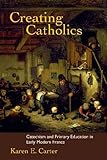
Karen E. Carter. Creating Catholics: Catechism and Primary Education in Early Modern France. Notre Dame: University of Notre Dame Press, 2011. 314 pp. $40.00 (paper), ISBN 978-0-268-02304-1.
Reviewed by Amy M. Harris (Department of History, Purdue University)
Published on H-Education (August, 2012)
Commissioned by Jonathan Anuik (University of Alberta)
“Why do adherents of a particular religious confession believe what they believe?” (p. 1). This seemingly simple question provided the inspiration for Karen E. Carter’s remarkable book Creating Catholics. Through painstaking archival research, Carter has produced an impressive book that is sure to become a landmark work in the fields of early modern history and the history of education. By examining the instruction of children by both village priests and primary school masters, Carter’s study provides readers with a fascinating look inside the formation of Catholics in early modern France. Unlike previous scholarly work, Creating Catholics contends that the sixteenth-century Catholic Reformation, at least in rural France, was not a top-down effort but “the result of interaction between the clergy and the laity” (p. 4). One of the key strategies used to reassert Catholicism among the masses was primary education. Carter argues that by examining the curriculum and pedagogy of early modern French education, often overlooked by historians, scholars can more accurately understand the process of religious indoctrination and rural understanding of faith. Moreover, her book illustrates the limits of absolute power in early modern France by highlighting the important roles that local officials, teachers, and parents played in developing curriculum, educating children, and overseeing schools. Thus more than simply focusing on education, Carter analyzes the very foundation of power itself, both centralized and clerical, in early modern France.
Creating Catholics is divided into two main parts. Part 1, “Diocesan Catechism in Seventeenth- and Eighteenth-Century France,” centers on the role of the catechism in early modern education. Carter argues that Catholic scholars adopted educational techniques that had proven successful for Protestant reformers. Chief among these was the simplification and standardization of the catechism, a document widely used for religious instruction that included the Apostles’ Creed, the Ten Commandments, the sacraments, and instructions for ritualized communication with God. While Protestants were not the first to rewrite the catechism, they were certainly the most successful in turning it into “an inexpensive and portable text that was easy to teach and read” (p. 28). Catholics sought to do the same in the centuries following the Council of Trent. By framing religious education as foundational for education in all other subjects, Catholic officials began to refer to salvation as a “science” that would insure that children would become not only Catholics but also good citizens. In this manner, early modern religious education dovetailed with the works of early Enlightenment thinkers. Although religious doctrine and Enlightenment ideals are often juxtaposed as inherently oppositional, Carter convincingly argues that the primary education offered to students by village priests or in rural French schools often emphasized the very same values championed by early philosophes. Most notably, reformers’ emphasis on enhancing children’s moral character corresponded with Lockean pedagogical theory. Although Catholic bishops and philosophers might have disagreed on what virtue was, they recommended remarkably similar paths to achieve it.
While the first half of the book focuses on the creation of curriculum, the second half examines educational theories put into practice. Part 2, “Primary Education in Auxerre, Châlons-sur-Marne, and Reims,” is where Carter provides much of the archival evidence for her claims. Two chapters, “Cures and the Catechism” and “The Village Schoolmaster,” discuss the training, responsibilities, and expectations of those overseeing rural education. Carter chose to focus on these particular dioceses due to not only the abundance of visitation records but also the quality of those records. The breadth of these archival sources allowed Carter to analyze the relationship between clergy and local laity. Most notably, Carter is able to provide clear answers about the implementation of church doctrine in rural schools by uncovering invaluable information from bishops’ visitation records about the everyday functioning of primary schools. Often bishops were met with examples of imperfect adherence to doctrine thus proving that “early modern Catholicism, as it was practiced all over France, was not simply a result of bishops imposing the will of the church on the laity” (p. 105).
The last two chapters, “Boys and Girls at School” and “Learning to Read, Write, and Recite,” examine respectively the gender composition of the student populations and the ability of primary schools to make students functionally literate. In these chapters, Carter counters previous assumptions that peasant boys were overwhelmingly favored to receive basic instruction over their female counterparts. Although officials certainly sought to impose sexual division in primary schools, rural communities often chose to ignore these restrictions. Due to parental demand and financial necessity, it was not uncommon for schoolmasters to teach peasant girls alongside their brothers. Ideals of sex-segregation common in elite society did not apply to rural communities. For peasant families, it was necessary for all children to receive “the core elements of an early modern education: reading, catechism, and the practices of the Catholic faith” (p. 175).
Carter ends her work by addressing levels of literacy among students. Just as she poses a seemingly simple question to begin her book, she poses another to end it: “Did the children who attended school actually learn and retain what their schoolmasters and schoolmistresses taught?” (p. 198). Traditionally scholars have sought to answer such questions by examining levels of literacy among the peasantry. But is this a viable method? Carter argues that it is incorrect for scholars to assume that the pedagogical goals of early modern schools were the same as their modern counterparts. Emphasis on reading and writing skills were often secondary to the primary purpose of instruction, “to teach children how to be good French villagers,” and by extension, good Catholics (p. 199). In addition, Carter questions other scholars’ methods of determining literacy rates among early modern men and women, noting that signature rates on acts de marriage do not correspond to the availability of instruction. Moreover, she questions whether the inability to sign one’s name implies complete illiteracy. Since primary schools emphasized the teaching and memorization of religious texts and often charged extra fees to teach writing, the ability to sign one’s name is not an accurate indicator of access to education.
With Creating Catholics, Carter has made an important contribution to the historiography of early modern education in France. With a deft hand, she elegantly weaves meticulous archival research with critical analysis of existing historiography. While her findings can only be attributed to her chosen dioceses, the existence of these findings sets a precedent for future scholarly work. Thus, Carter’s work not only fills a gap in the historiography of the Catholic Reformation in France but also provides a template for future scholars of primary education. Most important, Creating Catholics dispels long-held notions concerning the reach of absolute power and access to education in early modern France, making it an essential read for scholars of education in the early modern world.
If there is additional discussion of this review, you may access it through the network, at: https://networks.h-net.org/h-education.
Citation:
Amy M. Harris. Review of Carter, Karen E., Creating Catholics: Catechism and Primary Education in Early Modern France.
H-Education, H-Net Reviews.
August, 2012.
URL: http://www.h-net.org/reviews/showrev.php?id=35319
 | This work is licensed under a Creative Commons Attribution-Noncommercial-No Derivative Works 3.0 United States License. |

