



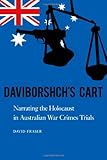
David Fraser. Daviborshch's Cart: Narrating the Holocaust in Australian War Crimes Trials. Lincoln: University of Nebraska Press, 2010. xv + 371 pp. $55.00 (cloth), ISBN 978-0-8032-3412-3.
Reviewed by Timothy Dowling (Viriginia Military Institute)
Published on H-German (August, 2012)
Commissioned by Benita Blessing (Oregon State University)
Truth and Consequences
The University of Nebraska Press note that accompanied this volume states that "Daviborshch's Cart is more than an account of Holocaust perpetrators who found a safe haven in postwar Australia. It is also the story of the Holocaust in the Ukraine, the War Crimes Act, Nazi policies, and the ways in which future generations translate history into law, archives into proof, and law into justice." The author, however, contradicts much of this claim, as well as the title. "This is not," Fraser writes in his introduction, "a detailed and nuanced history of Ukraine.... Neither is it a more focused study of World War II in Ukraine, the brutal occupation regime and its tragic consequences. Nor indeed is it a history of the Holocaust in Ukraine" (p. 16). Fraser also notes that this volume is not the place for a detailed examination of the Menzies Inquiry (p. 68), the attempt to create "an international crimial jurisdiction" (p. 197), or even the legal proceedings against Ivan Polyukhovic for war crimes--one of the three cases upon which the book is based (pp. 94-95, 100). He further states that where "many see Holocaust-related trials as an opportunity to establish in the judicial forum an officialized [sic] version of the truth.... The Adelaide trials offered none of these possibilities. The Holocaust was not contested.... There was no dissident history" (pp. 316-317). There was and is, in other words, no narration of the Holocaust, no translation of history into law and, since the only one case even came to trial, arguably not much translation of law into justice either. So what's left? Surprisingly, quite a bit.
First and foremost, there is a legal case study. Fraser lays out in detail the legal and political background of the (Australian) War Crimes Act, then carefully walks the reader through the only three (thus far) attempts to apply the law in Australia. He provides a meticulous account of how Australian law differs from international law and, using colloquy and other specific examples, shows how the Australian law was applied in each case. Fraser is precise and clear on every point, and the study is easy for a non-lawyer to follow. Still, much of the work is likely of interest only to lawyers practicing or aspiring to practice international criminal law, or Australians.
There should, however, be a much broader audience for this book, for in the interstices of the cases Fraser examines are the ideas of "truth," "justice," "history," and how they interact in court. While it is not exactly a work of philosophy, Fraser's work thus often takes thoughtful and provocative turns that should stir the minds of historians, lawyers, and politicians everywhere. In the Australian War Crimes cases, for instance, the "truth" and the "history" of the Holocaust were not disputed. The defendants did not deny that the Holocaust occurred or even contest the particular forms it took un Ukraine--i.e., that the killings were often carried out by locals working for or with the Germans, or involved shootings instead of gassings. Instead, defense lawyers contested the details of those larger, historical "truths," and the "truth" of evidence given in a different time, in a different culture, and for a different purpose. Some historical evidence was admitted and some, even while admittedly "true," was not. At least one historian was thus "convinced that the law is little concerned with truth" (p. 305).
This is not, unfortunately, an uncommon view; those who hold it, however, would do well to read this book, for Fraser has much to say on the topic that is worthwhile. His frequent and lengthy forays on the nature and problems of translation (both linguistic and cultural) are less novel and thus less successful, but there are other, more stimulating meditations slipped into the overall narrative that will keep inquiring minds busy. Chapter 5, for example, is a long, only loosely related chapter on the interplay between history and literature, as well as a running engagement with the work of Hannah Arendt. In short, there is something here for scholars in any field connected to either law or the Holocaust. It may take a bit of work to piece it all together, but it's not hard work, and it will be worth it.
If there is additional discussion of this review, you may access it through the network, at: https://networks.h-net.org/h-german.
Citation:
Timothy Dowling. Review of Fraser, David, Daviborshch's Cart: Narrating the Holocaust in Australian War Crimes Trials.
H-German, H-Net Reviews.
August, 2012.
URL: http://www.h-net.org/reviews/showrev.php?id=35280
 | This work is licensed under a Creative Commons Attribution-Noncommercial-No Derivative Works 3.0 United States License. |

