



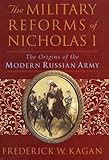
Frederick W. Kagan. The Military Reforms of Nicholas I; The Origins of the Modern Russian Army. New York: St. Martin's Press, 1999. 337 pp. $49.95 (cloth), ISBN 978-0-312-21928-4.
Reviewed by Sarah Badcock (Department of Slavonic Studies, University of Durham)
Published on H-Russia (October, 1999)
A Task Too Great: Nicholas I as Conservative Reformer
Kagan's useful addition to the literature on Nicholas I attempts to challenge the conception of Nicholas I's reign as a return to pre-Napoleonic thinking and stagnancy in the military sphere, using previously unused archival material. Kagan asserts that Nicholas I succeeded in implementing the changes that Russia's military administration required if it was to survive the threefold expansion of the Russian army, and provided a sound administrative base for the further reforms of Alexander II. He proposes another aspect to the argument for Russian exceptionalism, that reforms initiated by Nicholas I and his senior administrators set Russian military structure apart from other European powers, by avoiding the General Staff system, "widely held to be one of the most important military developments of modern times" (p. 1).
An acute Russian military crisis, which was not remarked upon by contemporary observers, because Nicholas dealt with it so effectively, is the starting point to Kagan's work. Kagan regards Nicholas I's main military achievements to have been his recognition that the army was poorly organised, and that the administration was corrupt and inefficient. He dealt with these problems and achieved a codification of military law. He failed, however, to address the more fundamental problems facing Russia: the manpower available under serfdom was inadequate for defending Russia's borders and interior and could not effectively be deployed in other foreign policy initiatives, and the Russian state was simply in too much debt and had too little income to embark on expensive foreign policy initiatives. Nicholas was forced to 'paper over the cracks' in Russia's military system in order to retain Russia's international prestige. This he did, according to Kagan's narrative, with considerable aplomb.
Chapter One summarises the problems Alexander I faced whilst Russia's budget suffered from a large and increasing deficit, in waging war with Napoleon. Alexander left Nicholas with an army of 800,000 men to support, and a huge budget deficit. There were some reforms of the military administration after Russia's failures between 1805 and 1809, which established something equivalent to the Prussian General Staff, but these reforms were formed when war was imminent, and accordingly did not really have provision for peacetime administration. Chapter Two details Nicholas I's first, unsuccessful attempts at codification of military laws. These attempts demonstrate Nicholaevan bureaucrats as active and diligent, and Nicholas himself as personally supporting legal reform. The attempts at codification in 1827 foreshadowed the successful codification in 1836, successful partly because initiative for codification and reform came from within the bureaucracy.
Chapter Three details attempts to economise within the military bureaucracy, and highlights the difficulties faced by bureaucrats in attempting to downsize their departments when their workload was proportionally greater due to the greatly increased size of the army. Kagan asserts that the failure of his attempts to decrease the cost of military administration "confirmed two things in Nicholas' mind. The first was that it was much more important to increase the efficiency of the military administration than it was to save pennies by firing the odd bureaucrat... The second was that the military administration as it was constituted was not responsive to his will and could not handle the administrative load it already faced" (p. 64).
Chapter Four tackles the problems of the 1828 campaign in Turkey. Kagan outlines Russia's war aims, and claims that Russia was not interested in possessing the straits, but in intimidating Turkey. English hostility meant that Russia had to win any Russo-Turkish conflict rapidly, before other forces had a chance to mobilise, but not so decisively that the Turkish empire was destroyed altogether. Kagan then goes on to outline the disastrous course of the first campaign. Besieging Turkish fortresses was considered the most effective way to destroy the Turkish army, but this required a large army, and Russia sent only 100,000 men to fight against the Turkish force of 180,000.
This paucity of Russian troops was explained by troop commitments in the interior, in Poland, and to combat any potential Austro-Turkish attack on Russia. Those troops that were sent to Turkey did not receive the administrative and supply back up they required, and the results were disastrous. Transport, horse and oxen shortages all severely hampered the Russian war effort, and the shortage of reserves, drawn upon earlier than planned due to sickness and supply losses, also became critical. Kagan argues that although expenditure on the army did increase in the period of the Turkish conflict, the army was still painfully underfunded.
Chapter Five points to the main failings in the Turkish campaign, particularly in strategy, in supply, in transport and in the chain of command, and utilises responses to the problems of the three main protagonists, General Vasil'chikov, Chief of Staff Dibich and Commander in Chief Wittgenstein. Kagan then goes on to describe Nicholas's successful change of tactics in Turkey, and his definition of the war aims of Russia as being nothing more than the enforcement of currently existing treaties. Kagan considers the significance of this war to be that Nicholas personally witnessed the painful failures of both his army and his military administration. This set the stage for conservative reform in 1829.
Chapter Six deals with the first stages of military reform between 1831 and 1832, with which Nicholas was closely involved. Chernyshev, a man disliked by contemporaries as an ambitious sycophant, led the reforms, which ultimately concentrated military power in the hands of the war minister, and produced a strong and independent military council, as well as unifying almost all the chanceries. Chapter Seven goes on to discuss the reforms aimed at greater administrative efficiency and effectiveness. Civil service pay scales were increased, and the number of bureaucrats reduced. Military administration was rationalised and centralised.
Chapter Eight details the final stage of the military reforms, the codification of military law. Kagan outlines the conflict between two reformers, Speranskii, who sought the codification to be the basis of a more thorough overhaul of the Russian system of law, and Chernyshev, who saw codification as simply the practical application and completion of previous reforms. Chernyshev won this argument, but Kagan argues that regardless of motivation, the completion of this codification was a major achievement as it placed a firm base of law beneath the Russian state, which allowed development of a modern administration.
Chapter Nine, perhaps the most interesting, looks at Russia's great unresolved military problems, which were diplomatic isolation and a manpower crisis. Despite Russia's apparently large population, the defense of Russian borders was a massive burden for the army. Serfdom restricted what percentage of the population could be called up, and left Nicholas with few alternatives in trying to muster a greater army, or even to maintain the one he already had. Kagan asserts that, in this light, the foreign policy of Nicholas I was nothing more than an elaborate bluff, which aimed to maintain Russian status whilst avoiding conflict that might strain Russia's resources to breaking point; even emancipation of the serfs could not create an army large enough to satisfy Russia's strategic needs.
Kagan concludes by asking the reader to embrace the tragedy of Nicholas I's reign, that no twenty year period could have remedied two hundred years of inadequacy, and that though Russia was humiliated in the Crimean War, 'the deployment of two and a half million men may, in fact, have been one of the most important achievements of Russian arms in the nineteenth century' (p. 243). The crux of what Kagan says is that things would have been worse still without the reforms of Nicholas I, and that the need for more profound reform was not obvious in the period of Nicholas' reign. There is a detailed section on archival holdings that may be useful to other researchers in the field, and a bibliography which serves to guide further reading.
Kagan is certainly successful in explicating the course of military reform in the reign of Nicholas I, and in indicating the importance of these reforms to the development of the Russian army, most critically as a base for the reforms that Miliutin carried out in the 1860's. The book would have been clearer if its structure were laid out thematically rather than chronologically. The chronological pattern leads to inevitable repetitions, particularly in allusions to Nicholas I's concentration on secondary, rather than primary causes for Russia's military failings, and repeated comments on the conservatism of military reform.
In places the chronological approach gives way to confusion --for example, Chapter Four commences with an explanation of Russia's motivations in entering into a war with Turkey (pp. 78-86). The middle of chapter five, however, returns to this theme in a different context, when Nicholas I finally reveals the State's war aims (pp. 125-126). It would have enlightened the reader considerably to have had this information before embarking on narrative of the Turkish campaign. This problem is also apparent in the various discussions on attempts at codification of military law, which ranges through chapters two and eight. A lack of clarity is further apparent when trying to grasp issues such as the development of chains of military command. Again, such development is more clearly explicable when set out together, rather than spread out chronologically through chapters.
A further criticism is directed towards some of the language employed in this work. Abbreviations like CINC/LAA [Commander in Chief of the Large Active Army] are used only a couple of times in the book, and seem somewhat unnecessary, adding confusion, rather than clarity, to the subject. The use of military euphemism in places is distasteful --in Chapter Five, Kagan reports that of 100,000 men led on Constantinople in 1828, only 17,000 arrived at Adrianople, and accounts these losses to 'friction (soldiers dying, getting sick, deserting, getting lost, etc.)' (p.104). There is no place for the word friction here; its meaning was so uncertain that Kagan was drawn to include an explanation, rendering the word superfluous. In Chapter Five, when assessing contemporaries' responses to the failures of the 1828 Turkish campaign, Kagan abruptly goes on to justify his use of modern military terminology, when 'in Russia in 1828 the language and method of thinking that has come to characterise strategic discussions did not yet exist' (p. 121). I remained unconvinced by his justification, and fear that such terminology reduces the book's readability for non-military historians.
These criticisms notwithstanding, this reviewer believes that Kagan's book is an interesting addition to scholarship on Nicholas I, and will serve as a valuable reference work for specialists in the field.
Copyright (c) 1999 by H-Net, all rights reserved. This work may be copied for non-profit educational use if proper credit is given to the author and the list. For other permission, please contact h-net@h-net.msu.edu.
If there is additional discussion of this review, you may access it through the network, at: https://networks.h-net.org/h-russia.
Citation:
Sarah Badcock. Review of Kagan, Frederick W., The Military Reforms of Nicholas I; The Origins of the Modern Russian Army.
H-Russia, H-Net Reviews.
October, 1999.
URL: http://www.h-net.org/reviews/showrev.php?id=3525
Copyright © 1999 by H-Net, all rights reserved. H-Net permits the redistribution and reprinting of this work for nonprofit, educational purposes, with full and accurate attribution to the author, web location, date of publication, originating list, and H-Net: Humanities & Social Sciences Online. For any other proposed use, contact the Reviews editorial staff at hbooks@mail.h-net.org.

