



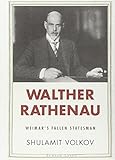
Shulamit Volkov. Walther Rathenau: Weimar's Fallen Statesman. Jewish Lives Series. New Haven: Yale University Press, 2012. ix + 240 pp. $25.00 (cloth), ISBN 978-0-300-14431-4.
Reviewed by Michael A. Meyer (Hebrew Union College - Jewish Institute of Religion, Cincinnati)
Published on H-Judaic (April, 2012)
Commissioned by Jason Kalman (Hebrew Union College - Jewish Institute of Religion)
The Tragedy of a Talented German Jew
When Weimar's foreign minister, Walther Rathenau, was assassinated by right-wing extremists in 1922, having just achieved his goal of reaching the inner circle of political decision making, the outpouring of mourners was astounding. Perhaps as many as a million Berliners marched in the funeral procession with similarly striking numbers in other cities. His friend and early biographer, Count Harry Kessler, asserted that "not since the assassination of Abraham Lincoln has the death of a statesman so shaken a whole nation."[1] Rathenau's death was not only a personal tragedy, but also an all too indicative foreshadowing of the Weimar Republic's own misfortune.
Multiple biographies have been written on this first Jew to achieve a cabinet position in a united Germany, yet his extraordinary life continues to exercise an extraordinary fascination. Shulamit Volkov's brief biography is no mere rehash of earlier studies. It is a highly perceptive, well-balanced, and elegantly written contribution to our understanding of a man who possessed the most varied talents--and engaged in the most agitated private and public struggles. His life moved back and forth between supervising the huge electrical enterprise founded by his distant and difficult father, his striving for political power and influence, and his compulsive need to emerge as a productive intellectual. He had considerable talent in all three areas. It was his competence as an industrialist that ultimately gained him entry into the realm of political power; he possessed a political acumen like few others, even if his positions were inconsistent; and some of his books dealing with abstract matters more than practical ones gained a large readership. Along the way he made both enemies and friends, some of them turning from one into the other. Yet he remained a lonely man, never choosing to marry, for reasons that may have to do with his sexual orientation.
Unlike other ambitious German Jews, Rathenau rejected the possibility of conversion to Christianity, which would doubtless have advanced his career much earlier. Volkov rightly puts him in the category of those Jews who regarded opportunistic apostasy to be an act of cowardice, the so-called Trotzjuden, Jews who would not allow antisemites to dictate their inner lives. Under the transparent pseudonym of W. Hartenau, he even published some "Talmudic Stories." Rabbi Leo Baeck, who received Rathenau's library after his death, reported that it included a multivolume collection of Midrash translations, which presented clear evidence that their owner had delved into it. Yet in Jewish historical writing one essay is invariably cited in brief references to Rathenau. It is his pseudonymous "Hear O Israel," which appeared in 1897, when he was twenty-nine years old, and is invariably taken as a parade example of Jewish self-hatred. There is some truth to that charge. Rathenau firmly detested whatever he believed to be un-German among German Jews: their foreign appearance, their tribal exclusiveness, their men's lack of an athletic build, and their women's ostentatious dress. Jews in Germany needed to undergo a metamorphosis that would make them more German physically as well as mentally. At one point, he even referred to the Jews as "an Asiatic horde" on German soil. Yet he also wanted to ennoble the Jews, raise them to the status of "Jewish patricians, not of property but of spiritual and physical culture."[2] Moreover, in the course of time, his relation to his Jewish origins became more ambivalent and he rarely made an effort to hide it. Volkov captures his Jewish odyssey when she writes that "as a Jew Rathenau moved between self-loathing and intense inner pride" (p. viii). And the Germanism he had exalted in that early essay, he soon came to realize, did not easily stand firm on the pedestal where he had placed it. As Volkov points out, by 1911, he had turned against the Prussian state on account of its deep injustice and counterproductive policies. Although initially a patriotic enthusiast for Germany's cause in World War One and a loyal champion of the kaiser, he broke with expansionists like General Ludendorff on the issue of annexation and opposed unlimited submarine warfare.
In a sense Rathenau's life can even be seen as modeling a self-idealized German Jew. Whereas in "Hear O Israel" he attacked Jews for failing to live up to an ideal, his life was an attempt to show that the stereotype he had himself laid out need not hold even in the present. If Jews were regarded as sloppy, he would dress impeccably (as did Theodor Herzl, who tried to recruit him for Zionism). If their loyalty to Germany was in question, he would present an example of tried and true faithfulness. Most interestingly, through his writings, he showed that even this Jewish industrialist was not a crass materialist, as the antisemites branded all Jews. He showed that he valued the human soul more than the advance of mechanization. Ascending to ethereal realms, his writings demonstrated his profound (and sometimes sentimental) attachment to the transcendental traditions of the German spirit.
Despite the relative brevity of this volume, Volkov magnificently penetrates the character of this most complex individual: the private as well as the public man, the continuities as well as the contradictions. Perhaps because of the book's limits, she avoids the unnecessary detail that often weighs down a biography. She draws usefully from the wealth of extant Rathenau letters, a rich treasure trove collected from the hundreds of revealing letters that he wrote each year. Her idiomatic English is remarkable considering that English is not her first language. Although she does not neglect any aspect of Rathenau's personality and achievements, the Jewish factor in his life remains consistently before the reader. Empathetic as a biographer must be up to a point, Volkov maintains, as well, the necessary critical distance. This volume is one of a number that have appeared so far in the series Jewish Lives published under the aegis of Yale University Press. It follows others that range in subject from the biblical Solomon to Emma Goldman and include Shmuel Feiner's equally outstanding study of Moses Mendelssohn. This volume certainly does honor to the series.
Notes
[1]. Count Harry Kessler, Walther Rathenau: His Life and Work (New York: Harcourt, Brace and Company, 1930), 359.
[2]. Walther Rathenau, "Höre, Israel!" (1897), http://germanhistorydocs.ghi-dc.org/sub_document.cfm?document_id=717&language=german (my translation).
If there is additional discussion of this review, you may access it through the network, at: https://networks.h-net.org/h-judaic.
Citation:
Michael A. Meyer. Review of Volkov, Shulamit, Walther Rathenau: Weimar's Fallen Statesman.
H-Judaic, H-Net Reviews.
April, 2012.
URL: http://www.h-net.org/reviews/showrev.php?id=35248
 | This work is licensed under a Creative Commons Attribution-Noncommercial-No Derivative Works 3.0 United States License. |

