



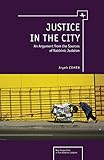
Aryeh Cohen. Justice in the City: An Argument from the Sources of Rabbinic Judaism. Brighton: Academic Studies Press, 2011. 160 pp. $59.00 (cloth), ISBN 978-1-936235-64-3.
Reviewed by Jonathan K. Crane (Emory University)
Published on H-Judaic (August, 2012)
Commissioned by Jason Kalman (Hebrew Union College - Jewish Institute of Religion)
Humane Urbanism Rabbinically Conceived
It is always refreshing to read a book that renders the ancient Judaic textual tradition relevant to the complexities of modern living. Aryeh Cohen’s Justice in the City delves into the Babylonian Talmud and finds there ample ethical, philosophical, and legal sources that paint “a compelling picture of what a just city should be” (p. 9). A just city is not just any city in which residents go about their daily routines with mind-numbing hedonism. Rather, it is to be a “community of obligation” in which those “who are not always in view”--such as the homeless, poor, and working class--are nonetheless attended to and cared for (p. 9). Lest one worry that Cohen’s is an argument for each individual citizen to take on the burdens of caring for all the marginalized in a city and do nothing else, he stresses that it is the city’s responsibility as well to notice and attend to them. In this way a just city is precisely that: a city as a whole that is just (not just the individuals therein).
Cohen draws inspiration for this line of inquiry from his muse, Emmanuel Levinas, especially his brief 1978 Talmudic lecture (on BT Makkot 10a), “Cities of Refuge.”[1] In that piece Levinas compares contemporary cities to those biblically commanded ones that served as refuges for the unwitting committer of homicide. Such cities were to offer sufficient sanctuary for the half-guilty, half-innocent so that they could live therein (see Deut. 4:42). According to the rabbis, these cities must be neither too big nor fortified, they should provide access to water, house ample and mixed populations, and tightly regulate the sale of weaponry. This kind of “humanist urbanism” leads Levinas to assert that religious salvation is impossible without earthly justice: “There is no other access to salvation than that which passes through the dwelling places of men.”[2] A city in which the most marginalized find succor and safety cannot be an outopia, a non-place, but a eutopia, a real (and really) good place in which embodied people live, work and play. Cohen thus develops his book to “flesh out” this “humane urbanism” (p. 13).
Cohen deploys two methods for this task. The first is a “thick analysis” of complete sugyot (Talmudic discussions) instead of a rehearsal of pithy sayings or anecdotes. The second is a Levinasian analysis of asymmetrical obligations among city dwellers, the network of responsibilities that befalls all, even the destitute. Thankfully his writing is not encumbered with technical language of either classic sources or modern philosophy; indeed, he deliberately interrupts his readings with recitations of stories from his own activism on behalf of the marginalized and with facts and figures about their appalling conditions. In this way the book embodies how ancient and modern, generic and particular, personal and philosophical--stories all--necessarily intertwine.
The book has a twofold structure. Part 1 delineates three foundational principles: audibility, dissent, and boundless responsibility. Cities are those places in which the unacknowledged must nonetheless be heard, minorities empowered to protest, and citizens accompany anonymous others into and out of urban centers. Part 2 is more practical, with chapters hearing homelessness, empowering labor, and accompanying individuals and institutions to repair compromised relations.
This last chapter on restorative justice fascinated me most. The impulse to conceive of justice as punitive appears increasingly silly since the modern prison industry bulges beyond capacity and recidivism rates continue to soar. Relationships remain severed in such a system. Unlike punishment, restoring relations between victim and offender, citizen and institution, is more likely to right (cathartically) a prior wrong and also prevent another wrong from occurring at all. Cohen weaves together several classic sources to show that even the rabbis of old understood the importance of stitching back together ripped relations, lest the fabric of society unweave into acrimony if not anarchy. Levinas, though strangely absent from this chapter, could add to the argument, insofar as the rabbinic commuting of lex talionis to a fine demonstrates that the nature of justice is to interrupt the chain reaction of violence begetting violence; it is to manifest the “spirit of kindness.”[3]
Indeed, Cohen could have gone further with Levinas’s notions of justice just as he could have gone beyond the two sources in Levinas’s oeuvre that he cites. Elsewhere Levinas discovers that “justice remains justice only, in a society where there is no distinction between those close and those far off, but in which there also remains the impossibility of passing by the closest.”[4] All too often the closest in a city remain invisible, passed over, unjustly disregarded. Such inequality of treatment can be corrected by another inequality: “the surplus of my duties over my rights” by which I forget myself and attend to the (close) Others surrounding me.[5] Yet forging such inequality at personal and systemic levels is difficult--philosophically, legally, socially--and Cohen’s optimism about the merits of restorative justice seems premature until these challenges are robustly met.
Justice in the City offers a sweeping and easy read regarding these few topics. And this is perhaps the source of my major issue with the volume: its thinness. Cohen’s “thick reading” turns out to be rather thin. Rarely does the book go beyond the editio princeps of the Talmud and dive deep into the manuscript variants of these stories, or show the breadth and depth of intertextual relations between the selected sugyot and other biblical and Talmudic sources or midrashim playing on similar words, themes, and concerns. As noted, his use of Levinas is also rather thin. And the volume itself is thin. Since sociopolitical marginalization is a hugely complex issue, I am surprised this book addresses only three practical issues, two of which are already well examined in the secondary literature. I hope Cohen will turn his ample talents to other pressing issues, such as the deportation of illegal immigrants, how languages isolate and suppress minorities, who can and should be eligible for government education grants. And, of course, larger issues needing attention include who defines disabilities and how, what voting rights the under-documented and seasonal laborer can and should have, and who should have access to what health care. Though more certainly needs to be done to understand the nature of humane cities (rabbinically understood), Justice in the City gives us a refreshing and energetic first glimpse.
Notes
[1]. Emmanuel Levinas, “Cities of Refuge,” in Beyond the Verse: Talmudic Readings and Lectures, trans. Gary D. Mole (London: The Athlone Press, 1994), 34-52.
[2]. Ibid, 38.
[3]. Emmanuel Levinas, “An Eye for an Eye,” in Difficult Freedom: Essays on Judaism, trans. Seán Hand (Baltimore: The Johns Hopkins University Press, 1990), 146-148.
[4]. Emmanuel Levinas, Otherwise than Being, or, Beyond Essence, trans. Alphonso Lingis (Pittsburgh: Duquesne University Press, 1998), 159.
[5]. Ibid.
If there is additional discussion of this review, you may access it through the network, at: https://networks.h-net.org/h-judaic.
Citation:
Jonathan K. Crane. Review of Cohen, Aryeh, Justice in the City: An Argument from the Sources of Rabbinic Judaism.
H-Judaic, H-Net Reviews.
August, 2012.
URL: http://www.h-net.org/reviews/showrev.php?id=35235
 | This work is licensed under a Creative Commons Attribution-Noncommercial-No Derivative Works 3.0 United States License. |

