



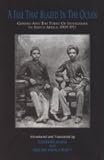
Surendra Bhana, Neelima Shukla-Bhatt. A Fire That Blazed in the Ocean: Gandhi and the Poems of Satyagraha in South Africa, 1909-1911. New Delhi: Promilla and Company, 2011. 213 pp. $56.00 (cloth), ISBN 978-93-8018813-3.
Reviewed by David Hardiman (Warwick University)
Published on H-Asia (March, 2012)
Commissioned by Sumit Guha (The University of Texas at Austin)
Inspirational Poems from a Gandhian Protest
The ongoing nonviolent protests that have been a major feature of world politics in the past few years have raised important questions about participants’ motivation and inspiration to carry out acts that involve so much personal risk. In this collection of protest poems from a much earlier protest, we obtain a vivid glimpse of how this was achieved in Mahatma Gandhi’s campaign for civil rights for Indians in South Africa waged between 1906 and 1914. A new word, satyagraha--meaning literally “sticking to truth,” and sometimes translated more loosely as “soul force”--was created to describe the method of nonviolent resistance that was deployed in this struggle by the racially oppressed Indian community. The poems show that this satyagraha was rooted in existing cultural idioms and traditions. They were composed largely by participants in Indian languages, mainly Gujarati, but also Urdu and Hindi, and are translated here into English by Surendra Bhana and Neelima Shukla-Bhatt. They were all printed between 1908 and 1914 in Gandhi’s campaigning weekly Indian Opinion. The poems sought to instill pride in Indian culture and traditions, depicting these as superior to those of their oppressors, the British and the Boers. They celebrated those who had suffered for the cause, usually by going to jail, as great heroes. They extolled the power of truth that could defeat the greatest tyranny, and they thus imparted a spiritual quality to their protest.
The book has a long forty-nine-page introduction by Bhana and Shukla-Bhatt, which sets the scene, detailing Gandhi’s career in South Africa that is for the most part already common knowledge. The two authors then examine some of the individual poets. These are in some cases interesting characters in their own right, such as Gandhi’s manipulative early companion Sheik Mehtab. Although the authors could have deepened their analysis here from a reading of Thomas Weber’s extended commentary on Mehtab in his book Gandhi as Disciple and Mentor (2004), they provide details about Mehtab’s later career that are not so well known. They are not, however, able to tell us much about the lives of the majority of these activist-poets. Finally, they analyze the actual poems, perhaps the most valuable part of their introduction.
Bhana and Shukla-Bhatt show how these poems drew on longstanding Indian cultural resources. Many followed the pattern of bhakti poetry, which upheld love for both God and fellow devotees as a supreme value, while others followed the ghazal, which was originally a form of Arabic love poetry that was very popular in nineteenth-century India. The authors comment: “The irony of presentation of a forward-looking political ideology in a pre-modern style is striking” (p. 37). Such tropes and symbols were deployed to assert continuity, stability, and cultural pride in an alien milieu, that of South Africa. They depicted truthfulness, generosity, bravery, and self-sacrifice as “Indian” values that could be contrasted with the inferior “modern” values of the colonial ruler. Their power lay in their performance, as they were intended to be recited or sung to an audience.
The introduction is followed by 35 poems, taking up 132 pages, with both the English translation and the original reproduced in Gujarati script (the typesetters of Indian Opinion had only English and Gujarati fonts). One of the main themes that emerges in this poetry is pride in national identity. India’s history was depicted as a series of glorious achievements, and the deeds of mythical and historical characters were extolled. The deeds of the satyagrahis were compared to those of such past heroes. Cases of past heroism, generosity, and self-sacrifice were celebrated, and the deeds of present satyagrahis placed on par with them. Poets sought to give a sense of pride to those branded in South Africa as mere “coolies,” unskilled laborers. Communal harmony was another recurring theme. Although Gandhi claimed that religious tolerance was a feature of Indian culture, he in fact had to fight incipient communal tensions within the movement in South Africa. The poems carried on this task, exhorting those of different religions to pull together for the sake of Indian pride.
Mehtab wrote in one poem: “Muslim or Christian, Hindu or Parsi, we are brothers. By birth, caste, and relationship, we are all Indians,” (p. 135). And in another, he wrote: “Sing the songs of Bande Mataram and Allah Akbar [Hindu and Muslim exhortations respectively] ... pick up the arrow of up the arrow of unity and shoot disunity down” (p. 165). There was also a frequent call for ahimsa (nonviolence), with satyagraha being depicted as a moral value embedded in Indian culture.
The poems vividly present the spirit that informed this campaign in South Africa, helping us to better understand how the supposedly “timid” Indians overcame their fears and courted police beatings and jail. It also shows that many of the values that Gandhi later brought to the struggle in India were first forged and expressed in an emotive and inspiring form in the earlier movement. All in all, this is a valuable collection.
If there is additional discussion of this review, you may access it through the network, at: https://networks.h-net.org/h-asia.
Citation:
David Hardiman. Review of Bhana, Surendra; Shukla-Bhatt, Neelima, A Fire That Blazed in the Ocean: Gandhi and the Poems of Satyagraha in South Africa, 1909-1911.
H-Asia, H-Net Reviews.
March, 2012.
URL: http://www.h-net.org/reviews/showrev.php?id=35196
 | This work is licensed under a Creative Commons Attribution-Noncommercial-No Derivative Works 3.0 United States License. |

