



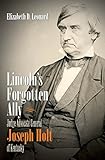
Elizabeth D. Leonard. Lincoln's Forgotten Ally: Judge Advocate General Joseph Holt of Kentucky. Chapel Hill: University of North Carolina Press, 2011. xii + 417 pp. $40.00 (cloth), ISBN 978-0-8078-3500-5.
Reviewed by Mark Neels (Southern Illinois University Edwardsville)
Published on H-CivWar (September, 2012)
Commissioned by Martin P. Johnson (Miami University Hamilton)
New Perspectives on Well-Known Subjects: Elizabeth Leonard’s Lincoln’s Forgotten Ally and the Growing Importance of Historical Biography
Biographies tend to be problematic for most historians. Often, they are far too apologetic for their subjects. I am reminded of James McPherson’s forward to Richard Harwell’s 1997 one-volume abridgement of Douglas Southall Freeman’s Lee, in which McPherson marveled at Freeman’s nonchalance in referring to General Robert E. Lee as a “national hero.” After all, McPherson felt compelled to remind the reader, Lee had fought for four long years to destroy the very nation that now elevated his memory to the level of that of George Washington and Abraham Lincoln. Still, Freeman’s freewheeling attempt at hagiography can be forgiven when the reader understands that it is first, and foremost, a biography, and not a history of the war; for what biographer, in the end, does not admire the person who they have spent--in some cases--years studying? It is the rare historian, however, who can successfully write an objective biography. Nonetheless, in Lincoln’s Forgotten Ally, Elizabeth D. Leonard has succeeded in showing how this discipline has quickly become a legitimate, scholarly tool for finding new means of approaching relatively well-known historical periods.
In the last half-century, Civil War biography has provided us with a new understanding of many well-known American figures. For instance, Joshua Wolf Shenk’s 2006 Lincoln’s Melancholy revived--and confirmed as true--a little-understood aspect of President Lincoln’s personal life that had been adamantly declared by early Lincoln biographers, such as William Herndon, but that had regrettably been almost completely discredited by others of Lincoln’s contemporaries. Similarly, William J. Cooper’s 2001 Jefferson Davis, American, by refusing to view the confederate president’s life through the prism of Davis’s unfortunate actions against the Union he so loved, sought to portray Davis instead as a patriotic man who believed strongly in basic American ideals, such as liberty and freedom. Likewise, in Reading the Man (2008), Elizabeth Brown Pryor joined the ranks of biographers of Lee, such as Thomas L. Connelly, who have sought to unravel the mythos with which Freeman and others had surrounded the general. In the case of Pryor, by weighing Lee’s private life against his military career, she sought to discover the true nature of the man.
Similar accounts have recently appeared for such notable figures as Ulysses S. Grant, John Brown, William Lloyd Garrison, and William T. Sherman. And indeed, this is not an exhaustive list. But, with the ongoing commemoration of the sesquicentennial, historians have likewise delighted readers with new works devoted to an entire crop of secondary characters (who, although less well-known than the giants listed above, nonetheless were crucial to the outcome of the war). In her newest book, Leonard has done the rare work of crafting an objective look about one such “secondary character,” Judge Advocate General Joseph Holt.
A true son of the South, Holt was raised in a Kentucky family with strong political values. An attorney by training, he was incredibly skillful at his craft. Yet, despite continual urging by his meddling uncles, Holt shied away from the political career that so many other attorneys who shared his talent for oratory naturally pursued. Nonetheless, he was not shy in expressing his political opinions, and his rousing speeches in favor of the Democratic Party quickly made him an important figure during the tumultuous decade of the 1850s.
Chosen to head the United States Patent Office by President James Buchanan, Holt became an influential aide to the president during the secession winter of 1860-61, where, despite pressure from his brother to resign his position and join the Confederacy, Holt remained steadfastly loyal to the Union. For such tenacity, Buchanan elevated him to replace outgoing Secretary of War John B. Floyd in the last days of 1860, an office that Holt subsequently occupied into the first days of the Lincoln Administration. As such, Holt suddenly found himself the ranking military officer during one of the greatest crises in American history.
Had Holt’s public career ended there, he would already have rightly gained a place in American history. However, as Leonard suggests, his greatest service to the Union began after he left the war department. Although he had voted for John C. Breckinridge in the 1860 election, over the course of the next four years, Holt’s resolute loyalty to the Union converted him into a staunch Lincoln man. It was a transition that Lincoln, himself, helped to foster. After spending considerable energy serving as the administration’s emissary to the border state of Kentucky, Holt helped Lincoln choose Edwin Stanton to head the War Department in 1862, then joined Stanton there when Lincoln subsequently tapped Holt to fill the position of judge advocate general. It was the partnership of Stanton and Holt, Leonard argues, that ultimately helped Lincoln transition the Northern forces from a “soft” war policy to the “hard” war policy that ultimately won the conflict. For while Stanton and Lincoln worked with various military generals to defeat the confederate armies, Holt and Stanton simultaneously worked to defeat anti-Union sentiment throughout the Northern states.
Leonard is particularly suited to tell this story. Since 1997, she has written five full-length books dealing with nineteenth-century history. Four of them have directly pertained to the American Civil War and its immediate aftermath, and two of those four (including this biography) have dealt directly with the persons and events surrounding the trial of the seven men, and one woman, convicted in the Lincoln assassination. Indeed, my own previous acquaintance with Leonard as a historian has been through her 2004 book, Lincoln’s Avengers: Justice, Revenge, and Reunion after the Civil War, in which she portrays the assassination trial as the opening act of the era of Reconstruction, rather than the closing act of the Civil War. Likewise, it was in this earlier work that Leonard first introduced readers to Judge Advocate Holt as central to the prosecution--a subject she returns to in the later part of this, her most recent work.
Because Leonard’s work is, at heart, a biography of one man, the reader would not be wrong to assume--upon first glance--that many well-known details of the war would be either completely absent, or covered only sparingly, in the way that they affected the subject under examination. And, in thinking thusly, the reader would be correct. For instance, there is little mention of such grand battles as Antietam, Shiloh, or Gettysburg. However, while glancing over some better-known events, one of the merits of biography is its ability to provide greater detail about lesser-known events. For instance, through the prism of Holt’s central importance in the Buchanan administration, the reader is privy to a more complete understanding of the federal government’s actions in response to secession before Lincoln was inaugurated president in March 1861. Likewise, the assassination of the president in 1865 is portrayed through the more intimate perspective of a man who, like his partner Stanton, had grown to respect and admire Lincoln as the most important figure in winning the war, as well as in winning the peace. In fact, Leonard is at her strongest as a scholar in her handling of Holt’s actions as chief prosecutor in the trial of the assassins; for not only is she most familiar with this topic--having previously written a full-length account of it--but it is also here that she most piercingly observed Holt’s fallibility by letting his personal feelings interfere with his public duties.
Overall, Leonard’s Lincoln’s Forgotten Ally should be entertaining for the general reader, and also enlightening for the more serious scholar. While she does not necessarily break new ground in our general understanding of the Civil War and the national figures who conducted it, Leonard does provide a unique perspective into the Northern war machine, and--at the same time--elevates Holt back to his place among the more important secondary characters in that drama. Similarly, her work should serve as an example to future scholars on the important role that biography can play in highlighting the intimate details of greater historic events.
If there is additional discussion of this review, you may access it through the network, at: https://networks.h-net.org/h-civwar.
Citation:
Mark Neels. Review of Leonard, Elizabeth D., Lincoln's Forgotten Ally: Judge Advocate General Joseph Holt of Kentucky.
H-CivWar, H-Net Reviews.
September, 2012.
URL: http://www.h-net.org/reviews/showrev.php?id=35191
 | This work is licensed under a Creative Commons Attribution-Noncommercial-No Derivative Works 3.0 United States License. |

