



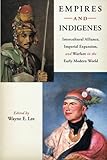
Wayne E. Lee, ed. Empires and Indigenes: Intercultural Alliance, Imperial Expansion, and Warfare in the Early Modern World. New York: New York University Press, 2011. 320 pp. $80.00 (cloth), ISBN 978-0-8147-5308-8; $28.00 (paper), ISBN 978-0-8147-5311-8.
Reviewed by Rainer Buschmann (California State University Channel Islands)
Published on H-Empire (February, 2012)
Commissioned by Charles V. Reed (Elizabeth City State University)
Indigenous Peoples and the European Military Revolution
The flood of literature on the European military revolution has somewhat abated in recent years. The present edited volume seeks to revive interest in this historiographical relic by focusing on what the revolution’s literature has hitherto neglected: the indigenous role in imperial expansion and consolidation during the early modern age (1500-1800). In a strong introductory chapter, Wayne E. Lee closely examines the Habsburg’s conquest of vast Native American empires, which he identifies as the Spanish model. In Lee’s view, the uniqueness of this model derived from a combination of unintentional weapons of conquest (especially pathogens) and the desperation of Spanish actors who lacked the ability to retreat in case of failure. While this feat became the object of collective envy from other European powers, the model was hardly replicable until the arrival of novel technologies and medical breakthroughs during the nineteenth century. Despite its uniqueness, however, the Spanish model still depended on indigenous collaborators to be successful. It is this particular aspect that contributors to this volume interrogate in subsequent chapters. Eschewing the thorny issue of autochthonous origins, Lee prefers to define “indigenous” people as “a people with generations of experiences with the local climate, terrain, and subsistence systems” (p. 9).
The nine chapters comprising the present work are organized into three overarching sections. The first set of chapters takes a close look at cultural, diplomatic, and military exchanges between Europeans and the indigenous peoples whom they encountered. The second section focuses on empire building in the non-Western world. Lastly, the third segment sheds light on the early modern Atlantic world.
Leading off the first section is Jenny Hale Pulsipher’s essay, which examines indigenous impact on the unfolding European expansion in North America. She argues that prior to 1763, Amerindians exploited the competitive nature of European players through marriage and symbolic exchange while taking full advantage of their detailed knowledge of the local terrain and subsistence systems. She maintains that the exit of the French following the conclusion of the Seven Years’ War, however, severely curtailed the indigenous polities’ ability to negotiate with the remaining British forces. Lee builds on Pulsipher’s insights by painting an even bleaker picture of Amerindian agency. Although he maintains that Native Americans incorporated various aspects of the European military revolution in their repertoire, including the ability to repair defective muskets, they still remained dependent on Europeans for a steady supply of fire weapons and gunpowder. They were thus unable to terminate negotiations unilaterally, which tilted the exchange increasingly in favor of the Europeans. Similarly, the arrival of European fortifications broke apart Native American settlements. On the whole, Lee maintains that it was Western disease that took a horrendous toll among indigenous peoples. From a different geographical vantage point, Douglas Peers tackles the question of indigenous influences from the established “gunpowder” empire of the Mughals. He asserts that European military superiority was mostly limited to maritime warfare and that European Orientalist sources greatly exaggerated British military superiority in India. In his assessment, it was the ability of outsiders to manipulate economic forces, in particular the vast labor market of the subcontinent, that ultimately brought about the greatest advantage for British expansion. Taken together, these three chapters form an important interpretive nucleus about indigenous agency within the unfolding European military revolution. At the same time, the authors agree that other ecological and economical factors did much to constrain indigenous ability to contest external control. Moving beyond muskets, strategy, and fortification, the authors maintain that multiple factors need to be considered when approaching the issue of European expansion.
The book’s second section addresses these considerations for regions whose expansion is generally neglected by historians. David Jones argues that the Janus-faced growth of the Russian Empire differed from its European counterparts. He states that, on the one hand, in the West, Russian rulers successfully participated in the European military revolution by winning emerging conflicts. Their eastward expansion, on the other hand, jettisoned the reliance on large-scale armies for a more accommodating policy of incorporation toward horse-riding nomads residing in the vast steppes. Virginia Aksan’s eloquent ethnographic analysis of Ottoman warfare also illustrates differences with the Western tradition. The static division between European and indigenous peoples that characterized European transatlantic empires was mostly absent from the Ottoman expansion until the arrival of clear-cut national identities during the nineteenth century. These two chapters highlight the more accommodating aspects of empire building and underscore that Western European expansion embarked on a different path than the Russian or Ottoman empires.
The last section opens with John Thornton’s assessment of the Portuguese penetration of Angola. Building on his extensive expertise on the Atlantic word, Thornton summarizes the accomplishments of the European military revolution, a topic that most authors of the present volume take for granted. He convincingly argues that the pathogens affecting both Europeans and their livestock made Portuguese expansion a slow and costly endeavor. Success was mostly limited to the Kwasa River Basin, which the Portuguese employed as an inland corridor. Any additional advance was closely tied to the availability of local troops and carriers. In the end, the Portuguese were willing to accept the growing cost of human and animal losses due to the steady stream of war captives who could be employed or sold as slaves. Of all the chapters in the book, Mark Meuwese’s contribution is perhaps most negative about the impact of indigenous peoples on Europeans. Focusing on the Tupi-speaking Potigueres in Brazil, he explores their interaction with incoming Dutch forces who sought to challenge the Portuguese hold during the seventeenth century. Initially, the Dutch successfully employed the Potigueres in their expansion. When the losses of the West India Company increased, however, Dutch officials opted to abandon their venture and left their Tupi allies behind. Unable to withdraw, the Portigueres felt the Portuguese wrath in a destructive war of revenge. Geoffrey Plank looks at two failed eighteenth-century episodes of the employment of tribes in North America, Mohawks in Nova Scotia and Scottish Highlanders in Georgia. He skillfully illustrates the contradictory nature of employing savage warfare in the service of the expansion of civilization. Lastly, Marjoleine Kars focuses on the cooperation between the Dutch and Native Americans in Dutch Guiana to put down a threatening African rebellion. Since the indigenous peoples played such a prominent role during the campaign, she argues that the term “ethnic soldering” is more accurate than “ethnic shouldering.”
Lee and his eight fellow authors should be lauded for their attempts to examine indigenous and imperial relationships in a global context. Their efforts, however, also reveal the work’s major shortcoming. As with most volumes with similar broad temporal and geographical scopes, Empire and Indigenes experiences tensions that make for difficult organization. The tripartite division of indigenous-imperial relations, non-Western empires, and the Atlantic world is somewhat arbitrary. Given that most papers deal with the Atlantic--a total of six out of nine take this geographical dimension--perhaps an emphasis on this important field of historical literature would have been more advisable.
This criticism aside, however, the nine authors present enough evidence to allow for general statements about the possibilities and limits of indigenous peoples. They move away from arguments purely steeped in technological superiority while allowing for indigenous peoples to be at their most active when they employ local knowledge of topography and subsistence systems to their advantage. An additional advantage emerged from their ability to play the European powers against each other, illustrating that the divide and conquer strategy was hardly a European monopoly. Indigenous roots and ties, however, also revealed weaknesses. Most of the indigenes discussed in this volume were unable to abandon a particular venture or locale and move to another place when defeated or faced with declining profits. Here the expansion of European maritime links proved to be a distinct advantage. In sum, Empires and Indigenes should be required reading material for individuals interested in early modern empire building.
If there is additional discussion of this review, you may access it through the network, at: https://networks.h-net.org/h-empire.
Citation:
Rainer Buschmann. Review of Lee, Wayne E., ed., Empires and Indigenes: Intercultural Alliance, Imperial Expansion, and Warfare in the Early Modern World.
H-Empire, H-Net Reviews.
February, 2012.
URL: http://www.h-net.org/reviews/showrev.php?id=34978
 | This work is licensed under a Creative Commons Attribution-Noncommercial-No Derivative Works 3.0 United States License. |

