



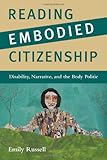
Emily Russell. Reading Embodied Citizenship: Disability, Narrative, and the Body Politic. New Brunswick: Rutgers University Press, 2011. viii + 253 pp. $44.95 (cloth), ISBN 978-0-8135-4939-2.
Reviewed by Andrea Zittlau (Universität Rostock)
Published on H-Disability (August, 2012)
Commissioned by Iain C. Hutchison (University of Glasgow)
Physical, Textual, and National Bodies
Reading Embodied Citizenship takes its departure from the American with Disabilities Act (ADA) that was passed in 1990. The act ensures equal civil rights to people with disabilities, and, by its pronouncement as such, at the time of its passage, it revealed public and legal insecurities about American individualism and identity. Emily Russell sets out to examine “the narrative revisions that take place in the face of these public encounters” with the body perceived to be different (p. 2). Each of the narratives analyzed in the book is seen to represent a central national crisis without reading disabled bodies entirely metaphorically. Russell’s introduction provides a substantial background to citizenship and meditates about the problematic use of disabled bodies as metaphors. The book then concentrates on “flashpoints in the history of twentieth-century American embodiment,” and their reflection in literary works that “enact crisis moments in the enduring connection between physical, textual, and national bodies” (p. 18). Russell organizes the five chapters that follow chronologically, each presenting an American crisis, and includes one or two literary texts in which disability can be crucially related to these crisis and to perceptions of individuality and citizenship.
The first chapter, entitled “Domesticating the Exceptional,” is the strongest of the book. It analyzes Mark Twain’s Pudd’nhead Wilson (1894) and “Those Extraordinary Twins” (1894). Russell brilliantly guides the reader into contradictions of public and private, and normal and pathological, as well as their uncanny potential. The failures of Reconstruction in the era after the Civil War, she notes, resulted in “split dogs, multiracial slaves, and conjoined twins as figures for the nation self” (p. 26). Citizenship is complicated for people with unusual bodies, and Russell masters this difficult intersection between metaphorical and political understanding of the text. The body becomes legal evidence as well as a fantasy manifested in the freakish spectacle. Russell’s inspiring connections to discourses of curiosity, the uncanny, and performance studies form the most fundamental analysis of the two Twain texts published to date.
Having set such high expectations within the reader, the following chapters face the difficulty of keeping up with the excellent beginning. From Sigmund Freud’s Uncanny (1919), Russell moves to the grotesque, analyzing Carson McCullers’s The Heart Is a Lonely Hunter (1940) and Flannery O’Connor’s Wise Blood (1952). Whereas Russell’s understanding of Freud’s Uncanny is very original, there is nothing new about the grotesque in this chapter except that the grotesque citizen becomes a national symbol. The role of the imaginary, the imagined, and the imagining becomes central. She discusses grotesque figures “as a conduit to an obscured or lost reality” that is more related to a general mid-century crisis than the actual post-World War Two scenario (p. 71). Disabled citizens are continuously threatened by isolation since the crowd refuses to acknowledge their individuality, an individuality that is so strangely conforming to the crucial idea of American identity.
The next crisis for the United States that produced disabled bodies which then became “politically eloquent” was the Vietnam War (p. 98). Russell uses the example of Ron Kovic’s Born on the Fourth of July (1976) and Larry Heinemann’s Paco’s Story (1986). Both novels feature male main characters who struggle with the consequences of their severe war injuries. Russell can hardly neglect the very male and patriotic impulse of these novels despite their open antiwar propaganda. They become an “erotic script of national reunion” to her, especially considering the metaphorical potential of the physical impotencies described in them (p. 112). This is no weakness of Russell’s interpretation but of the texts as such in which the entirely strange and different are never the disabled male protagonists but the females they encounter. The national scar then is also a result of insecure masculinity, revealing the national body as predominantly male.
Chapter 4 is based on Katherine Dunn’s Geek Love (1983) and Ruth Ozeki’s My Year of Meats (1998), focusing on the female body, mainly in the context of reproduction. While the male body of the soldier, and the problem of this masculine domain of war, is an issue in the previous chapter, gender issues, like motherhood, reproduction, and pregnancy, are not grasped to their full potential (particularly as a contrast to the previous chapter). Instead, the idea of the collection is introduced in the form of the concept of Americana and the freakish bodies of the novel’s function as a prestigious assembly of American commodities: “The body, especially the body marked as different, is constantly pressed into service as a symbol of America, both as a key metaphor for national belonging and as a model for cultural artifacts” (p. 143). It seems odd that the female body (the authors of the texts discussed in this chapter as well as their protagonists) become part of a commodity context whereas the male voices of the previous chapter have a strong influential political claim even within Russell’s book.
The final chapter deals with David Foster Wallace’s Infinite Jest (1996) and its rich inventory of disabled characters. Here Russell returns to ADA and reads Wallace’s novel as a “disability-inspired alternative to individualism in the multiple forms of corporeal, textual, and political assemblage” (p. 172). Russell lists the several prodigies with which the text works and analyzes the medicalization of the disabled body in particular. Although the chapter is not as intense as its forerunners, it serves as a nice conclusion that ends with a summary of the book’s argumentation.
Russell’s Reading Embodied Citizenship is original in its approach, exploring the idea of American citizenship in relation to literature and the disabled body. The novels have been carefully chosen and intensely analyzed. The narrative potential of the bodies is respectfully explored without turning them into curiosities or spectacles, negotiating them as metaphors and very real markers of identity. Each chapter can be read separately since they deal with different texts, concepts, and time frames. However, as much as this is an advantage, it also becomes the clear disadvantage of the book. Topics that appear throughout, like the spectacle, gender, and the grotesque, remain unconnected. Only when considered as an entity does the book make sense since the individual chapters only refer to the texts they discuss and not to their wider historical context and relationship to a body of different texts and documents. It is a selective account of how we try to make sense of the disabled body, and it is a valuable contribution to the field of disability studies and American literature.
If there is additional discussion of this review, you may access it through the network, at: https://networks.h-net.org/h-disability.
Citation:
Andrea Zittlau. Review of Russell, Emily, Reading Embodied Citizenship: Disability, Narrative, and the Body Politic.
H-Disability, H-Net Reviews.
August, 2012.
URL: http://www.h-net.org/reviews/showrev.php?id=34954
 | This work is licensed under a Creative Commons Attribution-Noncommercial-No Derivative Works 3.0 United States License. |

