



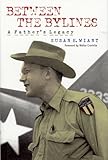
Susan E. Wiant. Between the Bylines: A Father's Legacy. World War II: The Global, Human, and Ethical Dimension Series. New York: Fordham University Press, 2011. Illustrations. 256 pp. $35.00 (cloth), ISBN 978-0-8232-3301-4.
Reviewed by Ida E. Jones
Published on Jhistory (April, 2012)
Commissioned by Heidi Tworek (University of British Columbia)
Getting to Know the Journalist and Man Called Dad
When one reaches middle age a flood of questions bubble up, such as what is life all about? Susan E. Wiant’s Between the Bylines examines that question through the life of her father, Thoburn Hughes “Toby” Wiant, a wartime correspondent for the Associated Press (AP) from 1942 to 1945. This biography serves as a unique history of a journalist using his own words and interpreted by his daughter against the backdrop of the history of World War II. Especially useful to the historian are his civilian letters to his parents, which provide clear real-time reflections of war.
The book is presented in eighteen digestible chapters chronicling the life of Toby Wiant from his birth in 1911 to his death in 1963. Susan Wiant indicates that his journalistic voice in the letters to his parents is essential to understanding how his generation viewed their contributions to world history. Moreover, the letters show the effects of being foreign/war correspondent: apprehension about being taken as a prisoner of war, being hurt, or being killed; as well as witnessing inordinate amounts of human suffering in the era before posttraumatic stress syndrome was diagnosed or treated for noncombatants. These glimpses into Toby’s life are an invaluable source of information on the effects of wartime conditions on journalists, their families, and military personnel.
The motivation for the book stems from Wiant’s daughter, Susan, who compiled and edited his letters, articles, and unpublished autobiography for publication. Toby died when Susan was fifteen years old. During their time together, his life was plagued with bouts of alcoholism. He joined Alcoholics Anonymous and turned his life around several times.
At age twenty-five, Susan Wiant received from her paternal grandmother a box of 150 letters and scrapbooks of her father kept since his childhood and throughout his career. That cache of primary sources provided another voice of her father--the journalist. “The bespectacled, occasionally stern man from my childhood became a three-dimensional human being whose admitted failings, stubborn dreams, and well-earned accomplishments continue to serve as strong motivators for me” (p. 9).
So who exactly was Thoburn Hughes “Toby” Wiant? Toby was born April 23, 1911, eldest of two sons to Warren Wiant, a Methodist minister and pillar of the community, and Myrtle Wiant. His first and middle name Thoburn and Hughes memorializes two Methodist bishops, possibly Bishop James Thoburn who served in India and Malaysia and Bishop Edwin Holt Hughes, a Christian educator.
In 1930, Toby was enrolled at DePauw University where he wrote for The DePauw, the school newspaper. He published a weekly student opinion column on campus issues. While at DePauw and dating his future wife Betty, he and Betty returned to her dorm just after curfew and were greeted by an enraged dorm mother whose verbal assault resulted in an equally angered Toby storming off to The DePauw newsroom to pen a denouncement of school policy under the name G. A. B. Toby’s personal politics ran afoul of campus culture resulting in his removal from the editorship of The DePauw and the completion of his degree in liberal arts without graduating with his class. Nevertheless, degree in hand he was hired by the Indianapolis News in 1932, then the state news wire for AP in 1934. By 1939, he was promoted to the AP New York office. The outbreak of World War II and the bombing of Pearl Harbor in December 1941 radically changed the focus of AP from New York society to foreign affairs, changing Toby’s task along with it.
In November 1942, a confident Toby informed his parents about his assignment in India. “Quite frankly, I’m no hero, but I don’t fear anything I’ll have to face over there. I have a job to do, and I’m going to give it everything I’ve got” (p. 37). The scenes of war are vivid accounts of nonmilitary personnel riding along with gunners, flying with combat troops, and seeing the enemy forces up close. In an October 12, 1943 article, he wrote: “The forgotten men of combat flying are the ground crews. They don’t get the headlines, or medals. They are mentioned in communiqués. But there wouldn’t be any communiqués, if the ground crews weren’t on the job, before and after each raid” (p. 154). He continued to describe the scene: “I was leaning over the shoulders of our pilot and our acting copilot ... when ack-ack shattered our right windshield.... We were showered with glass. A large piece hit me on the chest. And I fell back on the flight deck, positive I’d been shot. I stuck my hand inside my shirt to find out whether I was bleeding. I wasn’t!” (p. 156).
Numerous scenes of military engagements, loss, and grief plagued Toby during the war. Moreover, the letters speak of a foreign correspondent’s impression of the “real” impact of war on one’s psyche and endurance. On April 14, 1945, Toby wrote to his parents that “the curtain is about to go down on the final act of this war in Europe, thank God.... I’ve never worked as hard, nor been under such pressure as in the past few weeks. I’ve returned from trip after trip to the front, convinced I couldn’t do it again--ever.... I’ve seen concentration and prison camps unbelievably inhuman” (p. 265).
Susan Wiant does a good job in providing context to the reader about military engagements from 1942 to 1945. The photograph section contains images of Toby dressed in service uniform mingling with servicemen as well as top military brass, such as General George S. Patton. These pictures with accurate captions aid readers whose only memory of World War II are films and documentaries. In June 1945 Toby resigned from the AP. In August 1945 he joined Young and Rubicam Inc. advertising agency and was assigned as public relations director for the Packard Motor Company.
Toby’s life was a rollercoaster ride of professional and personal loops and dips. During his bouts with malignant melanomas and two heart attacks, the words of a military rifleman encouraged him: “You lose fear through faith. With faith you have courage. If you have enough faith you can do anything” (p. 316). His life came full circle when he was asked to speak at this twenty-fifth reunion of his DePauw University class. His speech was entitled “Let’s Never Graduate.” In his address, he admonished classmates to move from occupation to occupation, become a student of life, and never settle for idleness.
Useful for students of journalism, history of journalism, or avid biography readers, Between the Bylines is well crafted from primary sources allowing the subject to speak for himself. Usually many military accounts are written from a top-down perspective or from combatant to civilian. Susan Wiant’s access and use of Toby’s voice add depth to experiencing war through an adventurous and troubled journalist, whose postwar life was equally troubled.
If there is additional discussion of this review, you may access it through the network, at: https://networks.h-net.org/jhistory.
Citation:
Ida E. Jones. Review of Wiant, Susan E., Between the Bylines: A Father's Legacy.
Jhistory, H-Net Reviews.
April, 2012.
URL: http://www.h-net.org/reviews/showrev.php?id=34872
 | This work is licensed under a Creative Commons Attribution-Noncommercial-No Derivative Works 3.0 United States License. |

