



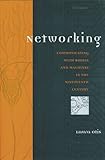
Laura Otis. Networking: Communicating with Bodies and Machines in the Nineteenth Century. Ann Arbor: University Of Michigan Press, 2011. 284 pp. $29.95 (paper), ISBN 978-0-472-03490-1.
Reviewed by Kate Edenborg (University of Minnesota)
Published on Jhistory (May, 2012)
Commissioned by Heidi Tworek (University of British Columbia)
Making Connections
“Networking” is seemingly such a twenty-first-century term, but Laura Otis reveals that it has origins much, much earlier. Her book focuses on the nineteenth century, explaining that “references to communication systems as webs and networks have filled scientific and literary writing for at least 150 years” (p. viii). Yet the terms and themes she draws from are so clearly connected to today’s social media world. While many books draw on the importance of narrative and storytelling for communicating, Otis takes a precise and key piece of how we communicate, the metaphor, and explores it in fascinating depth. Otis argues for the power of metaphor in understanding the world, writing, “It seems hard to believe that such lasting pervasive figures [metaphors] say nothing about industrial culture, the minds of its creators, or both” (p. viii). Otis reveals these “families of metaphors” (p. viii); she shows us how language and history reveal the pervasive connectedness between and amongst diverse and sometimes divergent disciplines that occurs at particular cultural moments.
The key theme of the book is the interwoven nature of culture and science. In fact, Otis says that culture shaped science--especially literature. The book articulates history by following the use of metaphors as they are employed simultaneously in different disciplines such as engineering, physiology, and literature. The idea of intertwined networks fits well with how Otis presents her work. It’s not a clean, chronological presentation of information but a multilevel connection of ideas and concepts. The concepts and ideas presented in the book are intensely engaging, but very dense. While there is an overwhelming amount of information in this book, the organization of the chapters provides some guidance and structure. The first two chapters after the introduction discuss two of the terms that are especially intertwined: “nerves” and “web.” Both chapters provide a broad sense of what these terms meant in different disciplines and how language was used to describe them. The chapters are filled with details from both American and international books of the era, such as German physicist and physiologist Hermann von Helmholtz’s textbook on theoretical physics. The chapter on the web relies partially on the ideas presented in lectures of physiologist Emil DuBois-Reymond. These chapters show how use and determination of metaphor reveal the intricacy of power embedded in how we conceive of our communications systems.
The third chapter brings these separate discussions into the literary realm of George Eliot’s book Middlemarch (1874). Eliot’s knowledge of natural and physical science informed her writing and ultimately created the structure of her novel and likely led to her use of web imagery. Otis suggests that the novel “offers the communications web as an epistemological and moral model, suggesting that the securest knowledge and the finest life are those richest in connections” (p. 81). Hers is a dynamic view of what networks could offer. When Eliot wrote Middlemarch, the world had gained knowledge about communication in the nervous system and railways and telegraphs. The timing of scientific and technological advances ties closely to the optimism and hope expressed in her use of the communication metaphor.
The next chapters explore the language of wires and then move to a discussion that is tied more directly to technology, focusing on telegraphers. Perhaps the most interesting elements here are the frustrations people express when the technology, network, or wires don’t seem to be effective. These chapters reveal the complex reactions and perceptions about technological advances. Here again one can see how this is not too far removed from what hear about or experience today. Once a new standard--whether it be in science, technology, or language--is set, expectations are also set. The final chapter examines a web without wires. Once again, Otis provides an investigation of the historical origins of what had appeared to be a present-day concept. Otis compares Bram Stoker’s perhaps pessimistic perspective about how communication channels are ripe for exploitation, compared to Eliot's optimism of dynamism.
The thought-provoking book offers up a wealth of ideas about language, culture, and technology, all of which is summed up in this statement: “in suggesting ways to convey information, art can sometimes lead the way” (p. xii). You could spend entire semesters of a graduate seminar exploring just one or two chapters of the book. For example, in the introduction the subject goes from artificial intelligence to Facebook to George Eliot--all in one page (p. x). The progression of the book seemingly moves from discussing the hidden or unseen communication in science, to something tangible like wires, back to something less visible again today. Otis focuses on how metaphor is used in a variety of nineteenth-century works to compare living and technological networks. An obvious concept, it is one that many of us have not likely thought of quite in the way she presents it. While reading her book, you find yourself nodding and saying, “Why, yes, of course.” Like metaphor, the information she imparts in her book is already in our minds but she pushes the reader to explore the concepts of networks and webs in greater and more historical depth.
If there is additional discussion of this review, you may access it through the network, at: https://networks.h-net.org/jhistory.
Citation:
Kate Edenborg. Review of Otis, Laura, Networking: Communicating with Bodies and Machines in the Nineteenth Century.
Jhistory, H-Net Reviews.
May, 2012.
URL: http://www.h-net.org/reviews/showrev.php?id=34837
 | This work is licensed under a Creative Commons Attribution-Noncommercial-No Derivative Works 3.0 United States License. |

