



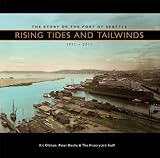
Kit Oldham, Peter Blecha. Rising Tides and Tailwinds: The Story of the Port of Seattle, 1911-2011. Seattle: University of Washington Press, 2011. 128 pages. Illustrations. $19.95 (cloth), ISBN 978-0-295-99131-3.
Reviewed by Steven Beda (University of Washington)
Published on H-Environment (May, 2012)
Commissioned by David T. Benac (Western Michigan University)
Beda on Oldham and Blecha
“The history of Seattle is to a great extent the history of its waterfront” (p. 6). So begins Rising Tides and Tailwinds, Kit Oldham and Peter Blecha’s new history of the Port of Seattle. This is a bold claim, but one the authors support, and support well. In a narrative that stretches from the late nineteenth century to the present, Oldham and Blecha show how questions over the building and expansion of the port significantly shaped Seattle’s economic, political, and social landscape. When finished with this book, it is hard to think about Seattle’s history independent from its shoreline.
Oldham and Blecha are both staff historians at HistoryLink (www.historylink.org), an online encyclopedia for Washington State history. Unlike other, perhaps more popular online encyclopedias, the entries on HistoryLink are credited to an author, based on properly citied primary and secondary source materials, and are well written and carefully edited for both content and style. Oldham and Blecha’s work on HistoryLink therefore makes them well versed in Seattle’s history and well practiced in writing the type of engaging and informative prose that appeals to a broad audience.
The argument running throughout Rising Tides and Tailwinds is that throughout the past one hundred years, port officials have effectively responded to changes in regional, national, and international markets, thereby keeping the port, and by extension Seattle, prosperous and economically relevant. Prior to the port’s founding in 1911, Seattle’s waterfront was “a chaotic mess,” where dozens of competing railroads terminated at small privately owned docks (p. 9). In the early twentieth century, city leaders believed that Seattle could become a major site of national and international trade, but feared that this chaos would inhibit growth. Progressive-Era reformers proposed a publicly built, owned, and operated port as the solution. This “public enterprise” model proved “productive and enduring” and allowed the port to change along with the times (p. 7). During World War I, officials effectively expanded the port to take advantage of the increase in Pacific trade, which paved the way for Seattle to become a center of wartime industry during World War II. In the postwar period, port officials undertook the building and managing of Sea-Tac airport, which again bolstered the local economy and helped Seattle transition into the jet age. And, Seattle was one of the first Pacific Coast ports to move to containerized shipping, which has had significant economic benefits as Asian trade has increased in the past few decades.
While Oldham and Blecha give readers a good sense of how large historical changes like the shift from a national to an international economy shaped the Port of Seattle’s history, they are also attentive to individuals and local political struggles. Readers learn a great deal about the port’s commissioners, prominent Seattle politicians, and boosters who fought for port expansion. The authors give readers an excellent account of labor-management conflicts on the docks and do a great job of showing how unions, and in particular the International Longshore and Warehouse Union, shaped port policy through labor activism. In other words, Rising Tides and Tailwinds is the best sort of local history: it is attentive to large historical changes but does not lose sight of the personalities and smaller stories that make local histories informative and fun to read.
But perhaps this book’s greatest asset is not its prose but its pictures. The words on every page are supplemented by beautiful reproductions of historic photographs, maps, and drawings that make the story more dramatic. The book’s recounting of the famed 1934 longshore strike, for instance, is made more powerful by photos of picketers facing down policemen in clouds of tear gas. The book’s pictures also serve a crucial narrative function, allowing readers to see the expansion of the port and the reshaping of the waterfront.
While Oldham and Blecha do not shy away from discussing social and political conflict, their overall narrative strikes a positive and optimistic tone that, at times, obscures the way in which port development often engendered deeper social conflict. For instance, the authors might have considered Coll Thrush’s arguments in his Native Seattle (2008) about how port development displaced indigenous peoples. Or, while the authors consider environmental activists’ protests over shipping pollution in the 1970s, their overall analysis might have benefited from Matt Klingle’s Emerald City (2009), which shows how Seattle’s shoreline has been the site of environmental conflict throughout the twentieth century.
But, overall, this is an excellent book that a diversity of readers will find valuable. The book’s narrative is clearly presented and the writing is lively. This, along with the beautiful pictures, makes the book accessible even to those unfamiliar with Seattle’s history. At the same time, Oldham and Blecha reveal many new dimensions of Seattle’s history that even readers already familiar with the Pacific Northwest’s past will appreciate.
If there is additional discussion of this review, you may access it through the network, at: https://networks.h-net.org/h-environment.
Citation:
Steven Beda. Review of Oldham, Kit; Blecha, Peter, Rising Tides and Tailwinds: The Story of the Port of Seattle, 1911-2011.
H-Environment, H-Net Reviews.
May, 2012.
URL: http://www.h-net.org/reviews/showrev.php?id=34820
 | This work is licensed under a Creative Commons Attribution-Noncommercial-No Derivative Works 3.0 United States License. |

