



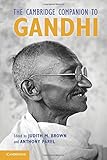
Judith M. Brown, Anthony Parel, eds. The Cambridge Companion to Gandhi. Cambridge: Cambridge University Press, 2011. 296 pp. $90.00 (cloth), ISBN 978-0-521-11670-1; $26.99 (paper), ISBN 978-0-521-13345-6.
Reviewed by Surendra Bhana
Published on H-Asia (March, 2012)
Commissioned by Sumit Guha (The University of Texas at Austin)
Gandhi, His Times, and His Legacy
In reviewing a book on Mohandas K. Gandhi (1869-1948), one might ask what is new about it. The twelve chapters in The Cambridge Companion to Gandhi introduced and edited by two distinguished scholars argue that there are “numerous reasons” for its production without fully exploring what they are. There is nothing in the chapters that is compellingly new. The book is intended as a “companion” to accommodate the growing number of institutions worldwide offering courses beyond “older national histories and political analyses” in which Gandhi’s relevance features prominently. There is a brief guide to further reading, and the individual note-sections lists major works, although they are by no means exhaustive. The book is not devoted to the discussion of the whole range of historiographical aspects on Gandhi, although individual chapters provide new insights into his life. The book offers understanding of key elements of Gandhi’s life suitable for the general reader, if not the specialist.
The book is divided into three parts. The first part provides historical backgrounds that shaped Gandhi’s thoughts and actions. Part 2 focuses on Gandhi as thinker and activist, and part 3 deals with the contemporary Gandhi.
His family was steeped in Kathiawar’s princely politics; and Gandhi was familiar with British rationalizations for their rule over the Indians, and the “coercive bonds between Indian subordinates and British colonial superiors” (p. 17). A vibrant vernacular press responded to such conditions, and searched for reforms Indians could undertake to counter British charges. Yasmin Khan suggests that Gandhi’s “quintessentially Indian home” shaped his views on religion, caste, and nationalism (p. 21). The empire offered Gandhi opportunities firstly as a student in London, and secondly as an imperial citizen in South Africa. The South African experience over twenty-one years was crucial in the making of a political and social reformer. It is here that he learned to use media effectively. Johannesburg provided him with a cosmopolitan setting where he made friends across the racial and religious divide, and confronted White supremacy by introducing a unique brand of resistance he called satyagraha with ahimsa as its central tenet. But the city also represented a “negative exemplar” of industrial capitalism; and he penned his criticism in a seminal tract, Hind Swaraj (1909).
South Africa certainly shaped a great deal of Gandhi’s thinking. Jonathan Hyslop misses, however, some important aspects of the experience. His relationships with Christians sharpened his understanding of his own faith as James D. Hunt has shown in Gandhi and the Nonconformist (1986). His interactions with his compatriots through their cultural and religious bodies offered him insights about how he should work with groups that did not necessarily agree with him, as S. Bhana and G. Vahed show in The Making of a Political Reformer: Gandhi in South Africa, 1893-1914 (2005). Joseph Lelyveld’s Great Soul: Mahatma Gandhi and His Struggle with India (2011) points to Gandhi’s hesitation to reach out to indentured and ex-indentured South Africans until 1913, and his failure to incorporate Black South Africans in his thinking. If South Africa prepared him to contribute to the politics of nationalism in India, he carried such inner contradictions with him to India, Lelyveld argues. How did they impact his thinking in the way he introduced creative strategies to conventional politics in India? The Indian National Congress recognized his mass appeal, and called on him on three major occasions, 1920-22, 1930-34, and 1940-42. He was able to build swaraj (independence, self-rule) from the grassroots by using civil disobedience through all-India programs that meshed with regional and local issues. Contradictions dogged Gandhi, however, as Tanika Sarkar points out in a later essay. Dalit leader B. R. Ambedkar forced Gandhi by to see that caste was a political rather than a religious problem. It was only at the very end of his life that Gandhi accepted a legal-constitutional prohibition of Untouchability.
As a thinker, Gandhi is much harder to pin down since he left such a voluminous body of writings. The Collected Works add up to one hundred volumes, and one gets many sides of Gandhi as one peruses his letters and articles from week to week, month to month, and year to year. Tridip Suhrud focuses, however, on seven of Gandhi’s key writings. When read together, he suggests, they show consistency of thoughts and ideas. Hind Swaraj (1909) makes sense, for example, if it is read in conjunction with A History Satyagraha in South Africa (1928) and the Story of My Experiments with Truth (1927 and 1929). While it may be possible to extract the essence of his thinking from Hind Swaraj, his autobiographical accounts produce narrative details that require analysis about events he considered important enough to include and those he excluded because he thought them unimportant. The act of inclusion or exclusion of events is important to the way we read his autobiographies. In A History of Satyagraha in South Africa, Suhrud argues that he made a distinction between itihas (it so happened) and history (the doings of kings and emperors). This does not, however, adequately explain why he devoted the longest chapter (chapter 22) detailing opposition to his compromise with Boer leader Jan C. Smuts and the serious fallout in the community. Why, to take another example, did he rarely introduce the names of people who disagreed with him? Why does he not mention by name a single African leader in his South African narrative? A more pertinent question is whether the first English translations maintain nuances true to the original Gujarati Gandhi used.
Akeel Bilgrami, a philosophy professor at Columbia University, provides an illuminating analysis on Gandhi’s religious thought. Gandhi was creative and original even if he was not a systematic thinker. His focus on the spirit rather than the literality of the Hindu scriptures allowed him to call himself a sanatanist (orthodox Hindu) even if critics did not think he was, and enabled him to incorporate both advaita and dvaita (monism and dualism) simultaneously to create his own system of belief. It reflected his “unblushing relativism”, the author tells us. He rejected canonical Hinduism and extracted from it a meaning that allowed him to “accommodate other religions” (96). He did this by stressing experience because religion for him was experiential, not doctrinal. Those who experienced Truth carried conviction, and so bridged the gap between pluralism and subjectivity of experience. There could be no human relevance if Truth was not seen and experienced. Gandhi was not saying that what he chose for himself should become a principle for others to follow. Rather, when he chose he set an example for others to follow. This is central to his understanding of satya (truth) and satyagrahi. A satyagrahi is one possessed of the “right” religious understanding in the service of others. “He or she represented the ideal of an individual’s life because the actions of such an individual were self-consciously conceived by him as exemplary. This is the vital element in the conceptual transition from individual choice in the realm of religion to a public and universal relevance of one’s choice.” A truly religious person had to be committed to a deeper level of ahimsa, and, “in that ideal ... the very idea of principles (or doctrines) is replaced by the idea of exemplarity” (p. 101).
Sexuality had to be governed by the “ideal of ahimsa” (p. 105); until fairly late in his life, he remained committed to varnashrama dharma (social divisions/stages of life) because it ensured enriching heterogeneity. Indeed, it was a reflection of a “heterogeneous distribution of human society” (p. 110). Do not introduce homogenization, he argued, simply to satisfy citizenship within the nation-state. He was not opposed to science but its misuse. It had exiled God, desacralized nature, and prepared the ground for extractive political economies. For Gandhi, the fault-line lay in the “entire way of thinking [that] nature and humanity ... can be improved and politically domesticated and made over, respectively, into resources and citizens” (p. 112).
Other essays in part two deal with aspects of Gandhi’s political beliefs, economy, and the state. Power resided in unconventional places, usually among marginalized places and people; his ideas about moral economics had a powerful impact on reformers worldwide seeking to counter debilitating consumerism; he desired a state that harmonized material pursuits with the ethics of spirituality. Indeed, the rise of fundamentalism on the subcontinent, among other things, has sparked renewed interest in Gandhi around contentious issue such as developmental paradigms, caste, class, poverty, gender, and sex.
Contemporary India has embraced Gandhi through rich portrayals of him in the fields of arts, literature, and films. Gandhi’s most enduring contribution has been the ideal of an inclusive nation, as Anthony Parel points out. He wanted a state in which minority rights were protected and poverty eliminated. The modern Indian state is plagued, however, by violence and intolerance inherent in religious and ethnic fundamentalism. Class and caste wars continue. Democracy prevails in India, but as Sunil Khilnani points out in The Idea of India (1997), it has not produced a strong civil society. A strong middle class has emerged in India. But independent India has only partially realized Gandhi’s vision of economic development in a holistic way.
Still, his legacy lives on in India and the rest of the world. David Hardiman shows how strongly Gandhi influenced the civil rights movement in the United States and the liberation struggles in Africa and elsewhere. Perhaps the strongest influence is on movements globally to save the planet. Gandhi’s dictum--“earth provides enough to satisfy every man’s need, but not every man's greed”--has been taken seriously by reformers everywhere.
If there is additional discussion of this review, you may access it through the network, at: https://networks.h-net.org/h-asia.
Citation:
Surendra Bhana. Review of Brown, Judith M.; Parel, Anthony, eds., The Cambridge Companion to Gandhi.
H-Asia, H-Net Reviews.
March, 2012.
URL: http://www.h-net.org/reviews/showrev.php?id=34712
 | This work is licensed under a Creative Commons Attribution-Noncommercial-No Derivative Works 3.0 United States License. |

