



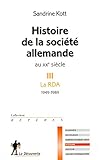
Sandrine Kott. Histoire de la société allemande au xx. siècle: III La RDA 1949-1989. Paris: Editions La Decouverte, 2011. 126 pp. ISBN 978-2-7071-6911-2; EUR 9.50 (paper), ISBN 978-2-7071-6906-8.
Reviewed by Dolores L. Augustine (St. John's University)
Published on H-German (October, 2012)
Commissioned by Benita Blessing (Oregon State University)
Socialist Identity and the Fog of History in East Germany
This slender volume provides an excellent introduction to Francophone research on the GDR, of which Sandrine Kott (of the University of Geneva) is the most prominent representative. Rejecting totalitarianism theory, she focuses on social history. Though the East German leadership had totalitarian impulses, society was able to establish limits to dictatorship.[1] Nonetheless, the SED (the Socialist Unity Party, or Communist Party of East Germany) "colonized" society. An interpenetration of society and state took place, described in an untranslatable turn of phrase as a "socialisation de l'Etat" and "etatisation du social." Her study combines a "history from below" with a historical/sociological analysis of the SED and major organizations and institutions.
In 1949, a "socialist Germany" (p. 6) was created with some German support; for example, that of antifascist groups. Kott argues that those mass organizations that looked back to an older tradition enjoyed a fair degree of legitimacy--unlike those organizations created by the SED to take control of society. The FDJ (Freie Deutsche Jugend, "Free German Youth"), founded in Czechoslovak exile during WWII, pursued, according to Kott, a rather independent course vis-à-vis the SED in the years after 1946. The FDJ was reorganized in 1953 and made into a recruiting grounds for party officials, a prerequisite for admission to university studies, as well as an instrument of political indoctrination. Similarly, the FDGB (Freier Deutscher Gewerkschaftsbund, "Free German Trade Union Federation") was subordinated to the SED. Strikes were criminalized. Local union officials were surprisingly nonconformist, though they were co-opted and robbed of any ability to negotiate on behalf of workers by 1970.
Chapter 1 focuses on social engineering, which was vast in scope, yet not always predictable in its impact. The complete redesigning of society ran into some opposition, but not civil war. Owners of large farms lost their land, and were often replaced by "new farmers." The latter were beholden to the SED, but also used the opportunities provided by the SED to their advantage. Their tenuous hold on land often ended in the face of the creation of collective farms. The process of collectivizing agriculture involved violence, and led to deep antagonisms, particularly between established and "new" farmers, as well as between farmers and factory workers. Urban factory workers, sent as "volunteers" into the countryside to promote collectivization, incurred the hostility and resentment of the farmers they were supposed to assist.
Vaunted as socialist "heroes," factory workers were in fact expected to participate in competitions that intensified exploitation. Frustrated by a lack of real rewards, as well as by the piece-work system in use in GDR factories, workers rebelled in a series of strikes, culminating in the 1953 uprising. The Communist leadership developed a distrustful attitude towards workers.
Traditional elites were supposed to be replaced by a "new intelligentsia." However, the SED had a rather "indulgent" attitude towards doctors, economic experts, engineers, scientists, and (until 1972) small businessmen. This toleration of a more traditional professionalism is due to three factors: the centrality of technical and scientific innovation in the SED's economic strategies, loss of elites due to postwar de-Nazification, and the danger of losing elites to the West (even after the building of the Berlin Wall in 1961). A "new intelligentsia" eventually did take over from older elites, but, ironically, did not enjoy the privileges and higher income of its predecessors. It found itself working under incompetent political appointees.
Chapter 2 undertakes an analysis of the "social nexus" of power. Kott argues that society itself "was used as an instrument and site of control" (p. 44). SED members kept each other in line and participated in the "political, social and even moral repression of their fellow citizens" (p. 35). Among party members, ideological commitment was replaced by outward conformism in the 1970s and 1980s. On the other hand, party members increasingly expected the party to assist them with personal difficulties, leading to "privatization" of the party. Similarly, members of Communist mass organizations behaved like "consumers," using membership for their own purposes rather than really participating with a sense of inner conviction. Forced to participate in paramilitary organizations and to serve in the military, young East Germans became increasingly pacifistic. Pacifism became the focal point of opposition to the SED. Nonetheless, mass organizations did help to create a sense of "community of the people" (p. 38).
The GDR upheld the Marxist view of work as essentially liberating. This view of human nature harmonized well with the needs of a planned economy that suffered from chronic labor shortages. In theory, socialist citizenship was centered on the factory, particularly the work brigade or work collective. In reality, the brigade was an instrument for disciplining workers. It also was a working unit that had to deal with the problems of the planned economy. Desperate attempts to deal with these problems helped create a deep sense of solidarity among its members. On the other hand, in accordance with the Leninist principle of "To each according to his contribution," those who did not work were not considered members of the socialist community and were ostracized, and sometimes imprisoned, as "asocials."
The Stasi was also deeply involved in organizing the policing of society from within, whereby those higher up in the hierarchy were more heavily involved in surveillance and oppression. The Stasi had a vast knowledge of what was going on in East German society, but it was the SED that had to act on that knowledge. The party became incapable of effective action. Thus, society was "tightly controlled but not really guided or governed by the SED in the 1980s" (p. 45).
Chapter 3 turns to the topic of social inequality. Though the official discourse was egalitarian, inequalities in pay, working conditions, and access to goods persisted and grew, particularly those between manual labor, office workers, and managers; between men and women; and between the generations. Opportunities for social advancement greatly decreased in the late 1960s. Inequalities in consumption were tied to the subordination of consumption to production. In the early years, for example, workers in priority sectors received larger rations. By the late 1950s, attempts were made to create a socialist model of consumption; for example, by promoting an East German fashion industry. This endeavor was abandoned in the wake of the oil crises of the 1970s. This economic downturn engendered austerity, as well as growing inequality. Better housing and goods were available to the intelligentsia (which became like an upper-middle class), inhabitants of big cities, those in possession of Western currency, people with West German relatives, skilled workers in favored industries, skilled handworkers who could offer their services in exchange for goods and services, and people with "connections."
Kott agrees with Rudolf Bahro--and, though not mentioned here, Milovan Djilas--that the Communist elite was a ruling class in the Marxist sense, a class (analogous to Djilas's "new class") that exploited the economic and social resources of society as it saw fit.[2] She sees the professional class as divided by rivalries and disagreements. She in fact revives the idea of a "counter-elite," first formulated by Peter Christian Ludz.[3] She seems to see the main cause for this rift in the rivalry between younger members of the elite and older, more senior members who rose to positions of power in the 1950s and 1960s, and who proved unable to deal with the increasingly dire economic and political problems of the 1980s. Her account here is somewhat confusing (p. 61) because she also writes that the intelligentsia (i.e., university-educated professionals) rose into positions of power in the 1980s. She hints at a more psychological and cultural analysis in her remark that individuals also had to deal with their own internal contradictions, arising from tensions "between political loyalty and professional competence" (p. 60).
Chapter 4 explores the contours of private and public identity in the GDR. A distinct East German identity emerged, though it diverged from what political leaders envisioned. Intent on creating a "socialist personality," the SED placed more emphasis on education than was the case anywhere else in the East bloc. Though the school system was modernized in the 1940s and 1950s, schools continued to be dedicated to the "reproduction--not production--of knowledge," as well as to social reproduction (p. 65). The children of cadres enjoyed the greatest successes in school. Children of the working class were, on the other hand, shunted off into technical careers. In theory, apprenticeships were supposed to further the development of class consciousness, but in fact the conditions under which apprentices were trained were wretched. (Here she somewhat understates the opportunities provided to members of the working class.) Despite "extreme politicization," schools "were hardly capable of bringing about the emergence of 'socialist man,' who looks with optimism to the future" (p. 67). A process of "reappropriation" emptied the Jugendweihe (a secular, socialist alternative to confirmation) of socialist content, turning it into a simple "rite of passage."
The GDR also placed greater emphasis on bringing high culture to the masses than did most socialist countries. Workers were encouraged to write literature and perform in theater groups. These endeavors ultimately could not overcome traditional divisions between "serious" and popular culture. However, average East Germans became voracious readers with a taste for fine literature. This was in part thanks to the endeavors of factory librarians, who brought book carts into factory halls.
Kott rightly points out that attempts in the GDR to overcome the public/private divide cannot be solely ascribed to the SED's totalitarian instincts (which the author fully acknowledges). They are also the expression of the Marxist ambition to overcome the bourgeois isolation of the individual and the family. Successful attempts in this direction included state-run daycare and nursery schools and after-hours socializing of work brigade members. Other experiments fizzled out, notably the inclusion of public facilities in housing complexes and attempts at socializing housework. In the 1970s and 1980s, the SED encouraged a retreat back into the family; for example, through the introduction of the "baby year" (a year-long, paid hiatus in employment after the birth of a child). A re-privatization of free time also took place, accompanied by an increase in TV viewing. In Kott's view, women did not lose ground as a result of these developments, however. Marxism claims that gender equality is best achieved through the employment of women. She is little inclined to disagree, nor to question the claim that East German women were more sexually liberated than West German women. However, as she points out, attempts to question inequitable gender roles in the private realm were nipped in the bud. Here, the lack of freedom of expression made itself felt.
Chapter 5 turns to those excluded from the socialist community, or at least pushed to its margins. Despite official proclamations of international solidarity, immigrants were segregated and treated as if they were suspected of being "serious criminals" (p. 85). As a result, the population became distrustful of them. But not until after 1989 did the full extent of the fallout from these xenophobic policies become clear. Worse off until 1989 were those East Germans defined as "asocials" because of supposed moral or psychological deviance, perceived, for example, in their lack of desire to work, alcoholism, sexual promiscuity (in the case of women), homosexuality, or contacts with the West. A multiplicity of institutions were mobilized to control and reeducate them, but many served long prison sentences. Few escaped the label of "asocial," and in fact they seem to have been part of an emerging underclass. The author believes that many were dropouts who could or would not live according to the very narrow dictates of the East German system.
Political dissidents were also marginalized, and at times were defined as "asocials" because they were unable to find stable employment. The Protestant Church provided "a kind of substitute public space" (p. 100) by the 1980s, but also contributed to a "ghettoization" of opposition. Youthful nonconformism was viewed with utmost suspicion by the SED. In the mid-1960s, those who adopted Western youth culture were branded as traitors, and were subject to incarceration and re-education. Thus, East German society was not only confined within "geographical, but also political and moral borders" (p. 103). The SED succeeded in creating an alternate German society that was "centered on work, more homogeneous, more communitarian, but also closed, intolerant and self-supervising" (p. 104). Nonetheless, the Communist leadership did not get the society it expected. Unable to properly respond to popular wants, the SED "dominated" society without truly "governing" it. Kott sees the end of the GDR as caused by the failure and collapse of the system.
This is without a doubt the best short summary of GDR history available in any language. Largely steering clear of scholarly controversies, Kott's book provides an excellent synthesis of current research. Her bibliography provides a good, brief overview of recent literature, including German, English, and French titles. She has done a fine job of mining empirical studies and providing salient factual information, while also providing analysis and insightful (if brief) examples that illuminate culture and psychology. The value of this work is greater than the sum of its parts because of the sophisticated manner in which she weaves together accounts of ideology, policy, and (messy) reality. She does somewhat underestimate conflicts within GDR society.[4] However, this study is highly recommended for those interested in twentieth-century German history. Its clear language should be accessible to all who have a reading knowledge of French. Those who do not are left to hope for an English translation.
Notes
[1]. See Ralph Jessen and Richard Bessel, eds., Die Grenzen der Diktatur. Staat und Gesellschaft in der DDR (Göttingen: Vandenhoeck & Ruprecht, 1996).
[2]. Milovan Djilas, The New Class: An Analysis of the Communist System (New York: Praeger, 1957).
[3]. Peter Christian Ludz, Parteieliten im Wandel (Cologne and Opladen: Westdeutscher Verlag, 1968).
[4]. For an in-depth analysis of these conflicts, see Andrew Port, Conflict and Stability in the German Democratic Republic (Cambridge and New York: Cambridge University Press, 2007).
If there is additional discussion of this review, you may access it through the network, at: https://networks.h-net.org/h-german.
Citation:
Dolores L. Augustine. Review of Kott, Sandrine, Histoire de la société allemande au xx. siècle: III La RDA 1949-1989.
H-German, H-Net Reviews.
October, 2012.
URL: http://www.h-net.org/reviews/showrev.php?id=34694
 | This work is licensed under a Creative Commons Attribution-Noncommercial-No Derivative Works 3.0 United States License. |

