



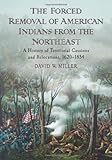
David W. Miller. The Forced Removal of American Indians from the Northeast: A History of Territorial Cessions and Relocations, 1620-1854. Jefferson: McFarland, 2011. viii + 215 pp. $45.00 (paper), ISBN 978-0-7864-6496-8.
Reviewed by John Bowes
Published on H-Environment (January, 2012)
Commissioned by David T. Benac (Western Michigan University)
The Forced Removal of American Indians from the Northeast is a book born out of personal interest and intellectual curiosity and is a companion to The Taking of American Indian Lands in the Southeast: A History of Territorial Cessions and Forced Relocations, 1607-1840 (2011), also written by David W. Miller. The author has tackled a massive topic in this work and he admits in his preface that numerous scholars have already covered aspects of this history in a variety of ways. But Miller also makes a statement in the preface that summarizes his work best. Because so many have already covered the history of Indian dispossession in the northern sections of what became the United States, he chose to focus on contemporary quotations as opposed to details from the historiography. “That is what you will find in this book,” Miller writes, “no analysis or justification for what happened” (p. 1). What unfolds in the nearly two hundred pages that follow is an uneven and surface level description of events involving the dispossession of American Indian tribes from New England to Wisconsin from the seventeenth to nineteenth centuries.
The following summary of the book’s contents is brief largely because the work does not provide any substantially new approaches, ideas, or material to scholars who are familiar with but want to learn more about this extended period of American Indian history. Miller has organized the book into thirty-four chapters that range in length from three to ten pages. Within that framework he deals with most of the major events well known to those who work within the field of American Indian history. The explorations of Jacques Cartier appear first, followed by a brief look at early Iroquois expansion and English colonization in New England. A chapter on the Pequot War leads into a chapter on the dispossession of the Narragansetts and the origins of King Phillip’s War. Each chapter presents the historical events in a brief manner as Miller proceeds to describe the history through the removal treaties of the 1840s in Michigan and Wisconsin. Indeed, only the early 1790s, a period encompassing the military campaigns of Josiah Harmar, Arthur St. Clair, and Anthony Wayne, receive treatment in any depth. That five-year period takes up over thirty pages, whereas the discussion of the War of 1812 and its impact encompasses less than one page.
This is not a bad book in terms of the material it presents. Miller clearly has an interest in the topic and desires to give his reader insight into the larger history that framed the dispossession of American Indians over the course of several centuries. He intends to be objective in his presentation and sprinkles his narrative with qualifying statements, such as when he follows a brief description of the torture of Colonel William Crawford in 1782 by saying that “readers should not rush to a conclusion that the Indians were barbaric compared to other races” (p. 97). Overall, therefore, this is a book with good intentions at its foundation.
That being said, I would not recommend this book for use in the classroom or as a source for someone interested in an introduction to American Indian history. There are a number of reasons for this conclusion. One concern is the uneven nature of the narrative in terms of the topics covered and not covered. The nineteenth century in particular receives relatively little attention and it is troubling that the War of 1812 is dismissed in such a quick manner. An even bigger issue is related to the secondary source material that grounds the project. Miller relies on very little material that has been produced in the last three decades. In a discussion of the Menominee Indian experience in the 1800s, for example, he relies primarily on a book written in 1939. While it is not necessary that the author provide lengthy footnotes including a litany of references from academic presses and journals, it would be much better if the secondary sources reflected a familiarity with more recent scholarship. It is admirable that Miller has attempted to tackle such a massive topic and has tried to go back to primary sources to give contemporaneous insights into historical events. But without the context provided by the work of the past several decades those primary sources lose their effectiveness.
It is possible that some might deem much of the above criticism unfair, especially in light of the manner in which Miller lays out his intentions in the preface and based on the fact that Miller is an independent scholar writing for a different audience. However, at a period of time when the field of American Indian history has made such substantial strides and continues to develop in critical ways, it would be wrong to promote or endorse work that adheres to older frameworks and admits from the beginning that it will contain no analysis.
If there is additional discussion of this review, you may access it through the network, at: https://networks.h-net.org/h-environment.
Citation:
John Bowes. Review of Miller, David W., The Forced Removal of American Indians from the Northeast: A History of Territorial Cessions and Relocations, 1620-1854.
H-Environment, H-Net Reviews.
January, 2012.
URL: http://www.h-net.org/reviews/showrev.php?id=34554
 | This work is licensed under a Creative Commons Attribution-Noncommercial-No Derivative Works 3.0 United States License. |

