



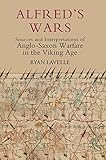
Ryan Lavelle. Alfred's Wars: Sources and Interpretations of Anglo-Saxon Warfare in the Viking Age. Woodbridge: Boydell, 2010. 400 pp. $115.00 (cloth), ISBN 978-1-84383-569-1.
Reviewed by Stephen M. Cooper
Published on H-War (December, 2011)
Commissioned by Margaret Sankey (Air University)
Long Ago and Far Away
I have long been interested in Anglo-Saxon England. The first essay I read as an undergraduate in 1966 was about Sir Frank Stenton’s Anglo-Saxon England (1943); Bede’s Ecclesiastical History was a set book; Warren Hollister’s Anglo-Saxon Military Institutions on the Eve of the Norman Conquest (1962) was still hot off the press, and his controversial theories about the difference between the “Great Fyrd”and the “Select Fyrd” were the subject of a tutorial. I fully expected to enjoy this book.
It does contain a wealth of interesting material. There are extracts from primary sources, for example the “Anglo-Saxon Chronicle” (with explanations as to how the different versions of the Chronicle vary at critical points); and likewise there is copious citation of secondary authorities, for example of one of Hollister’s articles; and there is a great deal of learned commentary on the various scholarly debates concerning late Anglo-Saxon England. The treatment is very extensive and thorough, not to say exhaustive. Indeed the main title--“Alfred’s Wars”--is something of a misnomer, since Alfred ruled Wessex and England from 871 to 899 only, whereas the book is concerned with the whole of the late Anglo-Saxon period. On the other hand, the subtitle--“Sources and Interpretations of Anglo-Saxon Warfare in the Viking Age”--is apt, since the book is essentially a commentary on sources.
The central question which has troubled historians is, perhaps, whether the late Anglo-Saxon state was essentially a strong one, which was unfortunate to go down fighting at Hastings, or whether it was weaker than its neighbors, and in particular than the Duchy of Normandy, so that, if William the Bastard had not triumphed, some other invader would have done so, possibly some Scandinavian successor to King Canute. Unfortunately, this book did not give me any clear answer.
Nor can I honestly say that I liked it, or even enjoyed reading it. The reason has to do with the structure and the style, rather than the content. First of all, none of the chapters proceed chronologically. I think this could work for a reader who is not only interested in the period, but very well informed. Such a prodigy would be so familiar with the dates that he would not have to refer constantly to the chronology in the appendix; but most readers will have to. Unfortunately, the Anglo-Saxons, even the later ones, remain fairly remote and obscure, no matter how much one reads about them.
Secondly, the style is elliptical, not to say impenetrable. Sad to say, the writer seldom tell us plainly what he means, or what his conclusions are, though five of the chapters finish with a “Summary” and one concludes with a “Summary and Observations.” Instead, we are given an analysis of the various conclusions reached by other scholars as to the interpretation of the sources, interspersed with overly lengthy quotations. The reader sometimes feels that he is removed from events--which are after all the stuff of history--by the presence of three panes of glass. If one were to construct a diagram of this, after the manner of Dr. Lavelle himself, one might say that there are five elements to the process of reading this book:
READING – ANALYSIS – COMMENT – SOURCE – EVENT
You may think this is an absurd method of criticism; but I include it because illustrates one of Dr. Lavelle’s own techniques. Some of his diagrams add nothing to the text, and frankly they are pretentious: see for example table 5.1 (p. 179). Likewise, some of his ideas--for example, the use of modern strategic concepts like C3I to explain medieval campaigns, are likewise unhelpful (p. 177). To interpret the medieval mind in the light of modern thinking is to assume the very things that the historian ought to be investigating, and questioning.
This book is bedecked with footnotes. Now, unlike the late A. L. Rowse, I do not disapprove of these as such; but I think the writer is in danger here of including them for their own sake; and there are certainly too many.
As to content, I wonder if the author ought from time to time to apply Ockham’s razor, and find an alternative explanation for some of the complex phenomena he describes. Perhaps the explanation for the complexities of the Anglo-Saxon response to Viking invasion was simple expediency, or even raw fear? When the barbarians are at the gates, do you stop to worry about which method of recruitment and organization to adopt, or do you find every man you can get hold of who can wield a sword, as soon as you can? When you are campaigning against a murderous and cruel foe, is it really “prestige” and “cohesion and co-ordination” you think about first, or how to survive, and how to kill the enemy if you can?
I am sorry to be so cutting. Perhaps others, with a deeper knowledge of the period than my own, will find more to enjoy here; but, on the other hand, is it possible that the sources for the period are so scarce and so thin that the historian is obliged to do the best he can, and sometimes admit that “we just don’t know,” rather than try to over-analyze the data?
If there is additional discussion of this review, you may access it through the network, at: https://networks.h-net.org/h-war.
Citation:
Stephen M. Cooper. Review of Lavelle, Ryan, Alfred's Wars: Sources and Interpretations of Anglo-Saxon Warfare in the Viking Age.
H-War, H-Net Reviews.
December, 2011.
URL: http://www.h-net.org/reviews/showrev.php?id=34488
 | This work is licensed under a Creative Commons Attribution-Noncommercial-No Derivative Works 3.0 United States License. |

